EV Charger Installation Malaysia
From a single 7 kW wall charger to a full DC fast-charging bay, installed to ST standards by a SEDA-registered EPCC, and paired with solar or battery storage so you charge on cheaper, cleaner power.
EDCA Energy handles EV charger installation across Malaysia for homes, offices, factories and commercial car parks, from a single 7 kW wall charger to a full DC fast-charging bay. As a SEDA-registered solar EPCC, we size your electrical supply, apply for TNB where needed, install to Suruhanjaya Tenaga (ST) standards, and pair chargers with solar or battery storage so you charge on cheaper, cleaner power. Pricing is quote-based. Get a free quote for your site.
Malaysia is switching to electric vehicles faster than most people expected. More than 21,700 EVs were registered in 2024 alone, up around 64% on the year before, based on JPJ registration data. Yet the public charging network is still catching up, which means the charger at your own home or business has become the one you actually rely on every day. That is where EV charger installation stops being a plug-and-play purchase and becomes a properly engineered electrical and clean-energy job, the same discipline we bring to every project across our solar solutions range.
On this page
Why install an EV charger in Malaysia now?
Quick answer: EV ownership is rising fast while public chargers lag behind, so a home or on-site charger has become essential rather than optional. Government tax relief of up to RM2,500 and cheaper overnight charging make now a sensible time to install, especially if you pair the charger with solar.
Malaysia registered over 21,700 EVs in 2024, and adoption keeps climbing across Klang Valley, Johor and Penang. But the charging network has not kept pace, which pushes drivers to charge where they park most: at home, at the office, or at their business premises.
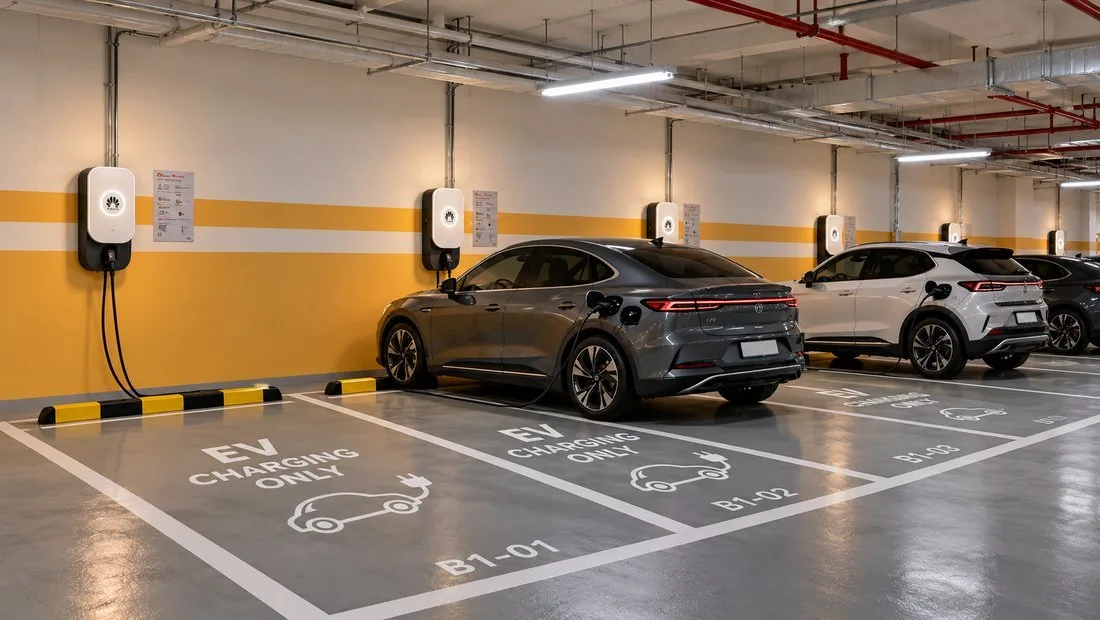
Sources: JPJ 2024 registration data, MIDA and MGTC. Figures are national context, not EDCA pricing.
Key takeaway: EVs are arriving faster than public chargers, so your own charger is what keeps you moving. Combined with the RM2,500 tax relief and off-peak charging, installing now pays back sooner than most owners expect.
How to choose the right EV charger
Quick answer: The right EV charger depends on four things: your vehicle’s onboard charging capability, the charging speed you need, your electrical supply, and where the charger will be installed. Get those right and the RM2,500 tax relief and cheaper overnight charging follow.
Choosing the right EV charger in Malaysia depends on your vehicle, charging speed, electrical supply and installation location. For home charging, factors such as 7 kW, 11 kW or 22 kW charging, single-phase or three-phase power, and your EV’s onboard charging capacity should be considered. For offices, shopping malls, hotels and industrial sites, the number of vehicles, charging demand and available electrical capacity also play an important role.
With Huawei Smart Charger, you can also integrate EV charging with your solar system, prioritising available solar energy and monitoring charging performance through the FusionSolar app. That is the same equipment family we use on home solar panel installation and solar battery storage projects, so the charger, the panels and the battery all report into one place.
Key takeaway: Match the charger to the car, the supply and the site before you look at the price. A correctly sized charger installed on the right supply is what makes overnight charging, solar charging and a clean tax-relief claim possible.
EV charger types: which one for home or business?
Quick answer: AC charging suits homes, offices and overnight charging at 7 kW, 11 kW or 22 kW. DC fast charging suits commercial sites, malls and fleets that need to recharge quickly. The car’s onboard charger, not the wall unit, sets your real AC speed.
AC charging — AC chargers are commonly used for home, office and overnight charging. They offer a practical and cost-effective way to charge your EV over longer periods, with common charging options such as 7 kW, 11 kW and 22 kW.
DC fast charging — DC chargers deliver power directly to the EV battery, allowing for much faster charging. They are better suited for commercial sites, shopping malls, fleet operations and locations where vehicles need to recharge quickly.
| AC charging | DC fast charging | |
|---|---|---|
| Best for | Homes & offices | Commercial & high-use sites |
| Charging speed | Standard | Fast |
| Typical use | Overnight / longer stays | Quick top-ups |
| Installation | Generally simpler | Higher power requirements |
| Ideal application | Residential & workplace | Shopping malls, fleets & industrial |
Key takeaway: Match the charger to your supply and your car. A 7 kW AC unit suits most homes, three-phase 22 kW suits workplaces, and DC fast charging suits commercial traffic. The car sets the AC speed, not the charger, so a bigger unit does not always mean faster charging.
How fast can your EV charge?
Quick answer: Charging speed is set by the lower of two numbers: what the charger can deliver and what your EV can accept. A 7 kW charger suits overnight charging at home, 11 kW and 22 kW speed up everyday and workplace charging, and DC fast charging is for short stops at commercial sites.
Charging time depends on the charger’s power output, your EV’s battery capacity and the vehicle’s maximum charging capability. Higher-power chargers can deliver energy faster, but the actual charging speed is always limited by what your EV can accept.
| Charging power | Typical application | Charging experience |
|---|---|---|
| 7 kW AC | Home charging | Ideal for overnight charging |
| 11 kW AC | Home & workplace | Faster everyday charging |
| 22 kW AC | Commercial sites | Suitable for longer-stay locations |
| DC fast charging | Commercial & high-use sites | Rapid charging for shorter stops |
The higher the charging power, the faster your EV can charge — provided your vehicle supports it.
Key takeaway: Buying a bigger charger than your EV can use adds cost, not speed. Size the charger to the car and the supply first.
Pair your charger with solar so daytime sun tops up the car, sized and installed as one connected project.
Home EV charger installation
Quick answer: For most Malaysian landed homes, home EV charger installation means a 7 kW single-phase wall charger on a dedicated circuit. It charges fully overnight, carries an IP65 outdoor rating for our tropical weather, and usually needs no TNB approval if your supply has spare capacity.
Charge your EV conveniently at home. Home EV charging gives you the convenience of charging your vehicle overnight, so it’s ready for the next day. The right home EV charger depends on your EV’s charging capability, your home’s electrical supply and how quickly you need to charge.
Make charging part of your daily routine.
Install a Huawei home EV charger and charge conveniently at home, with options to integrate solar energy and monitor your charging and solar system through FusionSolar.
Homeowners should not DIY this. A dedicated circuit, correct cable sizing, RCD protection and good earthing are what stop nuisance trips and keep the warranty valid. Homes that want cheaper, cleaner charging can pair the charger with rooftop home solar panel installation so daytime sun tops up the car, and add solar battery storage to carry that energy into the night.
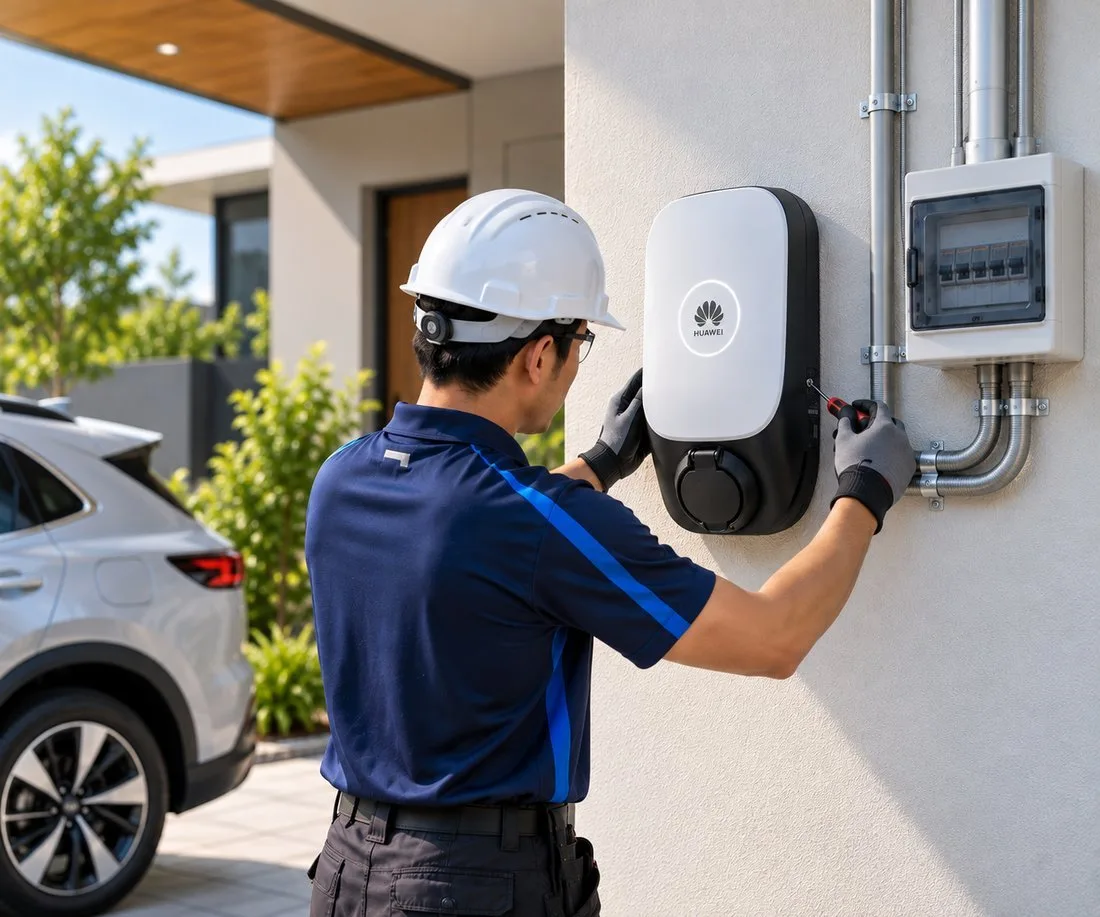
Convenient overnight charging
Wake up to a charged EV without relying on public charging stations.
7 kW / 22 kW AC charging
Choose a charging capacity that matches your EV and home electrical supply.
Solar integration
Use your solar energy to charge your EV and maximise your renewable energy usage.
One-app monitoring
Monitor your Huawei solar system and EV charger in one FusionSolar app.
Key takeaway: A 7 kW dedicated home charger delivers a full overnight charge and holds up outdoors, but only when installed on its own protected circuit by a licensed team.
Commercial & fleet EV charging
Quick answer: Commercial EV charger installation serves staff, customers and fleets, from a bank of AC chargers in an office car park to DC fast chargers at a mall or logistics depot. EDCA handles supply upgrades, load management and, where useful, on-site solar generation to control the energy bill.
Give your customers, employees and fleet drivers a convenient place to charge. Shopping malls, offices, hotels, retail outlets, factories and other commercial properties can install EV chargers on-site to provide charging facilities while supporting the growing adoption of EVs.
For commercial sites the challenge is not one charger but many, sharing a limited supply. Smart load management lets several chargers run without tripping the main incomer, and staged rollouts let you add bays as demand grows.
Larger sites and fleets often pair charging with on-site generation to blunt the demand charge. A rooftop system on a commercial or industrial roof, up to a large scale solar farm for the biggest operations, can feed daytime charging directly. EDCA scopes both the charging and the generation as one connected project.
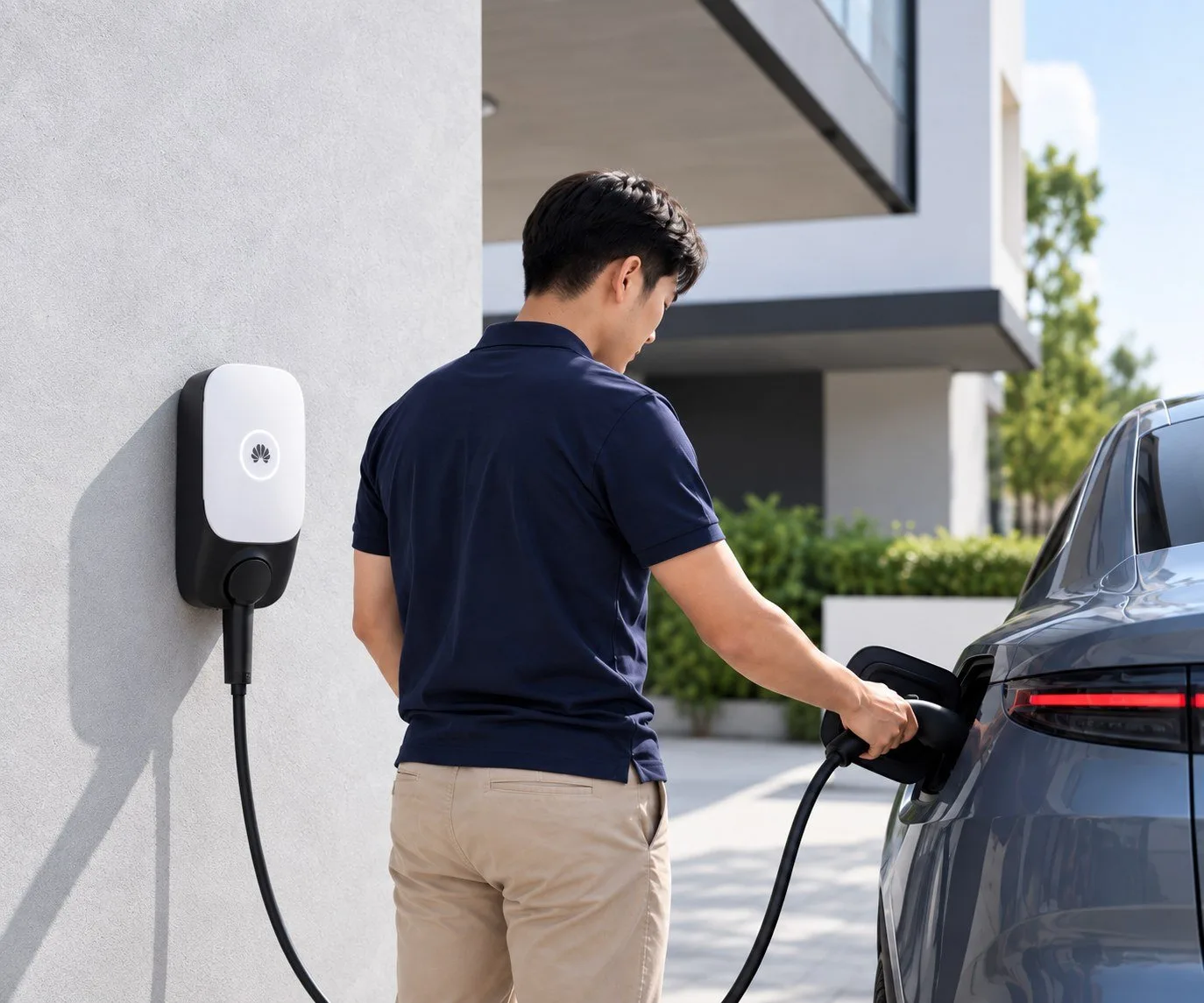
Benefits for your business
Attract more customers
Offer EV charging as an added amenity.
Improve customer experience
Let customers charge while they shop, dine or work.
Support your fleet
Convenient on-site charging for company vehicles.
Future-ready your property
Prepare your business for growing EV adoption.
Where we install
Shopping malls
Charge while customers shop.
Offices
Convenient charging for employees and visitors.
Hotels & retail
Add EV charging as a customer amenity.
Industrial & fleet
Support business vehicles and fleet operations.
Key takeaway: Commercial EV charging is an electrical-capacity and energy-cost problem as much as a hardware one. Load management plus on-site solar keeps a multi-charger site reliable and affordable.
EV charging for shopping malls and commercial properties
Quick answer: For a property owner, EV charging is an amenity that brings drivers onto the site and keeps them there. Chargers can be integrated with solar and smart energy management so the bays run on your own generation rather than adding to the demand charge.
Turn EV charging into added value for your property. As EV adoption grows in Malaysia, shopping malls, offices, hotels, retail outlets and commercial properties can install EV charging stations to provide convenient charging for customers, employees and visitors. Huawei EV charging solutions can be integrated with solar and smart energy management, giving property owners a more efficient and future-ready charging solution.
Attract more visitors
Offer EV charging as an added convenience for customers.
Improve customer experience
Let drivers charge while they shop, dine or work.
Support business & fleet vehicles
Provide convenient on-site charging for company and service vehicles.
Future-ready your property
Build EV charging infrastructure to support growing EV adoption.
Key takeaway: Charging bays are becoming part of what a commercial property is expected to offer. Installing them with solar and smart energy management keeps the running cost under control as usage grows.
Malaysia's charging network at a glance
Quick answer: Malaysia targeted 10,000 public charging points by 2025 but reached only about 5,600 by the end of that year, just over half. That gap is exactly why installing your own charger removes the daily dependence on a stretched public network.
Public EV charging points installed vs the 10,000 target
Sources: MIDA and end-2025 tally (MARii, reported).
Key takeaway: Public charging has doubled in under two years but still sits near half the target. Owning your charger is the surest way to skip the queue.
Not sure which charger fits your supply?
Our team assesses your home or premises before quoting, and can pair the charger with solar so you charge on cheaper, cleaner power.
What does EV charging cost to run?
Quick answer: Charging at home on grid electricity is far cheaper than petrol, and charging on your own solar is cheaper still. The illustrative comparison below shows why home and solar charging beat both public DC charging and a petrol car per typical month, modelled on a driver covering about 1,500 km a month.
Illustrative monthly “fuel” cost, 1,500 km/month driver
Illustrative scenario for comparison only. Actual savings depend on tariff, driving distance and system size. EDCA does not publish fixed prices; ask for a quote.
Key takeaway: Home charging already beats petrol on cost; solar charging widens the gap further. Pairing the charger with solar is the single biggest lever on your running cost.
Incentives, safety and compliance
Quick answer: Individuals can claim income tax relief of up to RM2,500 on EV charging equipment and installation through assessment year 2027. Installations must follow Suruhanjaya Tenaga (ST) rules and use licensed wiremen, with TNB approval for supply upgrades. EDCA manages both the compliance and the paperwork.
RM2,500 tax relief
Personal income tax relief on EV charging equipment and installation, running through YA2027.
ST-standard safety
Dedicated circuits, RCD/MCB protection and proper earthing to Suruhanjaya Tenaga rules.
Licensed wiremen
Certified installers, after TNB urged owners to avoid the trips caused by poor DIY wiring.
Paperwork handled
We manage TNB applications where needed and give you the documentation for a clean tax claim.
Key takeaway: Claim the RM2,500 relief, but only through a compliant, ST-standard install by licensed wiremen. EDCA handles both so your charger is safe and your claim is clean.
Smart monitoring in one app
Quick answer: The Huawei FusionSolar app shows solar generation, EV charging and household or site consumption on one screen, so you can see whether the car is charging on sun or on grid power.
Monitor your solar & EV charging in one app. With the Huawei FusionSolar app, you can monitor your Huawei solar system and Huawei EV charger in one place. Track solar generation, EV charging and energy consumption, giving you a clearer view of how your energy is being used.
Solar performance
Monitor your solar generation in real time.
EV charging
Track charging status and energy usage.
Energy overview
View solar, grid and EV energy flow in one platform.
One-app control
Manage and monitor your Huawei energy system through FusionSolar.
Key takeaway: One app across solar, battery and charger is what lets you shift charging into the hours your roof is producing, which is where the saving actually comes from.
How EDCA installs your EV charger
Quick answer: EDCA follows a four-step process, site assessment, system design, professional installation, then testing and commissioning. This protects your warranty, your wiring and your safety, and it is the same engineering rigour we apply on every solar project.
From site assessment to commissioning, we handle the complete EV charger installation process. Whether it’s a home, office, shopping mall or industrial site, we design and install a Huawei EV charging solution based on your site’s requirements.
Site assessment
Review your electrical supply, installation location and charging requirements.
System design
Determine the appropriate charger capacity, quantity and configuration for your site.
Professional installation
Install and connect the EV charger according to the site’s electrical requirements, by licensed wiremen and to Suruhanjaya Tenaga (ST) standards.
Testing & commissioning
Test the system, configure the charger and ensure it is ready for use, including the documentation for your tax-relief claim.
Key takeaway: A compliant install is an assessment, a proper design, ST-standard wiring and a tested commissioning, not just bolting a box to the wall. Because we also design solar, we future-proof the board so you can add battery storage later without re-wiring.
Why choose EDCA Energy
Quick answer: EDCA Energy is a SEDA-registered solar EPCC that treats EV charger installation as part of a whole-site energy plan. With 500+ projects completed and 10+ MWp installed across Malaysia, we deliver charger, wiring, supply upgrade and optional solar as one accountable job.
Most EV charger sellers stop at the box on the wall. EDCA looks at your whole electrical picture, supply capacity, safe wiring, and whether solar or battery should carry the load. That single-team approach is why homeowners and businesses come to us for charging and generation together rather than juggling separate contractors.
You get one accountable partner from survey to handover, backed by real accreditations and a track record across residential, commercial and industrial sites. Start with the charger and add solar when you are ready.
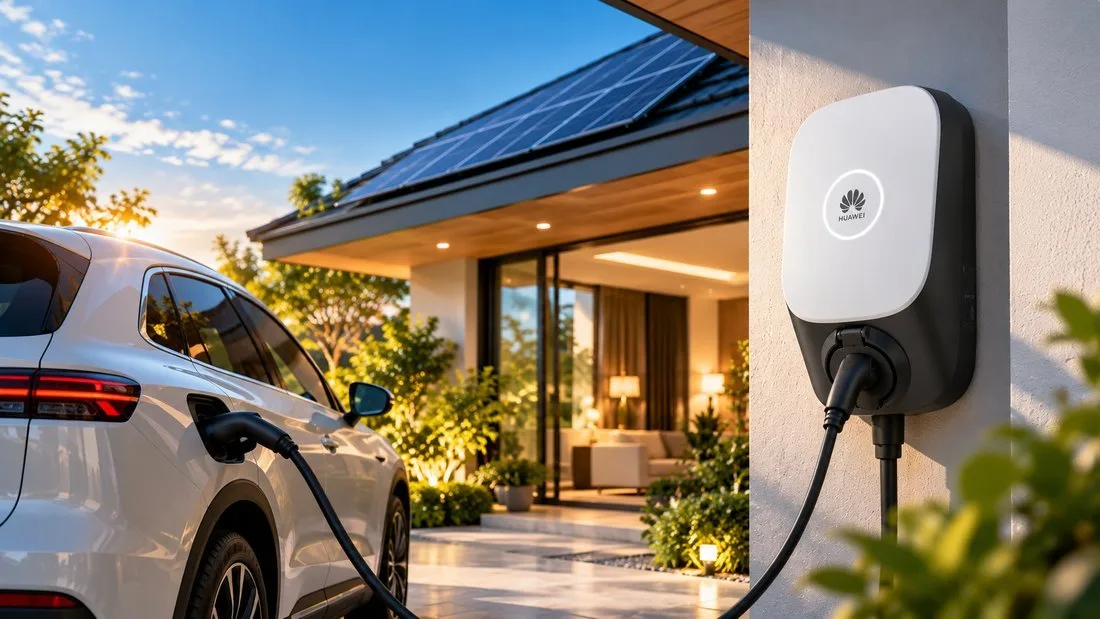
Key takeaway: One SEDA-registered team for charger, wiring and solar means fewer handoffs, safer work and a lower lifetime energy cost than buying a charger in isolation.
500+ projects and 10+ MWp installed across residential, commercial and industrial Malaysia.
See how solar-powered EV charging works
Quick answer: The short film below shows the Huawei FusionSolar Smart Charger running on solar energy, and how charging, generation and consumption appear together in the FusionSolar app.
Product film published by Huawei FusionSolar, the manufacturer of the smart chargers EDCA supplies and installs.
Key takeaway: The charger, the solar system and the app are one product family. EDCA sizes, installs and commissions all three as a single job.
EXCELLENT Based on 10 reviews
 Posted on Google

 Jamhuri JamaluddinI had a very good experience with EDCA. I managed to install 2 solar units just in time to secure the NEM quota, and now NEM has been replaced with ATAP scheme. The whole process was smooth, and everything was explained clearly from the beginning. The team was professional and helpful throughout. My TNB bill has dropped to almost zero. Most months, I only pay the minimum charge of around RM1 to RM3, depending on my electricity usage. Depends on the kWp that you are taken. Special thanks to Julia Cheah, the sales agent who assisted me. She was excellent, friendly, knowledgeable, and always ready to help. After-sales service very excellent. Highly recommended if you’re considering going solar.Posted on Google
 Geok See OngVery informative, helpful and knowledgeable during and after installation. Many special thanks to Jass for overseeing the whole installation.Posted on Google
 Jaeden WThank you to Jass Lee for making the whole process easy and efficient. It was a pleasant experience and was made even smoother with her explanation and updates throughout the entire process, would highly recommend to anyone considering installing solar panels. - Cheryl ChongPosted on Google
 Jing Chuan安装好大概半年了才放心留言推荐,现在市面上太多太阳能公司了不懂要选哪一家,一开始找了不同人来quote 到最后选edca主要是因为他们不会乱推荐一些不适合我的产品,我看到一些quotation要加这个那个的我都怕之后很多hidden cost,对接我的salesperson - Ms Loo也很nice,很有耐心回答问题,最重要是解释起来我们外行人都可以很容易明白👍 整体来说是一次很放心的体验,如果有朋友想装太阳能,我会推荐他们。Posted on Google
 Alice LeeThe whole process was smooth and easy. The team was friendly, helpful, and quick to get everything done. Highly recommend if you're thinking about going solar
Frequently asked questions
Common questions on EV charger installation in Malaysia, covering TNB approval, cost, solar charging, charge times and business rollouts. A free EDCA site assessment answers them for your specific site.
Do I need TNB approval to install a home EV charger in Malaysia?
Not always. A 7 kW single-phase charger on a supply with spare capacity often needs no prior TNB approval. You do need a TNB application if you upgrade from single-phase to three-phase or increase your main fuse size. EDCA checks your capacity during the survey and handles any application for you.
How much does EV charger installation cost in Malaysia?
It depends on the charger, your supply and any upgrade needed, so EDCA quotes per site rather than a fixed price. A basic 7 kW home unit is far cheaper than a DC fast charger or a multi-bay commercial rollout. Remember you can claim up to RM2,500 in income tax relief through YA2027.
Can I charge my EV from solar panels?
Yes. Pairing your charger with rooftop solar lets daytime sun feed the car directly, cutting your running cost close to zero after payback. Adding solar battery storage lets you store surplus energy and charge overnight on your own power.
How long does a home EV charger take to charge a car?
A 7 kW charger adds roughly 40 to 50 km of range per hour, so most EVs charge fully overnight. Your actual speed is capped by the car’s onboard AC charger, not just the wall unit, which is why a bigger charger does not always mean faster charging.
Can EDCA install EV chargers for my business or fleet?
Yes. We install AC charger banks and DC fast chargers for offices, malls, hotels and fleet depots, with smart load management and optional on-site solar, scaling up to a large scale solar farm for the biggest operations.
Ready to charge at home or across your business?
EDCA Energy handles your EV charger installation end to end: surveys your site, sizes the right charger, handles TNB and ST compliance, and can pair it with solar so you charge on cheaper, cleaner power. Pricing is tailored to your site.