Home Solar Panel Installation Malaysia
Turn your roof into a power source that cuts your monthly TNB bill and keeps saving for 25+ years, designed, installed and commissioned by a SEDA-registered (RPVSP) solar EPCC provider.
Home solar panel installation in Malaysia turns your roof into a power source that cuts your monthly TNB bill and keeps saving for 25+ years. EDCA Energy is a SEDA-registered (RPVSP) solar EPCC provider that designs, installs, and commissions residential rooftop systems nationwide. With the new Solar ATAP scheme now quota-free, getting started is easier than ever. Book a free site assessment and quote to size the right system for your home.
Electricity tariffs keep climbing, and most Malaysian homes have a roof sitting empty in the sun all day. Home solar panel installation Malaysia turns that roof into an asset that trims your bill and pays for itself over time. As a SEDA-registered solar EPCC provider, EDCA Energy has completed 300+ home solar projects and installed 6+ MWp across the country. This page walks through how residential solar works, what size system your home needs, how Solar ATAP shapes your savings, and why homeowners pick EDCA.
On this page
Why install home solar in Malaysia now?
Quick answer: Malaysia gets strong year-round sunlight, and rooftop solar now offsets electricity you would otherwise buy at rising retail rates. Pairing that with EDCA’s residential solar solutions means lower bills, cleaner energy, and a system that outlives its payback by two decades.
The maths is simple. Your panels make power during the day, your home uses it first, and anything left over earns a credit on your bill. Over 25 years, that daily saving adds up to far more than the system costs to install.
The main reasons Malaysian homeowners go solar now come down to sunlight, tariffs, easier access, and a very long asset life.
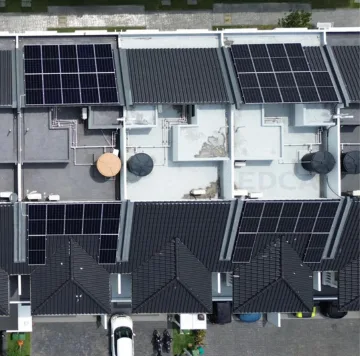
Rising tariffs
Every unit you self-generate is a unit you no longer buy from the grid at climbing rates.
Strong sunlight
Most Malaysian roofs receive three to five hours of peak sun a day, enough for a system to perform well.
Quota-free entry
The Solar ATAP scheme replaced the fully-subscribed NEM quota, so you no longer wait for an allocation to open.
Long asset life
Quality panels are built to generate for 25 years or more, long after the payback period ends.
Key takeaway: Home solar in Malaysia works because sunlight is abundant, tariffs keep rising, and Solar ATAP removed the old quota bottleneck. The sooner you start, the sooner your roof starts paying you back.
What does an EDCA home solar installation include?
Quick answer: EDCA runs the full EPCC scope in-house, so one team handles engineering, procurement, construction, and commissioning. The EDCA Energy team manages your project from the first site visit to the moment your system is switched on and registered.
Home solar is not just panels on a roof. A complete installation follows a clear order, and each step protects the quality of the one before it.
Free site assessment
We check your roof size, orientation, structure, and shading, and review your past TNB bills to understand your usage.
System design & quote
We size the system to your consumption and give you a transparent, quote-based proposal with no fixed off-the-shelf pricing.
Application & approvals
We handle the Solar ATAP application and the paperwork with the utility on your behalf.
Installation
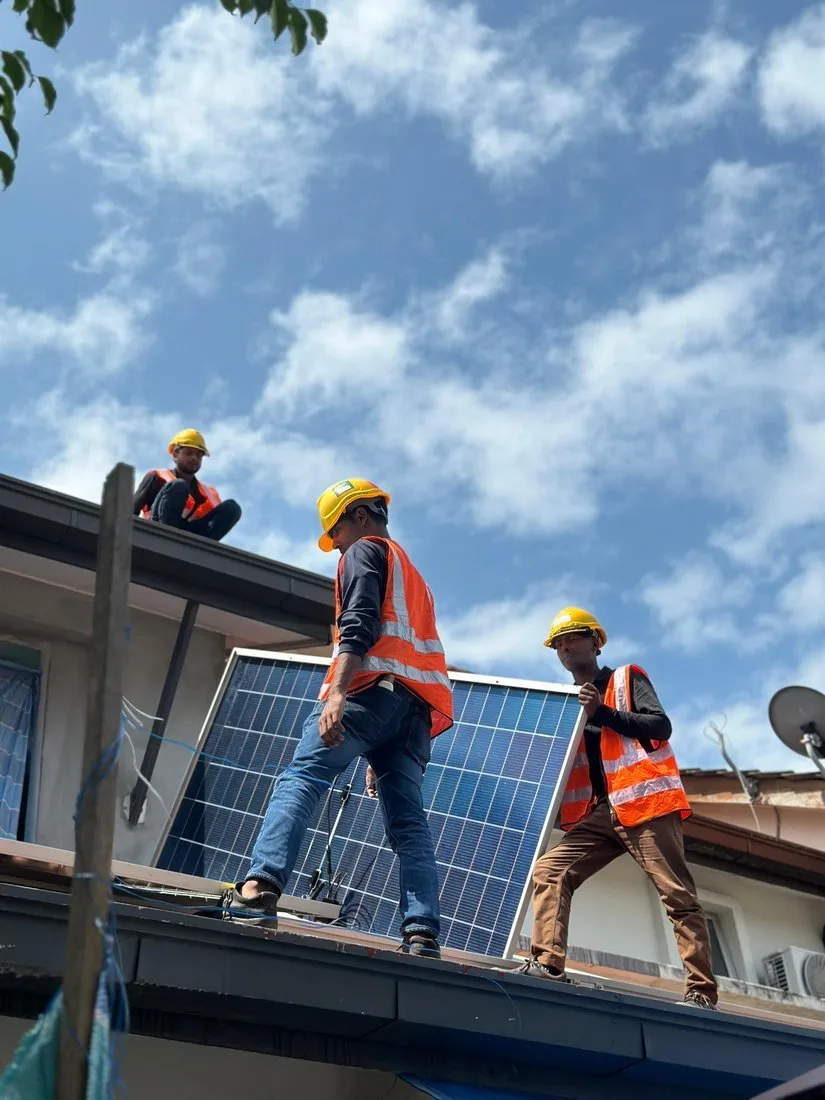
Our crew mounts the panels, wiring, and inverter, usually within one to two days for a typical home.
Commissioning & handover
We test the system, connect it to your meter, and show you how to monitor generation from your phone.
Key takeaway: Because EDCA delivers all four EPCC stages in-house, you deal with one accountable team rather than juggling a designer, an installer, and a separate paperwork agent.
What size solar system does a Malaysian home need?
Quick answer: Most Malaysian homes suit a system between 5 kWp and 22 kWp, matched to the monthly bill. The table below shows illustrative sizing bands; your exact system is confirmed by a free EDCA site assessment before any home solar package is proposed. System size is driven by how much power your home uses, not by roof space alone.
| Home profile | Typical monthly bill | Suggested size | Approx. panels | Est. daily output |
|---|---|---|---|---|
| Mid-size terrace | RM300–600 | 5–12 kWp | 7–19 pcs | 17–41 kWh |
| Large / semi-detached | RM600–1,200 | 13–18 kWp | 20–29 pcs | 44–99 kWh |
| Bungalow | RM1,200+ | 19–23 kWp | 30–36 pcs | 65–79 kWh |
Apartments and high-rise units are not suitable for rooftop solar, as the roof is common property and the available area cannot serve individual units.
Illustrative sizing based on EDCA Energy installation experience across 1000+ Malaysian residential projects. Actual system sized on a free site assessment; figures are market context, not a quote.
Key takeaway: Match the system to your bill, not to your roof. A right-sized system captures most of your daytime demand without paying for capacity you cannot use.
The same engineering discipline behind our commercial and utility-scale plants, brought to your roof.
How much can home solar save under Solar ATAP?
Quick answer: Under Solar ATAP, the power you use directly is worth the most, because it offsets the full retail tariff. Surplus you export earns a lower credit, which is why self-consumption and solar battery storage matter more than they did under the old NEM offset.
Solar ATAP replaced Net Energy Metering from January 2026 and runs on a self-consumption-first model, as administered by SEDA. The practical effect: shift more usage into daylight hours, and each system pathway carries different value.
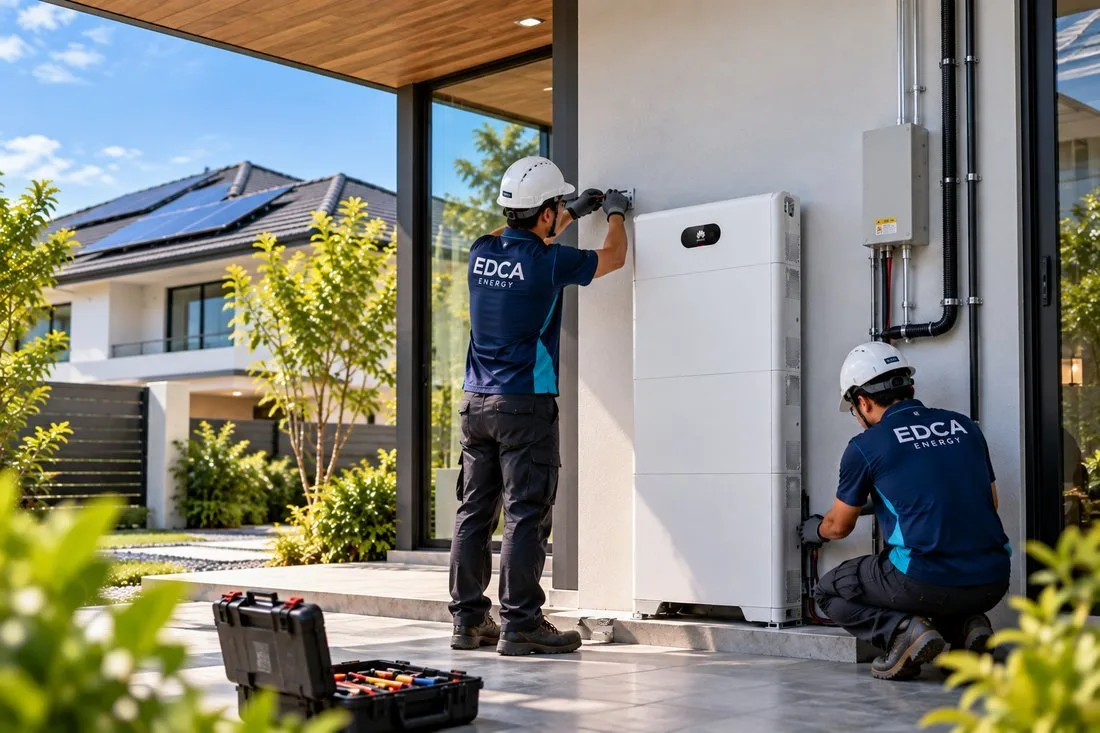
Adding a home battery stores daytime surplus for use after dark, recovering more value under the self-consumption-first model.
| Energy pathway | Typical share | Relative bill value | What it means for you |
|---|---|---|---|
| Used directly in the home | 60–80% | Highest, offsets full retail tariff | Run heavy appliances during daylight |
| Exported to the TNB grid | 20–40% | Lower, credited at export rate | Surplus still earns a bill credit |
| Stored in a home battery | Shifts 15–25% to night | Recovers evening tariff value | Use daytime surplus after dark |
Illustrative pathway shares based on EDCA Energy residential monitoring. Scheme mechanics per SEDA; savings confirmed on a free EDCA quote.
Key takeaway: The Solar ATAP model rewards using your own power. Sizing the system to daytime demand, and adding a battery where it makes sense, protects most of your savings.
What is the payback period for home solar?
Quick answer: A well-sized Malaysian home system typically pays for itself in roughly four to six years, then delivers free power for the rest of its 25-year life. Larger systems on higher bills usually pay back a little faster. Payback depends on your bill, your self-consumption, and your system size. The bars below show how it tends to shorten as the system grows.
Estimated payback by system size (illustrative)
Illustrative modelled payback based on typical Malaysian retail tariffs and daytime self-consumption, using EDCA Energy project experience. Not a guarantee; confirmed on a free quote.
Key takeaway: Expect payback in the four-to-six-year range for most homes, with the remaining 19-plus years generating near-free electricity.
Is home solar demand still growing in Malaysia?
Quick answer: Yes. The residential NEM Rakyat quota was repeatedly topped up and fully subscribed before it closed, and the quota-free Solar ATAP scheme now lets any home apply. Demand for rooftop solar solutions has only broadened since. The timeline below tracks the key NEM milestones that brought Malaysian households to the quota-free Solar ATAP scheme.
Residential NEM Rakyat quota uptake, Malaysia
2016
SEDA Malaysia launched NEM 1.0 with a 500 MW quota, featuring a displaced-cost export concept.
1 January 2019
Introduced NEM 2.0 adopting a true “one-on-one” offset basis for excess solar energy, which fully subscribed its 500 MW quota by December 2020.
1 Feb 2021 – 30 Jun 2025
Launched NEM 3.0 consisting of NEM Rakyat (residential), NEM GoMEn (government) and NOVA (commercial/industrial), with extended quota additions through mid-2025.
30 June 2025
New applications and quota allocations for NEM 3.0 officially closed.
1 January 2026
Implementation of the Solar Accelerated Transition Action Programme (Solar ATAP), governed by Suruhanjaya Tenaga, as the updated market-driven replacement mechanism.
Scheme milestones per SEDA Malaysia and Suruhanjaya Tenaga.
Key takeaway: Every residential quota Malaysia offered under NEM was taken up before the scheme closed in June 2025. Solar ATAP removes the cap entirely, so the growth has room to continue.
Want your real payback number?
Send us your recent TNB bill and we will model the savings for your specific home, with no obligation.
Why choose EDCA for your home solar installation?
Quick answer: EDCA Energy is a SEDA-registered (RPVSP) solar EPCC provider with 300+ completed home solar projects and 6+ MWp installed, covering everything from homes to commercial solar panel installation. One accredited team designs, installs, and commissions your system end to end.
Choosing an installer is choosing who stands behind your roof for the next 25 years. The same team that installs utility-scale plants brings that engineering discipline to your home, and can guide you across the full range of solar solutions as your needs grow.
SEDA-registered RPVSP
Accredited to design and install grid-connected solar under Malaysian rules.
Full accreditation stack
myHijau listed, Energy Commission (ST) recognised, CIDB registered, MPIA member, and a TNB partner.
Proven track record
300+ home solar projects and 6+ MWp installed, part of a group with 500+ completed projects and 10+ MWp installed.
Genuine EPCC
Engineering, procurement, construction, and commissioning handled in-house, not subcontracted piecemeal.
Key takeaway: EDCA pairs full SEDA and industry accreditation with a real EPCC track record, so your home system is engineered to the same standard as its commercial and utility work.
See how a home solar panel installation works
Quick answer: The short film below walks through a residential rooftop solar installation from site assessment to commissioning, so you can see what EDCA actually does on a Malaysian home before you book an assessment.
Video sourced from YouTube. Plays from the 2:34 mark, where the residential rooftop walkthrough begins.
Key takeaway: A home solar panel installation is a short, controlled job — most of the work on site is done in one to two days once the design and approvals are in place.
EXCELLENT Based on 10 reviews
 Posted on Google

 Jamhuri JamaluddinI had a very good experience with EDCA. I managed to install 2 solar units just in time to secure the NEM quota, and now NEM has been replaced with ATAP scheme. The whole process was smooth, and everything was explained clearly from the beginning. The team was professional and helpful throughout. My TNB bill has dropped to almost zero. Most months, I only pay the minimum charge of around RM1 to RM3, depending on my electricity usage. Depends on the kWp that you are taken. Special thanks to Julia Cheah, the sales agent who assisted me. She was excellent, friendly, knowledgeable, and always ready to help. After-sales service very excellent. Highly recommended if you’re considering going solar.Posted on Google
 Geok See OngVery informative, helpful and knowledgeable during and after installation. Many special thanks to Jass for overseeing the whole installation.Posted on Google
 Jaeden WThank you to Jass Lee for making the whole process easy and efficient. It was a pleasant experience and was made even smoother with her explanation and updates throughout the entire process, would highly recommend to anyone considering installing solar panels. - Cheryl ChongPosted on Google
 Jing Chuan安装好大概半年了才放心留言推荐,现在市面上太多太阳能公司了不懂要选哪一家,一开始找了不同人来quote 到最后选edca主要是因为他们不会乱推荐一些不适合我的产品,我看到一些quotation要加这个那个的我都怕之后很多hidden cost,对接我的salesperson - Ms Loo也很nice,很有耐心回答问题,最重要是解释起来我们外行人都可以很容易明白👍 整体来说是一次很放心的体验,如果有朋友想装太阳能,我会推荐他们。Posted on Google
 Alice LeeThe whole process was smooth and easy. The team was friendly, helpful, and quick to get everything done. Highly recommend if you're thinking about going solar
Home solar panel installation FAQ
The most common questions on home solar panel installation in Malaysia cover cost, timing, roof suitability, and the Solar ATAP scheme. Short answers are below; a free EDCA assessment covers your specific home.
How long does a home solar installation take?
For a typical home, the physical installation usually takes one to two days. The full journey, including site assessment, design, and Solar ATAP approval, generally runs a few weeks depending on paperwork.
How much does home solar cost in Malaysia?
Pricing is quote-based and depends on system size, roof type, and whether you add a battery. EDCA does not publish fixed prices because every home is different. A free assessment gives you an accurate figure.
Do I still need NEM to install home solar?
No. NEM closed to new residential applications and was replaced by the quota-free Solar ATAP scheme from January 2026, so any eligible home can apply without waiting for a quota.
Will solar work during a power cut?
A standard grid-tied system shuts off during an outage for safety. If you want backup power during cuts, you need a battery system, which EDCA can design alongside your panels.
What happens to the extra power my panels make?
Your home uses solar power first. Any surplus is exported to the TNB grid and credited on your bill at the export rate, so daytime self-consumption gives you the most value.
Get your free home solar quote
Home solar in Malaysia is now easier to start and rewards homeowners who size their system well and use their own power. Share your latest TNB bill and our team will size the right system and model your savings, with no obligation. Not sure if your roof is suitable? A quick site check confirms your roof size, orientation, and shading before anything is quoted. The best time to check is today, while tariffs keep climbing.