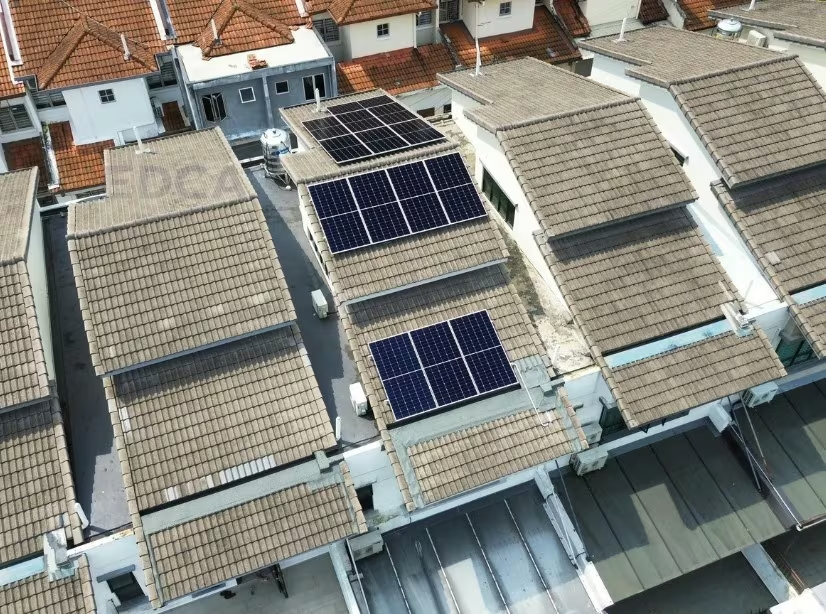
Once you decide to go solar, the first real question is which panels actually go on your roof. Brochures throw around terms like monocrystalline, TOPCon, bifacial and “Tier 1”, and it’s hard to tell what matters for a home in Malaysia’s hot, humid climate.
This guide keeps it simple. We’ll walk through the panel types available, how efficient they’ve become, how they cope with Malaysian heat, and the warranties that protect your investment. It sits alongside our home solar panel installation service, so you understand the hardware before you ask for a quote. First, a short video on how a solar panel turns sunlight into power.
Watch: how solar panels turn sunlight into electricity
A short, beginner-friendly explainer of the science behind every rooftop panel.
Source: History of Simple Things — “From Sunlight to Power: How Solar Panels Work”
1. What are residential solar panels, exactly?
Quick Answer: Residential solar panels are the flat photovoltaic (PV) modules mounted on a home’s roof that convert sunlight into direct-current electricity. They are the single most visible and important part of a home solar setup, but the panels alone are not the whole system — an inverter, mounting and a meter complete the picture.
It helps to separate the panel from the system. A panel is one module: dozens of silicon solar cells sealed under glass in an aluminium frame. A typical home needs somewhere between seven and twenty-five of them, wired together into an array. Everything else — the inverter, wiring and bi-directional meter — supports those panels.
If you want the full picture of how the parts connect and work with the grid, read our companion guide on the residential solar system in Malaysia. This article stays focused on the panels themselves: the part you’re really choosing between when you compare quotes. For a broader beginner overview, our guide to solar panels for the home is a good starting point too.
A quick site check confirms your roof space, orientation and shading before any panel is chosen. See our home solar installation service →
2. What types of solar panels can Malaysian homes choose from?
Quick Answer: Malaysian homes mostly choose between monocrystalline PERC panels, newer n-type TOPCon panels, older polycrystalline panels, and thin-film. In 2026, monocrystalline (both PERC and TOPCon) dominates residential rooftops because it offers the highest efficiency in the least roof space, which matters on a typical terrace-house roof.
Nearly every quality home panel today is monocrystalline — cut from a single silicon crystal, black in colour, and efficient. The real 2026 split is within that family: older PERC cells versus newer n-type TOPCon cells. Polycrystalline (blue, cheaper, less efficient) and thin-film are now rare on Malaysian rooftops. Here’s how the main types compare.
| Panel type | Typical efficiency | Look | Best for |
|---|---|---|---|
| Mono n-type (TOPCon) | ~22–24% | All-black | Best output in hot climates & tight roofs |
| Mono PERC | ~20–22% | Black | Proven, value-focused installs |
| Polycrystalline | ~15–17% | Blue | Legacy option, large open roofs |
| Thin-film | ~10–13% | Uniform dark | Niche & specialty surfaces |
Efficiency ranges aggregated from EnergySage and Clean Energy Reviews; market context for planning, not a product spec.
For most Malaysian homes with limited roof area, monocrystalline wins simply because it squeezes more watts into each square metre. That means fewer panels for the same output. If you’re weighing brands and installers, our guide to the best solar panel company in Malaysia covers what separates a good supplier from a cheap one.
3. How much has solar panel efficiency improved?
Quick Answer: Residential panel efficiency has climbed from around 16% a decade ago to roughly 22–24% for mainstream 2026 modules, while single-panel wattage has more than doubled. Higher efficiency means the same roof produces more power today than it would have a few years ago — so fewer panels do the same job.
This trend matters when you buy. A more efficient panel generates more electricity from the same patch of roof, so you can hit your target output with fewer modules. The industry has also shifted from p-type PERC to n-type TOPCon cells, which pushed efficiency up another notch. The table below tracks the direction of travel.
| Year | Mainstream cell tech | Typical efficiency | Typical panel wattage |
|---|---|---|---|
| 2016 | Polycrystalline | ~16% | ~260 W |
| 2019 | Mono PERC | ~19% | ~340 W |
| 2022 | Mono PERC (large format) | ~21% | ~450 W |
| 2026 | Mono n-type (TOPCon) | ~22–24% | ~570–620 W |
Illustrative industry trend aggregated from Clean Energy Reviews; representative figures for planning, not specific to any one brand.
The practical lesson: don’t chase last year’s clearance-stock panels just to save a little. A current high-efficiency panel makes better use of your roof for the next 25 years. The shift to n-type TOPCon as the production standard is exactly why 2026 systems fit more power on the same house.
4. How do solar panels perform in Malaysia’s heat and humidity?
Quick Answer: Solar panels actually lose a little efficiency as they get hotter, and Malaysian rooftops get very hot. Every panel has a temperature coefficient that measures this loss. Panels with a lower (better) coefficient — usually n-type TOPCon — hold more of their rated output on a scorching afternoon, which is why they suit our climate.
This is the most misunderstood point about solar in Malaysia. People assume more sun always means more power, but a panel’s rated output is measured at 25°C. On a hot roof, cell temperatures can reach 45–65°C, and output drops. The temperature coefficient tells you how much: a panel rated at −0.30%/°C loses less than one rated at −0.38%/°C. The illustrative chart below shows the effect on retained output at a hot cell temperature.
| Panel type | Temp. coefficient | Approx. output retained at 55°C |
|---|---|---|
| Mono n-type (TOPCon) | ~−0.30%/°C | ~91% |
| Mono PERC | ~−0.34%/°C | ~90% |
| Polycrystalline | ~−0.39%/°C | ~88% |
Modelled projection using a 30°C rise above the 25°C rating and typical published coefficients; illustrative only. Real retained output depends on ventilation, mounting and the specific panel model.
The differences look small per panel, but across an array and 25 years they add up — and heat is relentless here. Good airflow under the panels helps too, which is why mounting and installation quality matter as much as the panel choice. Our residential solar panel installation guide explains how proper mounting protects output.
We spec panels with the right temperature behaviour for Malaysian conditions. Request a free quote and panel recommendation →
5. What warranties and lifespan should residential panels have?
Quick Answer: Quality residential solar panels come with two warranties: a product warranty (against defects) and a performance warranty (guaranteeing minimum output over time). In 2026, strong Tier-1 panels offer 15–30 year product warranties and 25–30 year performance warranties, with annual degradation of about 0.4–0.55%.
Panels don’t fail suddenly; they fade slowly. That’s why the performance warranty matters more than any single spec. It promises the panel will still produce a stated percentage of its original output after 25 years. Lower annual degradation means more power kept over the panel’s life. Here’s how tiers typically compare.
| Panel tier | Product warranty | Performance warranty | Annual degradation | Output at year 25 |
|---|---|---|---|---|
| Premium Tier-1 (n-type) | 25–30 yrs | 30 yrs | ~0.40% | ~88–90% |
| Mid Tier-1 (PERC) | 15–25 yrs | 25 yrs | ~0.50% | ~84–86% |
| Budget / unbranded | 10–12 yrs | 20–25 yrs | ~0.70%+ | ~80% or less |
Illustrative market context for planning; exact warranty terms and degradation vary by manufacturer and are set out in each panel’s datasheet.
A warranty is only as good as the company standing behind it. A 30-year promise from a manufacturer that may not exist in 30 years is worth little, which is why Tier-1 status and a reputable local installer matter. A registered installer like EDCA Energy (a SEDA-registered RPVSP) handles warranty claims and keeps your paperwork valid.
6. How many solar panels does a Malaysian home need?
Quick Answer: Most Malaysian homes need between 7 and 25 panels, depending on the electricity bill and roof space. Because 2026 panels are more powerful, you need fewer of them: a 5 kWp system that once took sixteen 320 W panels now needs roughly nine 570 W panels.
The panel count comes from two numbers: your target system size in kilowatts-peak (kWp) and the wattage of each panel. Divide one by the other. Higher-wattage panels simply mean fewer modules for the same output — handy on a compact roof.
- Work out your target size first. This comes from your monthly TNB bill and daytime usage, not from a fixed package.
- Divide by panel wattage. A 6 kWp system ÷ 580 W panels ≈ 11 panels; the same 6 kWp with older 400 W panels needs 15.
- Check it fits. Each modern panel needs roughly 2.2–2.5 m² of unshaded roof.
Sizing to your bill is the step most worth getting right, and it’s covered in depth in our residential solar system guide. The residential net-metering scheme also caps home systems, so quota and roof both set a ceiling — our home solar installation team confirms the exact count on a site visit. The scheme itself runs under SEDA’s NEM 3.0 framework.
7. How to choose the best residential solar panels
Quick Answer: To choose residential solar panels, compare efficiency, temperature coefficient, both warranties, degradation rate, and the manufacturer’s Tier-1 standing — then judge them as a package with the installer. The cheapest panel rarely wins over 25 years; the best-value one balances output, durability and support.
Don’t buy on price per watt alone. Use a short checklist and weigh the panel together with who’s installing it:
- Efficiency. Aim for 21%+ so your roof does more with fewer panels.
- Temperature coefficient. Prefer around −0.30%/°C for Malaysian heat.
- Warranties. Look for a 25-year product and 25–30 year performance warranty.
- Degradation. Under 0.55% a year keeps more output late in life.
- Tier-1 & installer. A bankable brand plus a SEDA-registered installer protects the warranty.
Panels and the installer are a single decision — a great panel installed badly underperforms, and a fair panel installed well can outlast expectations. That’s why comparing providers matters as much as comparing modules; our guide to the best solar panel company in Malaysia shows what to look for, and EDCA Energy handles panel selection, design and install end to end.
8. Conclusion
Choosing residential solar panels in Malaysia comes down to a few clear ideas. Monocrystalline — ideally n-type TOPCon — is the mainstream choice because it delivers the most power per square metre and holds up well in heat. Panels keep getting more efficient, so a current-generation module makes the best use of your roof. And the specs that decide long-term value are efficiency, temperature coefficient, the two warranties and the degradation rate.
The one thing a guide can’t do is match panels to your actual roof, bill and budget. That needs a site visit and a proper design. When you’re ready, EDCA Energy handles the panel selection, the SEDA and TNB paperwork, and the installation from start to finish.
Ready to pick the right panels for your home?
Get a free, no-obligation quote with panels matched to your roof, climate and TNB bill.
Get a Free Quote9. Frequently asked questions
Which solar panels are best for homes in Malaysia?
Monocrystalline panels, especially newer n-type TOPCon modules, are the best fit for most Malaysian homes. They offer the highest efficiency in the least roof space and hold their output better in heat, which suits our hot, humid climate.
How long do residential solar panels last?
Quality panels are built to last 25 to 30 years or more. They fade slowly rather than fail suddenly — a good Tier-1 panel still produces around 85–90% of its original output after 25 years, backed by a performance warranty.
Are monocrystalline or polycrystalline panels better?
Monocrystalline panels are more efficient (around 20–24% versus 15–17% for polycrystalline) and perform better in heat, so they are the better choice for most homes. Polycrystalline is now largely a legacy option for large, open roofs where space is not a constraint.
Do solar panels work well in Malaysia’s hot weather?
Yes, though panels lose a little output as they heat up. That is why the temperature coefficient matters: n-type panels with a lower coefficient keep more of their rated power on a hot roof. Good mounting and airflow help too.
How much do residential solar panels cost in Malaysia?
Cost depends on the panel type, system size and roof, so pricing is quote-based rather than fixed. The clearest way to get your figure is a bill analysis and site survey — request a free quote for an exact number for your home.
See your solar savings in under a minute
Estimate your ideal system size, payback period and monthly bill offset with the EDCA calculator.