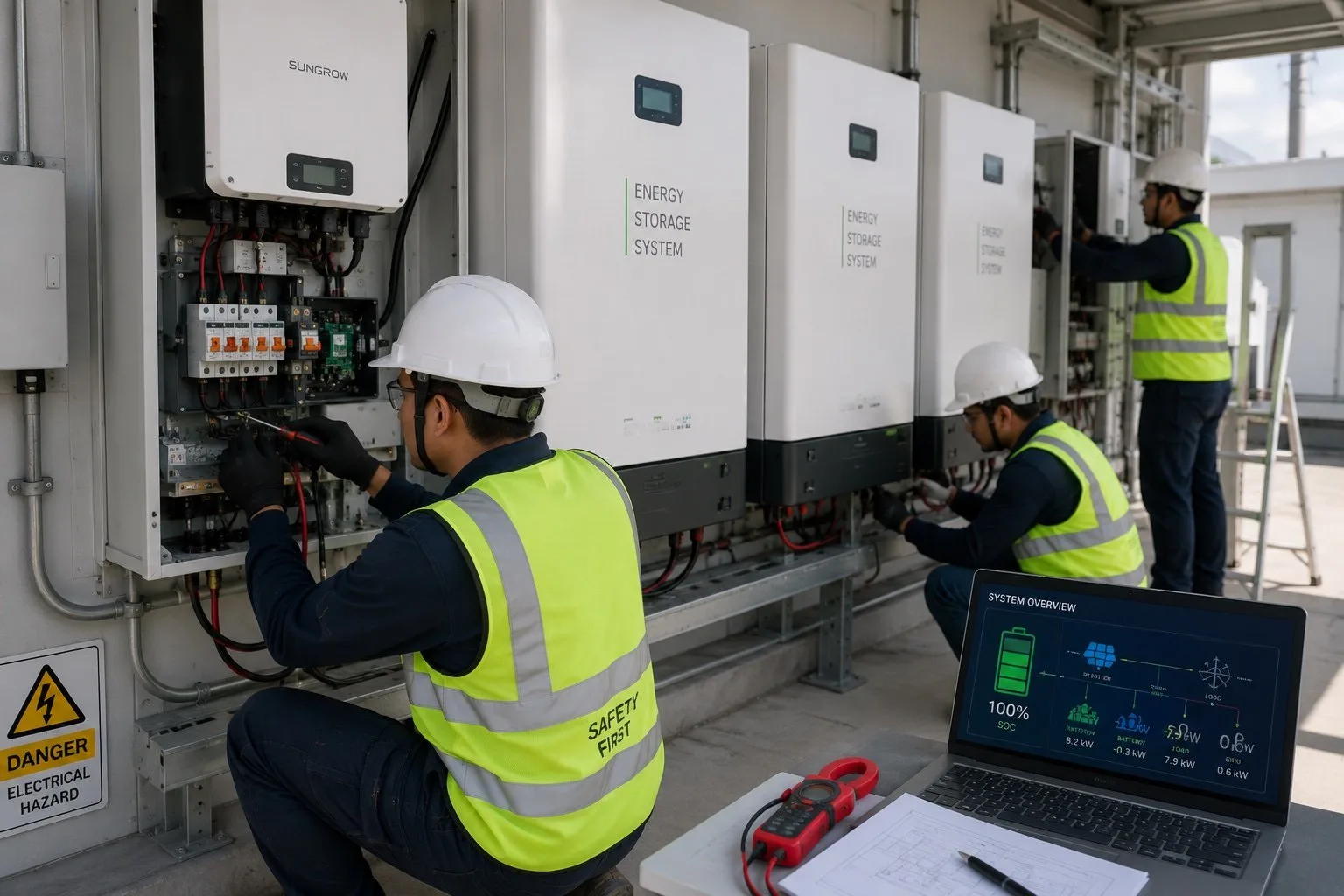
TL;DR: A commercial solar battery storage company designs, supplies, installs and maintains battery systems that let a business store solar or off-peak power and use it during expensive peak hours or outages. In Malaysia the case is driven by time-of-use tariffs, maximum-demand charges, and the need for backup at factories, cold rooms and data-heavy sites. The right partner sizes the battery to your load profile, handles TNB and safety compliance, and quotes to your actual usage rather than a fixed price list. EDCA Energy is a SEDA-registered EPCC provider that delivers solar-plus-storage for commercial and industrial sites nationwide.
Solar panels cut a Malaysian business’s daytime electricity bill, but they stop working the moment the sun drops or the grid trips. That gap is exactly where a commercial battery steps in. Add storage, and the energy your roof generates at noon can power your evening shift, hold your operations through an outage, and shave the costly peaks that inflate a commercial bill.
Choosing a commercial solar battery storage company is a bigger decision than picking panels. Batteries carry real fire-safety, warranty and control-software considerations, and a system sized wrongly either wastes capital or fails to deliver savings. This guide explains what these companies actually do, what storage delivers for a Malaysian business, how systems are sized, and how to tell a serious partner from a box-shifter. It complements EDCA Energy’s commercial solar battery storage service rather than repeating it — think of this as the buyer’s briefing before you ask for a quote.
Before the details, here is a clear, classroom-style explainer of how a battery energy storage system is put together — the batteries, the power conversion system, and the control software that decides when to charge and discharge.
How a battery energy storage system works
A plain-English walkthrough of BESS layout, the power conversion system (PCS), and the energy and battery management systems that run it.
Video: “Battery Energy Storage System (BESS) Explained” by Circuit Masterclass, published 11 March 2026. Watch on YouTube.
1. What does a commercial solar battery storage company do?
Quick Answer: A commercial solar battery storage company handles the full battery project end to end: studying your load profile, sizing the battery, engineering the electrical and safety design, supplying certified equipment, installing and commissioning it, and maintaining it afterwards. A capable EPCC partner also manages TNB liaison and warranty support, so you deal with one accountable team rather than several vendors.
Panels and batteries are different disciplines. A battery firm has to understand your consumption pattern across the day, not just your roof area. It reads your maximum-demand charges, your shift timings and your outage risk, then designs a system that charges and discharges at the right moments. Get that wrong and the battery sits idle; get it right and it quietly trims your bill every single day.
Most serious providers work as an EPCC partner — engineering, procurement, construction and commissioning under one roof. That structure matters because a battery touches your switchboard, your solar inverter and your safety systems all at once. The typical scope covers:
- Load and tariff study. Reading your bills and demand pattern to find where storage pays back fastest.
- System design and sizing. Matching battery capacity and power rating to your real load, not a catalogue default.
- Supply of certified hardware. Batteries, power conversion system, and the control software that dispatches them.
- Installation, safety and commissioning. Including fire protection, ventilation and compliant electrical works.
- Monitoring and maintenance. Ongoing performance checks, firmware and warranty handling.
If you are still weighing solar itself before adding storage, EDCA’s guide to choosing the best solar panel company in Malaysia covers how to judge an installer’s track record — the same rigour applies to a battery partner.
Key takeaway: A commercial battery company is not a hardware reseller. Its value is in sizing the system to your load profile and standing behind the install, safety and warranty as one accountable EPCC team.
Not sure whether storage fits your site yet?
Start with the fundamentals in EDCA’s solar battery storage solutions overview, then line it up against your own bills.
2. What commercial battery storage actually delivers for a business
Quick Answer: Commercial storage does four jobs: it shifts cheap or solar power into expensive peak hours, it shaves the maximum-demand spikes that drive up your bill, it keeps critical equipment running during an outage, and it stores surplus solar you would otherwise export cheaply. Which job matters most depends on your tariff and how sensitive your operations are to downtime.
A battery is only worth buying if it earns its place. For a Malaysian commercial site, the returns come from a mix of the roles below rather than any single one. The table sets out each use case, how the battery does it, and the kind of business that benefits most.
| Use case | How the battery does it | Benefits most |
|---|---|---|
| Peak-hour shifting | Stores solar or off-peak energy, discharges during costly peak tariff windows | Sites with heavy evening or night loads on a time-of-use tariff |
| Demand-charge shaving | Covers short, sharp spikes (compressor and machine starts) to hold peak demand down | Factories and cold storage with spiky, machine-driven loads |
| Backup power | Instantly powers critical circuits when the grid drops | Data rooms, clinics, F&B and any downtime-sensitive operation |
| Self-consumption | Holds surplus midday solar for later use instead of low-value export | Sites whose solar output exceeds daytime demand |
Source: EDCA Energy commercial installation experience, Malaysia. Actual results depend on site load and tariff.
Notice that the strongest cases stack. A factory on a time-of-use tariff can shave demand spikes and shift solar into the evening and keep a critical line running through a trip — one battery, three returns. That stacking is what an experienced commercial installer models before quoting. For the underlying mechanics of how a storage system is put together, EDCA’s explainer on the battery storage system for solar panels is a useful companion read.
Key takeaway: The value of a commercial battery comes from stacking use cases — peak shifting, demand shaving, backup and self-consumption — so the same asset pays back through several channels at once.
3. Why more Malaysian businesses are pairing solar with storage now
Quick Answer: Three shifts have moved storage from “nice to have” to “worth costing”. Malaysia’s move toward time-of-use pricing widened the gap between peak and off-peak rates, maximum-demand charges keep punishing spiky commercial loads, and grid reliability worries push firms to protect critical operations. Together they make a battery a commercial tool, not just a green statement.
Most articles frame batteries around sustainability. For a Malaysian business owner, the sharper lens is the bill and the risk register. Here is what is genuinely changing the maths:
- Time-of-use tariffs widen the arbitrage gap. When peak-hour electricity costs meaningfully more than off-peak, a battery that charges cheap and discharges expensive earns a spread on every cycle. The wider the gap, the faster storage pays back.
- Maximum-demand charges reward spike control. Commercial bills often carry a charge tied to your single highest demand reading in the month. A battery that trims those spikes attacks a cost that solar panels alone cannot touch.
- Resilience has a price. A single outage during a production run, a cold-chain hold, or a busy F&B service can cost more than months of energy savings. Backup capability is increasingly a business-continuity decision.
- Policy tailwinds. National schemes such as net energy metering and the broader push toward corporate renewable energy have normalised on-site generation, making storage the logical next layer.
The honest caveat: none of this makes storage right for every site. A daytime-only operation with steady, flat demand and low outage risk may see solar alone do the heavy lifting. The value of a good commercial partner — one that treats solar battery storage as an engineering decision, not an upsell — is telling you that plainly rather than selling you a battery you do not need.
Key takeaway: Storage now stacks up on cost and risk grounds — tariff spreads, demand charges and outage exposure — not just sustainability. A trustworthy partner will confirm whether your specific load actually benefits.
4. How commercial battery systems are sized
Quick Answer: Commercial batteries are sized by two numbers: energy capacity in kilowatt-hours (how much you can store) and power rating in kilowatts (how fast you can draw it). The right pairing depends on whether your goal is long evening runtime, sharp spike control, or backup, and it is always set against your measured load profile — never a one-size default.
The illustrative tiers below show how capacity typically scales with the size and goal of a commercial site. These are planning references only. Actual specification and pricing are quote-based, because they hinge on your load profile, roof or ground space, and how you intend to use the battery.
| Capacity band | Typical business profile | Primary goal |
|---|---|---|
| Small (up to ~100 kWh) | Retail outlet, small F&B, clinic, boutique office | Backup for critical circuits + modest peak shifting |
| Medium (~100–300 kWh) | Mid-size workshop, cold room, showroom, hotel | Demand shaving + evening self-consumption |
| Large (~300 kWh–1 MWh) | Factory, logistics hub, large commercial building | Stacked peak shifting, spike control and backup |
| Industrial (1 MWh+) | Manufacturing plant, industrial park, campus | Full load management across shifts and tariff windows |
Source: Illustrative planning scenario, EDCA Energy. Not a price list — every system is sized and quoted to the individual site.
The mistake to avoid is buying capacity as a headline number. A 300 kWh battery with a modest power rating behaves very differently from a 300 kWh battery built for fast discharge. To understand why both numbers matter, it helps to know how a battery storage system for solar panels is built. A good commercial installer specifies both dimensions against what your site actually does across a day and a week.
Key takeaway: Size on two axes — energy (kWh) and power (kW) — against your measured load, not a headline capacity figure. Tiers are a starting reference; the real spec comes from a site study.
Want the numbers for your actual site?
Sizing and payback only mean something against your own bills. Get a free quote and EDCA will model it to your load profile.
5. How to evaluate a commercial solar battery storage company
Quick Answer: Judge a commercial battery company on more than price. Accreditation and safety compliance, engineering and sizing capability, quality of equipment and warranty, proven commercial track record, and long-term service all matter. The weighting below reflects how EDCA prioritises these factors when specifying a system a business will rely on for a decade or more.
Batteries are a long-lived, safety-critical asset. A cheap install that skips fire protection or oversizes the battery is not a saving. The chart shows the relative weight a serious commercial buyer should give each factor.
| Accreditation & safety compliance |
Critical
|
| Engineering & sizing capability |
Very high
|
| Equipment quality & warranty |
Very high
|
| Commercial track record |
High
|
| Monitoring & long-term service |
High
|
| Upfront price alone |
Secondary
|
Source: EDCA Energy commercial procurement framework. Weightings reflect priorities for a safety-critical, long-life asset.
The same discipline applies whether the site is a home, a shoplot or a plant. EDCA’s guide for a residential solar battery storage installer walks through the credential checks in more detail, and they scale directly up to commercial procurement. On the commercial side, look specifically for SEDA registration, proper safety and electrical certification, and evidence of delivered commercial or industrial projects rather than only home installs.
Key takeaway: Weight accreditation, safety and engineering above headline price. A battery runs for a decade — the cheapest quote is rarely the lowest total cost of ownership.
6. Where commercial energy storage is heading in Malaysia
Quick Answer: Commercial and industrial storage in Malaysia is moving from early adoption toward mainstream as tariff structures reward flexibility, battery hardware costs fall, and national energy policy leans harder into renewables and grid stability. The direction of travel is clear even if the exact pace varies by sector.
The timeline below traces the momentum qualitatively — the milestones that have pushed commercial storage forward and how buyer interest has shifted alongside them. It is a market-context view, not a forecast.
| Period | Main drivers | C&I buyer interest |
|---|---|---|
| Earlier phase | Solar adoption via net energy metering; batteries seen as costly extras | Low — mostly backup-driven |
| Recent years | Time-of-use pricing spreads; falling battery costs; rising demand charges | Moderate — cost case emerging |
| Now | Tariff reform, corporate renewable targets, grid-stability focus | High — solar-plus-storage becoming default for large sites |
| Direction ahead | Deeper renewables integration; smarter dispatch and energy management | Accelerating — storage as standard infrastructure |
Source: Illustrative market context, EDCA Energy, drawing on public Malaysian energy-policy direction. Qualitative, not a numeric forecast.
For a business planning a solar project today, the practical read is simple: design the electrical system so storage can be added cleanly, even if you do not install the battery on day one. A partner who plans for that keeps your options open. You can see how storage fits the wider EDCA offering on the commercial solar battery storage page, and how EDCA operates as a whole at EDCA Energy.
Key takeaway: The trend points to solar-plus-storage as default infrastructure for larger commercial sites. Even if you delay the battery, design the solar system so storage can be added later without rework.
7. Conclusion
A commercial solar battery storage company earns its fee in the parts you cannot see on a spec sheet: reading your load, sizing power and energy correctly, engineering the safety, and standing behind the system for its full life. Storage is now a commercial tool — it shifts power into peak hours, shaves demand charges, and keeps critical operations running — but only when it is matched to how your site actually uses electricity.
The best next step is not to buy a battery; it is to get your own numbers modelled. A serious partner will tell you honestly whether storage pays back for your site, and size it to your real load rather than a catalogue default.
Ready to see if storage stacks up for your business?
EDCA Energy is a SEDA-registered EPCC provider delivering solar-plus-storage for commercial and industrial sites across Malaysia. Get a system sized and quoted to your actual load — no fixed price list, no guesswork.
Get a Free Quote8. Frequently asked questions
What is a commercial solar battery storage company?
It is a specialist that designs, supplies, installs and maintains battery systems for businesses, usually alongside solar. A capable one works as an EPCC partner — handling engineering, procurement, construction, commissioning, safety compliance and ongoing service — so a business deals with one accountable team for the whole system.
How much does a commercial battery storage system cost in Malaysia?
There is no fixed price, because cost depends on your energy and power requirements, site conditions and how you use the battery. Commercial systems are always quoted to the individual site after a load study. The best way to get a real figure is to have a provider model it against your bills.
Can I add a battery to an existing commercial solar system?
Often yes, though it depends on your current inverter and electrical setup. Some systems are retrofit-ready; others need additional equipment. A site assessment confirms what is possible. Even if you are only installing solar now, ask your installer to design it so storage can be added later without major rework.
What is the difference between energy capacity and power rating?
Energy capacity (kWh) is how much electricity the battery can store — it sets how long the battery can run a load. Power rating (kW) is how fast it can deliver that energy — it sets how big a load it can cover at once. A good commercial system is sized on both, matched to your site’s profile.
Does a commercial battery provide backup during a power outage?
It can, if it is configured for backup. The battery can power designated critical circuits when the grid drops. How much you can run and for how long depends on the battery’s capacity and how it is set up, which is decided during the design stage based on which operations you most need to protect.
See your solar savings in under a minute
Estimate your ideal system size, payback period and monthly bill offset with the EDCA calculator.