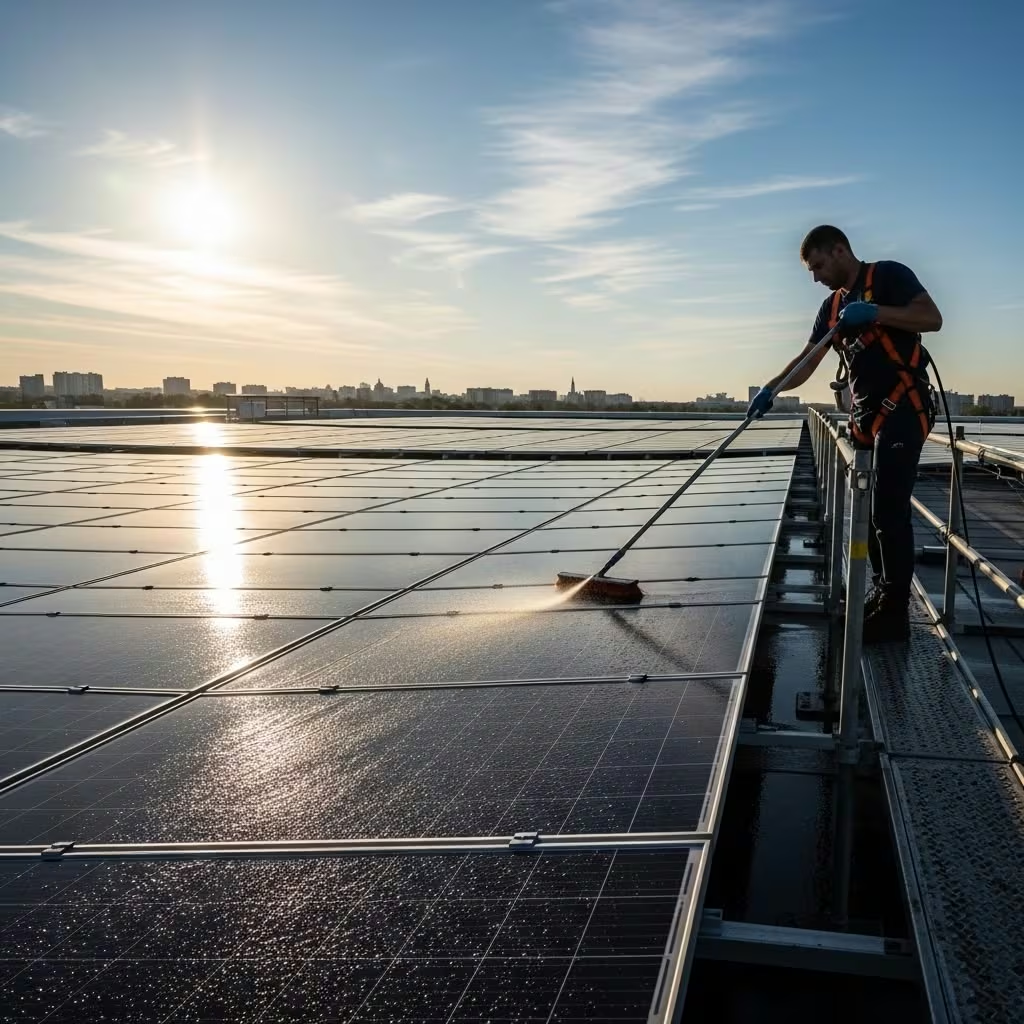
TL;DR: Solar panel maintenance cost in Malaysia is low compared with the value your system produces, but it is not zero. A typical rooftop home needs a clean one to four times a year plus an annual inspection, with the biggest swing factors being roof height, system size and how dirty your panels get. The real cost is not the cleaning bill — it is the energy you quietly lose when soiling builds up and no one checks the inverter. Budget for a simple plan, not a one-off.
Solar is often sold as “fit and forget”. That is mostly true — panels have no moving parts and can run for decades. But in Malaysia’s hot, dusty, tropical climate, a system that never gets looked at slowly bleeds output. Dust, bird droppings, leaves and haze all cut how much sunlight reaches the cells, and a quiet inverter fault can go unnoticed for months.
This guide breaks down the real solar panel maintenance cost in Malaysia. You will see what you actually pay for, what makes one quote higher than another, whether cleaning them yourself is worth it, and the hidden cost of doing nothing. As a Malaysian solar EPCC provider, EDCA Energy maintains systems across homes, businesses and factories, so the numbers below reflect real local conditions, not an overseas checklist. Pricing here is illustrative market context — your actual figure is best confirmed with a site quote.
Before the details, here is a short video that explains what solar maintenance involves and why the cost is usually smaller than people fear.
Watch: what solar panel maintenance really costs
A clear overview of the tasks behind solar maintenance and why the ongoing cost is modest relative to system output.
Source: Solar Panel Maintenance Costs Explained! (YouTube).
1. Do solar panels really need maintenance in Malaysia?
Quick Answer: Yes — just not much. Solar panels have no moving parts, so they are genuinely low-maintenance. But “low” is not “none”. In Malaysia’s tropical climate, dust, haze and bird droppings settle on panels between rain showers, and inverters need occasional checks. Skipping maintenance entirely is where the real cost hides, because lost output does not show up on any bill.
You will often read that solar is “maintenance-free”. That is a half-truth worth correcting. The panels themselves rarely fail and carry long warranties. What needs attention is everything around the glass: the surface stays clean, the wiring stays sound, and the inverter keeps converting properly. Ignore those and the system still runs — just at a quieter, lower output.
Malaysia adds its own twist. Frequent rain does rinse panels, which helps. But between showers, and especially during hazy or dry spells, a sticky film of dust and pollen builds up. On a flat or low-tilt roof, that film does not fully wash away, so it keeps shaving off output until someone cleans it. Choosing a capable installer matters here — the same care you would use when picking the best solar panel company in Malaysia applies to who you trust with upkeep.
Not sure what your system needs?
A quick check tells you the condition of your panels, wiring and inverter. See how our solar panel maintenance service keeps output where it should be →
2. What goes into solar panel maintenance cost?
Quick Answer: The maintenance cost you pay is really three or four small jobs bundled together: cleaning the panels, a visual and electrical inspection, an inverter check, and occasional minor repairs. Cleaning is the routine recurring item; inspection protects your warranty and safety; the inverter check catches faults early. Together they cost far less than the energy they preserve.
It helps to see maintenance as a set of separate tasks rather than one vague fee. Each item does a different job, and knowing what you are paying for makes any quote easier to judge. The table below shows the typical make-up of a routine service and roughly how much of the effort each part takes.
| Task | What it covers | Relative share of a visit |
|---|---|---|
| Panel cleaning | Removing dust, droppings and film from the glass | |
| Visual & electrical inspection | Checking mounting, cabling, connectors and hotspots | |
| Inverter check | Reviewing error logs, output data and cooling | |
| Minor repairs | Tightening, re-sealing or replacing small parts as needed |
Illustrative effort weighting for a standard residential visit; actual scope depends on system size and condition.
Cleaning is the part you repeat most often; inspection and the inverter check happen less frequently but matter more when something is wrong. A good service rolls all of these into one visit so you are not paying separate call-out fees. If your system is bundled into a care plan, the per-visit cost usually drops too.
Key takeaway: Maintenance is a small bundle of tasks, not one big bill. Cleaning recurs most often, while inspection and the inverter check are the parts that quietly protect your investment.
3. What makes one maintenance quote higher than another?
Quick Answer: Two homes on the same street can get different maintenance quotes. The biggest drivers are roof height and access, system size, how dirty the panels get, your location, and whether you buy a plan or a one-off visit. Safe access to a high or steep roof is usually the single largest swing factor.
When a quote looks higher than you expected, it is rarely the cleaning itself — it is the conditions around it. Understanding the drivers lets you see why your number is what it is, and where you have some control. The chart below ranks the common factors by how much they typically move the price.
| Cost driver | Relative impact on price |
|---|---|
| Roof height & access difficulty | |
| System size (number of panels) | |
| Soiling level & surroundings | |
| Location & travel distance | |
| One-off visit vs care plan |
Illustrative ranking of pricing factors; the actual weighting varies by property and provider.
A double-storey home with a steep roof needs more safety gear and time than a single-storey bungalow, so access alone can dominate the quote. Bigger arrays take longer to clean and inspect. Panels near trees, construction sites or busy roads soil faster and may need more frequent visits. A recurring plan usually beats repeated one-off call-outs on price per visit.
Want a figure for your exact roof?
Tell us your roof type, system size and location and we will scope it properly. Get a free quote →
Key takeaway: Roof access and system size drive most of the price gap between quotes. If your number looks high, it is usually the height and the panel count talking, not the cleaning itself.
4. DIY vs professional: is cleaning them yourself worth it?
Quick Answer: You can rinse ground-level or low panels yourself with soft water and a soft brush, and that saves a little on upkeep. But climbing onto a wet, sloped roof is dangerous, and a garden hose does nothing for wiring or inverter faults. For most Malaysian homes, DIY handles light cleaning while a professional handles safety, electrical checks and warranty-safe work.
DIY is tempting because the cleaning part looks simple. For some setups it genuinely is. The problem is that “maintenance” is more than washing glass, and the riskiest part — height and electricity — is exactly the part you should not improvise. The comparison below shows where each approach fits.
| Factor | DIY cleaning | Professional service |
|---|---|---|
| Out-of-pocket cost | Low — mostly your time | A per-visit fee, lower on a plan |
| Safety | Risky on a sloped or high roof | Trained crew with proper gear |
| Electrical & inverter checks | Not covered | Included and documented |
| Warranty protection | Wrong tools can void it | Work stays within warranty terms |
Illustrative comparison based on common Malaysian residential setups.
The sensible middle ground for many owners is simple. Do occasional light rinsing yourself if the panels are safely reachable, and book a professional once a year for the inspection and inverter check you cannot do from the ground. Never use a pressure washer or harsh chemicals — both can damage the glass or seals and turn a small saving into a big repair.
Key takeaway: DIY light cleaning is fine when access is safe, but it cannot replace a professional inspection. The money you save washing glass is not worth a fall or a voided warranty.
5. The hidden cost of skipping maintenance
Quick Answer: The real cost of solar upkeep is not the service fee — it is the output you lose when you skip it. In Malaysia’s climate, soiling can trim a panel’s output by roughly 2.5% to 3% in a single month, and that loss compounds the longer panels stay dirty. Cleaning restores it; neglect quietly eats your savings.
Dust does not announce itself. Your system keeps running, so nothing looks wrong — but every layer of grime means less electricity and a higher bill than you should have. A Malaysian field study in Perak Tengah measured how quickly this adds up.
Research on rooftop panels in Perak Tengah found monthly efficiency losses of around 2.5% to 3.1% from soiling, depending on tilt angle. Flatter panels trap more dirt and lose more; steeper ones shed it better. The table below shows how uncleaned output typically drifts over a year, grounded in that kind of local soiling rate.
| Time since last clean | Approx. output lost | Relative scale |
|---|---|---|
| 1 month | ~3% | |
| 3 months | ~6% | |
| 6 months | ~10% | |
| 12 months | ~15% |
Illustrative model based on Malaysian soiling research; rain partly offsets losses, so real figures vary by roof, tilt and surroundings.
Rain helps, which is why these figures are a ceiling rather than a promise — but on low-tilt or sheltered roofs the film persists. Set against the cost of one or two cleans a year, the lost energy from neglect is almost always the bigger number. That is the whole economic case for maintenance in one line.
Key takeaway: Skipping maintenance is not free — it costs you in silent output loss that grows month by month. A modest cleaning budget almost always beats the energy you would otherwise lose.
6. How often should you service solar panels in Malaysia?
Quick Answer: For most Malaysian homes, clean the panels one to four times a year, check the inverter app monthly, and book a professional inspection once a year. Dustier locations — near trees, farms, construction or busy roads — sit at the higher end. Monitoring is the free habit that tells you when a clean is actually due.
There is no single schedule that fits every roof, but a simple rhythm works for most. The key is to let your monitoring data, not the calendar alone, tell you when output has dipped enough to warrant a clean.
- Monthly: glance at your inverter or monitoring app. A steady drop in output usually means dirt or a fault worth checking.
- One to four times a year: clean the panels. Once or twice suits most homes; go higher if you are near heavy dust or foliage.
- Once a year: a professional inspection of wiring, mounting and the inverter, ideally paired with a clean.
- After storms or haze: a quick visual check, since heavy debris or thick haze film can cut output sharply.
Commercial and industrial rooftops often need more frequent cleaning because the arrays are larger and downtime costs more. Whatever the setting, pairing the yearly inspection with a clean keeps the total bill down by avoiding separate visits.
Key takeaway: Monitor monthly, clean one to four times a year, and inspect annually. Let output data drive the cleaning schedule rather than guessing.
7. What a good maintenance plan should include
Quick Answer: A worthwhile maintenance plan bundles cleaning, an annual inspection, inverter monitoring and a documented report into a fixed yearly price. That predictability usually lowers your effective maintenance cost versus ad-hoc call-outs, and the report gives you proof of upkeep for warranty claims.
If you would rather not track schedules yourself, a plan takes the thinking off your plate. The value is not just convenience — it is early detection and paperwork. Look for these elements before you sign anything.
- Scheduled cleaning matched to your location’s dust level, not a generic frequency.
- Annual inspection covering mounting, cabling, connectors and safety.
- Inverter and output monitoring so faults are caught before they cost you months of generation.
- A written report after each visit, which supports warranty claims and resale value.
A plan from an experienced local EPCC provider also means one accountable team knows your system’s history. Our solar panel maintenance service is built around exactly this: predictable upkeep that protects both output and warranty.
Key takeaway: A good plan bundles cleaning, inspection, monitoring and reporting into one predictable price — cheaper and safer than reacting only when something looks wrong.
8. Frequently asked questions
How much does solar panel maintenance cost in Malaysia?
It varies by roof height, system size, how dirty the panels get, and whether you buy a one-off visit or a yearly plan. Because those factors differ so much between homes, the honest answer is that a site quote gives you a real figure. What stays true everywhere is that the cost is small next to the energy good maintenance preserves.
Do solar panels really need cleaning if it rains often?
Rain helps but does not fully clean panels, especially on flat or low-tilt roofs where a dust film clings on. Malaysian research shows soiling can still cut output by a few percent a month between and despite showers, so occasional cleaning remains worthwhile.
Can I clean my solar panels myself?
Yes, if they are safely reachable — use soft water and a soft brush or cloth only. Never use a pressure washer, harsh chemicals or climb onto a wet, sloped roof. Leave high roofs and any electrical or inverter checks to a professional.
How often should solar panels be serviced?
For most homes: clean one to four times a year, check your monitoring app monthly, and book a professional inspection once a year. Dustier locations near trees, farms or construction need more frequent cleaning.
What happens if I never maintain my solar panels?
The system keeps running but output slowly drops as dirt builds up, and an unnoticed inverter fault can cause a bigger loss. Over months, that quiet under-performance usually costs more than routine maintenance would have.
9. Keeping your system at its best
Quick Answer: The smart way to think about solar panel maintenance cost is as insurance on your output, not an expense. A little spent on cleaning, inspection and monitoring keeps your panels earning their full return for decades — far cheaper than the energy lost to neglect.
Solar in Malaysia genuinely is low-maintenance, but low is not none. Keep the glass clean, watch the inverter, and get a proper eye on the system once a year, and your panels will quietly do their job for 25 years or more. Treat maintenance as protection for a large investment rather than a cost to avoid, and the maths works strongly in your favour.
Want your panels working at full output?
We clean, inspect and monitor solar systems across Malaysian homes, businesses and factories — and give you a clear report after every visit.
Get a Free QuoteSee your solar savings in under a minute
Estimate your ideal system size, payback period and monthly bill offset with the EDCA calculator.