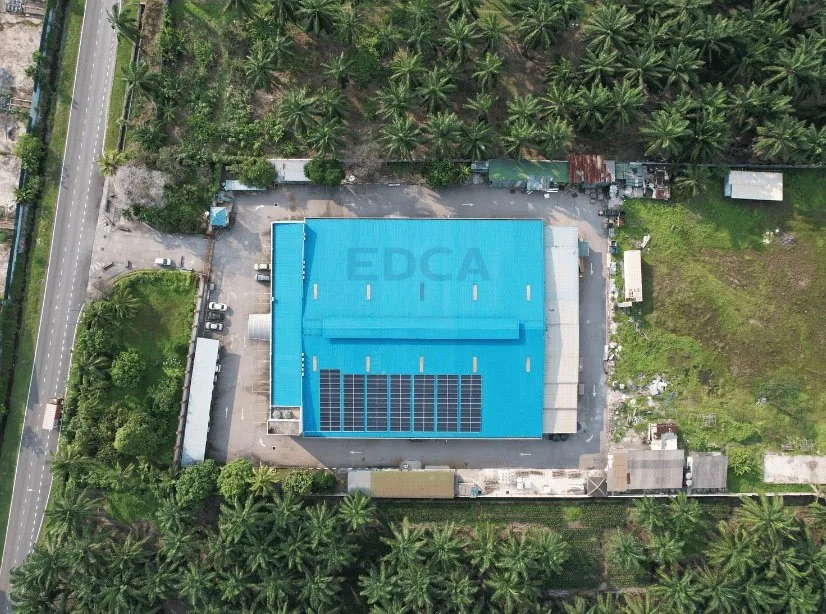
TL;DR: A commercial solar panel system in Kuala Lumpur turns your roof into a hedge against rising TNB tariffs. With the RP4 base tariff up 14.2% since July 2025, the new Solar ATAP scheme replacing NEM, and GITA/GITE tax incentives running to end-2026, KL businesses can offset 30–60% of their electricity bill and recover the outlay within a few years. This guide covers sizing, cost, payback, incentives, and how to pick the right installer.
Electricity is one of the few costs a Kuala Lumpur business can actually control. Rent is fixed by a lease, wages by the market, but the power bill? That depends on your roof. Since July 2025, the base tariff in Peninsular Malaysia sits at 45.62 sen per kWh, a 14.2% jump from the previous 39.95 sen, and commercial and industrial users felt it hardest. That single change is why so many KL owners are now looking up at their rooftops.
A commercial solar panel in Kuala Lumpur is not a green gesture. It is a financial decision with a measurable return. This guide is written for shoplot owners in Cheras, factory managers in Kepong, retail operators in the Golden Triangle, and anyone running a premises with a flat or metal roof soaking up the KL sun all day. We will walk through how big a system you need, what it costs, how fast it pays back, which incentives you can stack in 2026, and how the installation actually happens.
Not sure if your building qualifies? The quickest way to find out is a roof and load review. Explore EDCA’s commercial solar installation service to see how a system is scoped for a Malaysian business.
Before the numbers, here is a short explainer on how a commercial solar PV system actually converts a KL rooftop into usable, bill-cutting electricity.
How a commercial solar PV system works
A quick visual overview of how commercial rooftop panels generate electricity and feed your building’s load.
Video: “Solar panels — How commercial solar PV systems work” via YouTube.
1. Why Kuala Lumpur businesses are going solar in 2026
Quick Answer: KL businesses are switching to solar because grid electricity keeps getting more expensive while solar costs keep falling. The RP4 tariff period (2025–2027) lifted the base rate 14.2%, and commercial energy charges rose alongside it. A rooftop system locks in a lower cost per unit for 25 years, turning a rising expense into a fixed asset.
The maths changed in July 2025. When the base tariff moved to 45.62 sen/kWh under the new Regulatory Period 4 structure, commercial and industrial accounts saw energy, capacity, and network charges restructured into a bill that trends upward year on year. For a business drawing power through the hottest daylight hours, that is exactly when solar generates the most. A commercial solar panel in Kuala Lumpur produces power at the moment your air-conditioning, chillers, and machinery are working hardest, so almost every unit you make is a unit you do not buy from TNB.
Kuala Lumpur also has the ingredients that make solar work well: strong, consistent irradiance across the year and large flat commercial rooftops that would otherwise sit empty. The table below shows how the grid tariff has moved, which is the single biggest driver behind the switch.
| Regulatory period | Base tariff (sen/kWh) | Change |
|---|---|---|
| RP3 (2022–2024) | 39.95 | Baseline |
| RP4 (2025–2027) | 45.62 | +14.2% (from 1 July 2025) |
| Effective C&I rate band (illustrative) | ~48–52 | Inclusive of network & capacity charges |
Source: base tariff figures per The Edge Malaysia (RP4 announcement). Effective C&I band is an illustrative market range, not a fixed EDCA figure.
Key takeaway: Grid power is on a rising curve while solar is a one-time capital cost. The wider the gap grows, the stronger the case for a commercial solar panel in Kuala Lumpur becomes.
2. How big a solar system does your KL premises need?
Quick Answer: System size is set by two things: how much usable roof you have and how much power you use during daylight. As a rough guide, every 1 kWp of solar needs about 60–80 sq ft of clear roof and generates roughly 1,300 kWh a year in Kuala Lumpur. A small office might fit 20 kWp; a factory roof can carry 400 kWp or more.
The right size is the one that matches your daytime consumption, not the biggest system your roof can hold. Under self-consumption rules, the value comes from using the power you generate, so a well-sized commercial solar panel in Kuala Lumpur is scoped against your actual load profile. The table below gives indicative sizing for common KL building types, using a KL yield assumption of about 1,300 kWh per kWp per year.
| Building type | Usable roof (sq ft) | System size | Est. annual output | Typical bill offset |
|---|---|---|---|---|
| Small shoplot / office | ~2,000 | 20 kWp | ~26,000 kWh | 20–30% |
| Retail / showroom | ~5,000 | 50 kWp | ~65,000 kWh | 25–40% |
| Light factory / warehouse | ~15,000 | 150 kWp | ~195,000 kWh | 30–50% |
| Large industrial roof | 40,000+ | 400 kWp+ | ~520,000 kWh+ | 40–60% |
Illustrative scenario based on a KL yield of ~1,300 kWh/kWp/year. Actual sizing depends on roof condition, shading, and load profile, confirmed during a site assessment.
Roof material matters too. Metal trapezoidal roofs on KL factories are the fastest and cheapest to mount. Flat concrete roofs on commercial blocks need ballasted or raised frames. Older shoplot roofs may need minor reinforcement first. None of these are dealbreakers, but they change the design, so an honest installer inspects before quoting.
Key takeaway: Size the system to your daytime load, not just your roof area. The sweet spot offsets the power you use during working hours without exporting large surpluses cheaply.
3. Commercial solar cost and payback in Kuala Lumpur
Quick Answer: Commercial solar in KL is priced per project, not per panel, because roof type, system size, and electrical works all vary. What matters more than the sticker price is payback: most well-scoped commercial systems in Malaysia recover their cost within roughly 3 to 6 years, then deliver 20 years of near-free power. Larger systems on high-consumption sites usually pay back fastest.
There is no fixed price for a commercial solar panel in Kuala Lumpur, and any installer quoting a flat rate before seeing your roof is guessing. Cost depends on capacity, roof structure, cabling distance to your switchroom, inverter choice, and whether you add battery storage. What stays consistent is the logic of the return: the more daytime power you offset, the faster the system pays for itself. The chart below shows indicative monthly savings by business size, based on the current 45.62 sen/kWh base rate.
| System size | Indicative monthly saving | Relative scale |
|---|---|---|
| 20 kWp (office) | ~RM 1,050 | |
| 50 kWp (retail) | ~RM 2,600 | |
| 150 kWp (warehouse) | ~RM 7,800 | |
| 400 kWp (industrial) | ~RM 20,500 |
Illustrative modelled savings at ~45.62 sen/kWh with full daytime self-consumption. Real savings depend on your load profile and tariff category. For a figure specific to your premises, request a free quote.
Two things speed up payback in KL. First, high daytime usage, so businesses that run through the day (factories, cold storage, retail, clinics) do better than those that only draw power at night. Second, the incentives in the next section, which cut the effective cost of the system without touching the savings it produces.
Key takeaway: Judge commercial solar by payback and lifetime savings, not the upfront figure. A higher-priced system that offsets more daytime load often pays back faster than a cheaper, undersized one.
4. Incentives KL businesses can stack in 2026
Quick Answer: Three main mechanisms support commercial solar in Malaysia in 2026: the Solar ATAP self-consumption scheme (which replaced NEM and credits surplus exports at the System Marginal Price), the Green Investment Tax Allowance (GITA) on the system capex, and the Green Income Tax Exemption (GITE) for solar leasing income. GITA and GITE applications run until 31 December 2026.
The policy backdrop shifted recently, so it is worth getting the current picture right. Net Energy Metering (NEM) closed to new applicants in mid-2025 and was replaced by Solar ATAP, effective 1 January 2026. Under Solar ATAP, non-domestic consumers can install up to 100% of their maximum demand (capped at 1 MW), consume the power themselves, and receive credits for surplus exported to the grid at the System Marginal Price. On top of that sit the tax incentives that a commercial solar panel in Kuala Lumpur can qualify for.
| Mechanism | What it gives | Availability |
|---|---|---|
| Solar ATAP | Self-consumption; surplus exports credited at System Marginal Price | Active from 1 Jan 2026 for TNB consumers |
| GITA (investment allowance) | Tax allowance on qualifying solar capex, offset against statutory income | Applications to 31 Dec 2026 |
| GITE (income exemption) | Income tax exemption for qualifying solar leasing / service income | Applications to 31 Dec 2026 |
Source: incentive scope and deadlines per SEDA Malaysia. Eligibility and exact rates depend on your company’s circumstances; confirm with a licensed tax adviser.
The practical point for a KL business owner: eligibility and paperwork for GITA and GITE close at the end of 2026, so a system commissioned this year is best placed to claim. A capable installer will help align the technical documentation with the incentive applications rather than leaving you to chase them alone.
Want the incentive stack mapped to your building? Get a free quote and EDCA will scope the system, savings, and applicable incentives for your KL premises.
Key takeaway: Solar ATAP handles the day-to-day economics; GITA and GITE cut the effective capital cost. Stacking all three before the end-2026 window closes gives the strongest return.
5. How a commercial solar installation works in KL
Quick Answer: A commercial solar project in Kuala Lumpur runs through six stages: site assessment, system design, approvals, installation, commissioning, then monitoring. From signed proposal to grid-connected system typically takes a few weeks to a couple of months, depending on size and how quickly TNB and regulatory approvals come through.
Commercial solar is an engineering, procurement, and construction (EPCC) job, not a plug-and-play product. A registered installer manages every stage so your business keeps running while the work happens overhead. The sequence looks like this:
- Site and roof assessment. The installer inspects roof structure, orientation, shading, and your switchroom, and pulls your recent TNB bills to read the load profile.
- System design and proposal. Capacity, panel layout, inverter selection, and a savings and payback estimate are drawn up specific to your premises.
- Applications and approvals. Solar ATAP registration with TNB, plus compliance with Suruhanjaya Tenaga (ST) and CIDB requirements, are prepared and submitted.
- Installation and EPCC works. Mounting, panels, inverters, cabling, and protection devices are installed, usually scheduled to avoid disrupting operations.
- Testing and commissioning. The system is tested, inspected, and connected to the grid once approvals are cleared.
- Monitoring and maintenance. Generation is monitored remotely, with periodic cleaning and inspection to keep output high across the system’s life.
Because the approvals sit with TNB and the regulators, the timeline is partly out of any installer’s hands. What a good installer controls is a clean application the first time, so nothing bounces back for rework.
Key takeaway: The install itself is fast; approvals set the pace. Choosing an installer experienced with TNB and ST paperwork is the difference between weeks and months.
6. How to choose a commercial solar installer in Kuala Lumpur
Quick Answer: Pick an installer that is SEDA-registered, holds the right ST and CIDB credentials, and can show real commercial projects at your scale. For a commercial solar panel in Kuala Lumpur, an EPCC provider that handles design, approvals, installation, and maintenance in-house beats a broker who subcontracts each part to a different team.
The installer you choose is the biggest variable in whether the system performs for 25 years or underdelivers from year one. A few things separate a serious commercial provider from a reseller:
- Proper accreditation. Look for a SEDA-registered photovoltaic service provider with ST and CIDB standing. These are the baseline for legal, safe commercial work.
- Genuine EPCC capability. One team owning engineering, procurement, and construction means clearer accountability than a chain of subcontractors.
- A real commercial track record. Ask to see completed systems of a similar size and roof type in the Klang Valley.
- Honest, site-specific quoting. A quote after a roof inspection is worth far more than a number given over the phone.
- Aftercare. Monitoring and maintenance keep output high; a provider that disappears after commissioning is a red flag.
The same evaluation applies whether you are a KL business or expanding elsewhere. If you are weighing options across the country, our guide to the best solar panel company in Malaysia walks through the wider selection criteria. Businesses in the south comparing local options can read our companion piece on commercial solar panels in Johor, or its residential counterpart on home solar panels in Johor, while KL owners exploring home systems separately can see our home solar panel in Kuala Lumpur guide. For a full scope of works, EDCA’s commercial solar installation service covers design through maintenance, and you can learn more about the team on the EDCA Energy homepage.
Key takeaway: Accreditation, in-house EPCC, and a real commercial portfolio matter more than the lowest quote. The cheapest system is expensive if it underperforms for two decades.
7. Conclusion
Quick Answer: A commercial solar panel in Kuala Lumpur is one of the clearest investments a KL business can make in 2026: rising tariffs, strong sunlight, large rooftops, and a closing window of incentives all line up in your favour. The right-sized system on the right roof, installed by an accredited EPCC provider, turns a rising bill into two decades of savings.
Electricity costs are not coming back down. With the RP4 tariff locked in through 2027 and grid charges restructured to trend upward, the businesses that act now fix their energy cost for the long run while their competitors keep paying more every year. Add the Solar ATAP scheme and the GITA and GITE incentives closing at the end of 2026, and the case for moving this year is strong. The first step is simple: get your roof assessed and your numbers modelled by a provider who inspects before quoting.
Ready to see what solar could save your KL business?
EDCA Energy is a SEDA-registered solar EPCC provider with 150+ projects delivered across Malaysia. Get a free, no-obligation assessment of your roof, savings, and incentive eligibility.
Get a Free Quote8. Frequently asked questions
How much does a commercial solar panel system cost in Kuala Lumpur?
There is no fixed price, because cost depends on system size, roof type, cabling, inverter choice, and whether you add battery storage. Commercial solar is quoted per project after a site assessment. The more useful measure is payback, which for a well-scoped KL system usually falls within roughly 3 to 6 years.
Do I need TNB approval to install commercial solar in KL?
Yes. Grid-connected commercial systems require registration under the Solar ATAP scheme with TNB, along with compliance with Suruhanjaya Tenaga (ST) and CIDB requirements. An accredited installer prepares and submits this paperwork as part of the project.
What happened to NEM for commercial users?
Net Energy Metering closed to new applicants in mid-2025 and was replaced by Solar ATAP from 1 January 2026. Under Solar ATAP, businesses consume their own solar power and receive credits for surplus exported to the grid at the System Marginal Price.
Can my business claim tax incentives on solar?
Qualifying commercial systems may claim the Green Investment Tax Allowance (GITA) on capex, and solar leasing income may qualify for the Green Income Tax Exemption (GITE). Both application windows run until 31 December 2026. Confirm eligibility with a licensed tax adviser.
How long does a commercial solar installation take in KL?
The physical installation is quick, often days to a couple of weeks depending on size. The overall timeline from signed proposal to grid connection usually runs a few weeks to a couple of months, driven mostly by how fast TNB and regulatory approvals clear.
See your solar savings in under a minute
Estimate your ideal system size, payback period and monthly bill offset with the EDCA calculator.