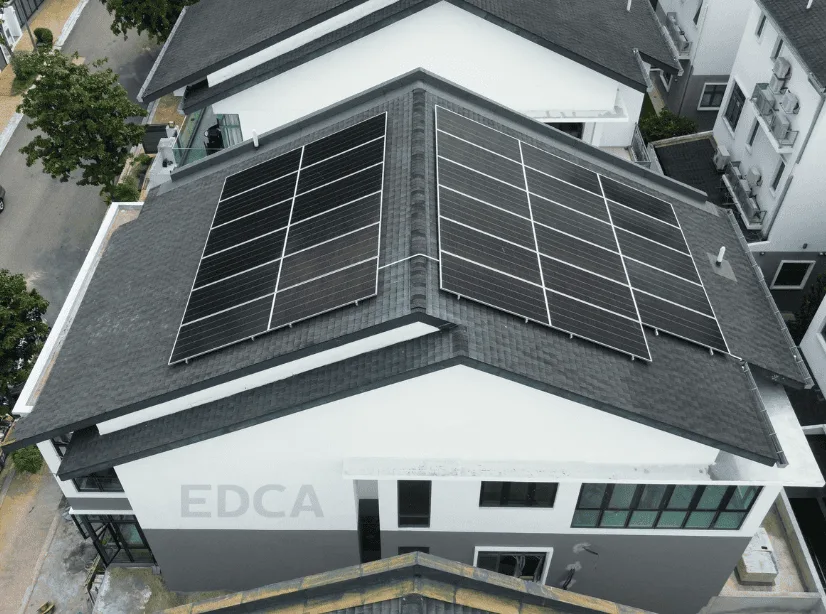
Rooftop solar has moved from a niche upgrade to a mainstream home decision in Malaysia. With the base electricity tariff climbing in 2025 and a new export scheme replacing net metering in 2026, a lot of homeowners are asking the same practical question first: how much do home solar panels cost, really? Not the brochure figure — the number that lands on the invoice.
The short answer is that there is no single price. Solar is sized to your home and your electricity use, so two houses on the same street can get very different quotes. What you can do is understand the ranges, the cost drivers, and the payback maths well enough to read any quote with confidence. That is exactly what this guide covers. If you want the full picture of the installation itself, our home solar panel installation service page walks through the process end to end.
As a SEDA-registered solar EPCC provider, EDCA Energy has installed systems across more than 150 projects, so the ranges below reflect what real Malaysian homes actually deal with — not idealised numbers. Every figure here is illustrative market context, not a fixed EDCA price. Let’s get into it.
Watch: two years of real solar numbers
A US homeowner’s two-year cost-and-savings review from Smart Home Solver. Tariffs differ; the payback logic is the same.
Source: Smart Home Solver on YouTube — Is Solar Worth It? My Experience 2 Years Later
1. What is the typical price range for home solar panels in Malaysia?
Quick Answer: A home solar system in Malaysia typically costs between RM16,000 and RM60,000 installed, driven mostly by size. Terrace homes (4–6 kWp) tend to fall around RM16,000–RM26,000; semi-detached homes (6–10 kWp) around RM26,000–RM42,000; and larger bungalows (10–15 kWp) from RM42,000 upward. These are illustrative market ranges, not fixed quotes.
Solar is priced by capacity, measured in kilowatt-peak (kWp). The bigger the system, the more panels and the higher the total — but also the more electricity it offsets. So the real question behind “how much do home solar panels cost” is usually “what size do I actually need?” That comes down to your roof space and your monthly bill.
The table below groups indicative prices by common Malaysian home types. Think of it as a starting sense-check, not a quote. A detailed solar panel cost in Malaysia price guide covers the per-kWp maths in more depth.
| Home type | Typical system size | Indicative range (RM) | Monthly bill it can offset |
|---|---|---|---|
| Terrace / link house | 4–6 kWp | 16,000–26,000 | RM250–450 |
| Semi-detached | 6–10 kWp | 26,000–42,000 | RM450–750 |
| Bungalow | 10–15 kWp | 42,000–60,000+ | RM750–1,200 |
Illustrative market ranges compiled by EDCA Energy for general guidance only. Not EDCA quotes — your actual price is confirmed after a site assessment.
Share your last electricity bill and we’ll size a system to it. Get a Free Quote →
2. What makes up the cost of a home solar system?
Quick Answer: Roughly 40% of a home solar price goes to the panels themselves, about 15% to the inverter, another 15% to mounting and cabling, around 20% to installation and labour, and the remaining 10% to design, permits and the SEDA/TNB paperwork. Knowing this split helps you tell a fair quote from an inflated one.
When you see a lump-sum quote, it can feel like a black box. It isn’t. A residential system is a fairly standard bill of materials plus the work to install it safely and get it approved. Understanding where the money goes is the best defence against both overpaying and cutting corners on the parts that matter.
| Solar panels (modules) | ~40% | |
| Installation & labour | ~20% | |
| Inverter | ~15% | |
| Mounting & cabling (BOS) | ~15% | |
| Design, permits & SEDA/TNB paperwork | ~10% |
Illustrative breakdown by EDCA Energy for general guidance. Actual proportions vary by system design and roof type.
Two line items are worth scrutinising on any quote. The inverter is the brain of the system and a common place for cheaper installers to save — a weak inverter drags down your whole yield. The installation and labour share pays for safe wiring, proper mounting, and a clean TNB tie-in, which is what protects your roof and your warranty. Our solar panel installation cost breakdown digs deeper into the labour side specifically.
3. How do the 2026 schemes and tariff change your real cost?
Quick Answer: Your upfront hardware cost is only half the story — the tariff and export scheme decide how fast it pays back. TNB’s base tariff rose to 45.4 sen/kWh from July 2025, making self-generated solar more valuable, while the new Solar ATAP scheme replaced net metering from January 2026 with no quota limit but a net-billing export model.
Two policy shifts reshaped the solar value case in Malaysia, and both work in a homeowner’s favour when the system is sized correctly.
First, electricity got dearer. Under the RP4 regulatory period, TNB moved to a component-based bill with a base tariff of 45.4 sen/kWh from 1 July 2025. Every unit your panels generate is a unit you no longer buy at that rate, so a higher tariff shortens payback rather than lengthening it.
Second, the export rules changed. The residential quota under Net Energy Metering (NEM 3.0) filled up and the programme closed to new applications in mid-2025. In its place, Solar ATAP launched on 1 January 2026 with no quota cap, so availability is no longer the bottleneck it once was. The trade-off is that Solar ATAP uses net billing rather than one-for-one offset, which means self-consumption during the day matters more than exporting a surplus.
The practical upshot: design your system around what your household uses in daylight hours. A well-planned home solar panel installation that mostly powers your own home beats an oversized one built to export.
We’ll map Solar ATAP and the current tariff onto your usage. Get a Free Quote →
4. How long until home solar pays for itself?
Quick Answer: Most well-sized home solar systems in Malaysia break even in roughly 4 to 6 years, then keep saving for the remaining 20-plus years of panel life. A modelled RM28,000 system offsetting about RM500 a month reaches breakeven around year 5 and delivers well over RM30,000 in net savings by year 10.
Payback is where the upfront price stops feeling large. Panels are warranted to produce for 25 years or more, so once the system has paid for itself, the electricity it makes is effectively free for the rest of its life.
The scenario below models a mid-range RM28,000 system (around 7 kWp) offsetting roughly RM500 a month at current tariff levels. It is an illustrative projection, not a guarantee — your numbers shift with usage, sunshine, and future tariffs.
| Year | Cumulative bill savings (RM) | Net position vs RM28,000 cost |
|---|---|---|
| Year 1 | 6,000 | −22,000 |
| Year 3 | 18,000 | −10,000 |
| Year 5 | 30,000 | +2,000 |
| Year 7 | 42,000 | +14,000 |
| Year 10 | 60,000 | +32,000 |
Modelled projection by EDCA Energy based on current TNB tariff levels; assumes ~RM500/month offset and steady output. For illustration only — request a quote for figures based on your home.
If you want to sanity-check the arithmetic for a different budget, our guide on how much it costs to install solar panels in Malaysia works through several system sizes.
5. Are home solar panels getting cheaper over time?
Quick Answer: Yes, the long-term trend is firmly down — the indicative cost per kWp of residential solar in Malaysia has fallen by well over half since the mid-2010s. But the curve flattened recently, and module prices even ticked up in late 2025, so “waiting for cheaper” no longer saves much against the electricity you’d buy in the meantime.
Solar has been one of the great cost-decline stories in energy. Falling module prices, better inverters, and a maturing installer market have all pushed the price of a home system down year after year. The illustrative index below tracks the direction of travel.
| Period | Indicative cost per kWp (RM) | Relative level |
|---|---|---|
| ~2015 | ~9,000 | |
| ~2018 | ~7,000 | |
| ~2021 | ~5,800 | |
| ~2024 | ~4,800 | |
| 2026 | ~4,000–6,000 |
Illustrative index by EDCA Energy reflecting general market direction, not a specific price series. 2026 range widened by a modest late-2025 uptick in module prices.
The lesson isn’t “buy now before prices rise” — it’s that the decline has slowed to the point where delaying mainly costs you the bills you keep paying TNB. Choosing a reputable installer matters far more to your total cost than trying to time the market; our take on the best solar panel company in Malaysia explains what to look for.
A site assessment turns these ranges into a firm figure for your roof. Get a Free Quote →
6. What else pushes a home solar quote up or down?
Quick Answer: Beyond system size, the biggest swing factors are your roof type, whether you add battery storage, and your electrical setup. A tricky roof or scaffolding adds a few thousand ringgit; a battery can add RM15,000–RM30,000; and a single-phase versus three-phase supply changes the inverter choice.
Two identical-size systems can be quoted differently because of the details around them. Here are the factors that most often move the final number:
- Roof type and access. Concrete-tile and metal roofs are straightforward; clay tiles, steep pitches, or multi-level roofs take longer and cost more. If scaffolding is needed, expect a few thousand ringgit added to the quote.
- Battery storage. A home battery lets you use solar at night and ride through outages, but it is a big add-on — commonly RM15,000–RM30,000 for a 5–10 kWh unit. Under Solar ATAP’s net-billing model, batteries also help by storing surplus instead of exporting it cheaply.
- Single-phase vs three-phase supply. Larger homes often run three-phase power, which needs a compatible inverter and changes the wiring plan.
- Panel and inverter brand. Tier-one panels and premium inverters cost more upfront but tend to produce more and last longer, improving lifetime value.
- Distance and location. Sites far from an installer’s base can carry higher logistics costs.
None of these should be a surprise on a good quote — a proper installer itemises them after a site visit, which is why comparing the real cost to install solar panels in Malaysia always starts with an assessment. That is why solar is quote-based rather than off-the-shelf: the honest price only exists once someone has seen your roof.
7. Frequently asked questions
How much do home solar panels cost for an average Malaysian house?
For a typical terrace or semi-detached home, expect an installed cost of roughly RM16,000 to RM42,000, depending on system size. A 4–6 kWp system suits most terrace houses, while larger homes with bigger bills move toward the upper end. These are illustrative market ranges — your exact price is confirmed after a site assessment.
Is home solar worth it in Malaysia in 2026?
For most homes with a monthly bill above roughly RM250, yes. The higher 2025 tariff and the no-quota Solar ATAP scheme improve the value case, and a well-sized system typically pays back in 4 to 6 years then saves for another two decades. The key is right-sizing to your own daytime usage.
Do I still need to apply to SEDA and TNB?
Yes. Grid-connected home solar in Malaysia runs through the Solar ATAP scheme administered by SEDA, with technical clearance and metering from TNB. A registered RPVSP installer handles the applications for you, so the paperwork sits with the installer, not the homeowner.
Can I reduce the upfront cost of home solar?
You can size the system to your real usage rather than over-building, choose a package without a battery initially, and compare quotes from registered installers on a like-for-like basis. Some banks also offer green financing for solar, which spreads the cost over monthly instalments.
How much does solar maintenance cost each year?
Home solar is low-maintenance. Occasional cleaning and periodic system checks are typically modest annual costs, and reputable installers include monitoring so faults are caught early. Panels usually carry performance warranties of 25 years or more.
8. The bottom line on home solar cost
Quick Answer: Home solar in Malaysia costs roughly RM16,000–RM60,000 installed, sized to your home and bill, with a 4–6 year payback on a 25-year asset. The 2026 tariff and Solar ATAP scheme both strengthen the case, so the real decision is choosing the right installer and the right system size for your usage.
So, how much do home solar panels cost in Malaysia? Enough to be a real investment, but structured so that it pays itself back within a few years and then quietly saves money for the next two decades. The wide price range simply reflects that solar is tailored to each home — the number that matters is the one built around your roof and your bill.
The smartest move isn’t chasing the lowest sticker price. It’s getting a properly sized system from a registered installer who itemises the quote, uses quality components, and handles the SEDA and TNB approvals cleanly. Get that right and the cost takes care of itself.
Find out what home solar would cost for your house
Send us your latest electricity bill and our SEDA-registered team will size a system, model your payback, and give you a clear, itemised quote — no obligation.
Get a Free QuoteSee your solar savings in under a minute
Estimate your ideal system size, payback period and monthly bill offset with the EDCA calculator.