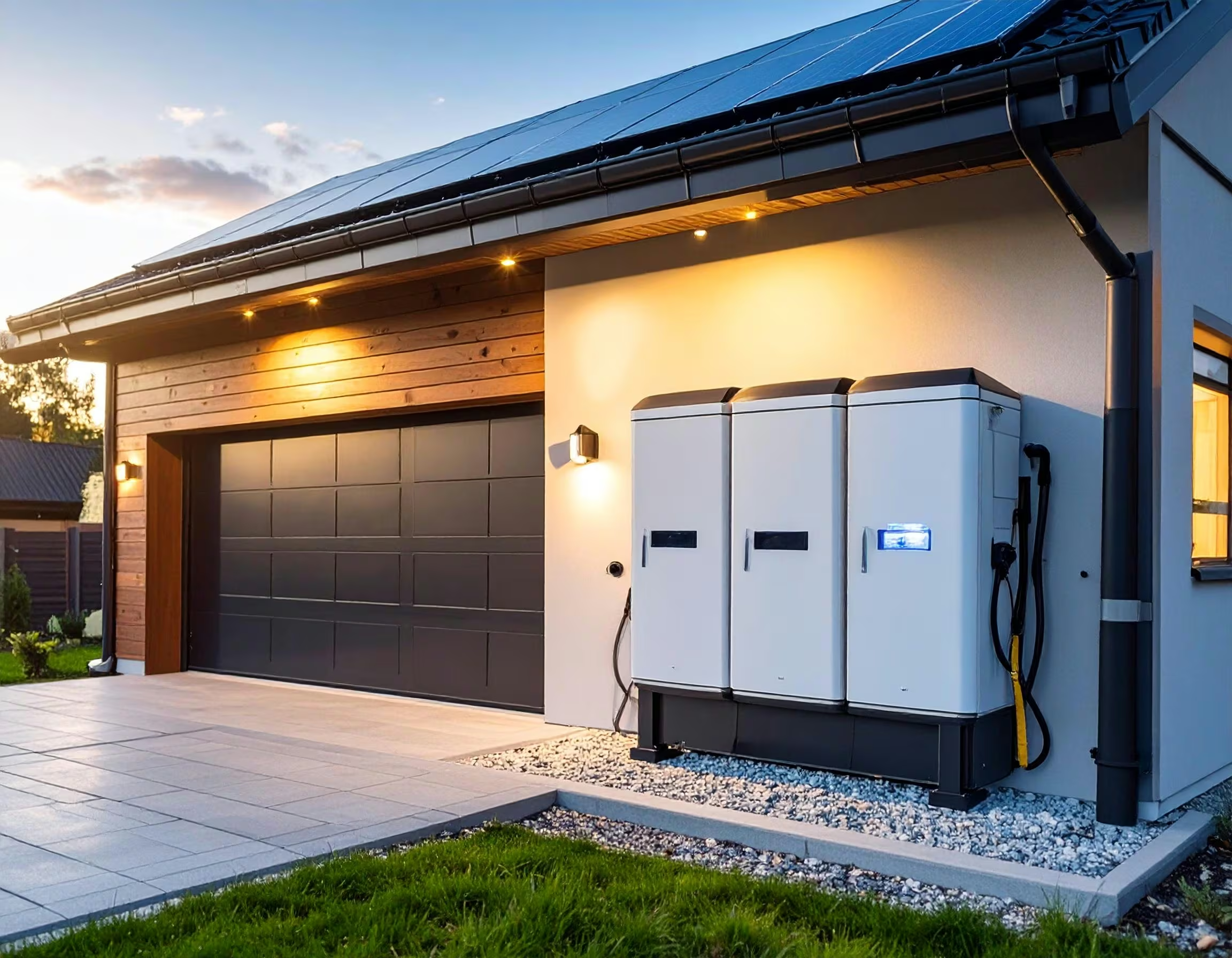
TL;DR: Solar battery storage in Johor lets your home keep its own solar power instead of sending surplus to the grid, then use it at night or during a blackout. With TNB’s tariff now favouring self-use and Johor’s fast-growing load from Iskandar and data-centre demand, a right-sized battery (usually 5–25 kWh for homes) adds backup and bigger savings on top of a solar system. Pricing is quote-based — sizing, not a fixed price list, decides the payback.
1. Why Johor homeowners are adding battery storage
Johor sits at the centre of Malaysia’s fastest-rising electricity demand. Iskandar Malaysia, the Johor–Singapore Special Economic Zone, and a wave of new data centres are pulling more load onto the grid every year. For homeowners in Johor Bahru, Iskandar Puteri, Skudai, Kulai and Pasir Gudang, two things follow: electricity is not getting cheaper, and a stable supply is worth protecting.
Solar alone already cuts your daytime bill. Adding a battery changes the maths again. Instead of exporting extra solar to the grid for a modest offset, you store it and spend it after sunset — exactly when a Johor household uses the most power, with aircon, cooking and lighting all running at once. A battery also keeps essential circuits alive when the grid drops, which matters during storm-season outages along the coast.
This guide explains how solar battery storage works in a Johor home, how to size it, what backup it really gives you, and how the economics stack up under Malaysia’s current rules. As one of Johor’s active solar EPCC providers, EDCA Energy builds these systems end to end — so the figures below reflect how real installations behave, not a brochure.
Thinking about pairing a battery with solar in Johor?
See how EDCA sizes storage for local homes on our solar battery storage service page, or watch the two-minute primer below first.
Before the numbers, here is a plain-language overview of how solar and storage fit together.
Watch: Solar & battery storage explained
A beginner-friendly walkthrough of how home solar and battery storage work together in 2026.
2. How does solar battery storage work in a Johor home?
Quick Answer: A solar battery stores the surplus power your panels make during the day so your home can use it later. When the sun sets or the grid fails, the battery discharges to run your lights, fans, fridge and other circuits — instead of buying that power back from TNB or losing supply entirely.
Your solar panels generate DC electricity in the day. An inverter turns it into AC to run the house. Whatever the house doesn’t use immediately is where the battery comes in — that surplus charges the battery rather than flowing to the grid. After dark, the flow reverses: the battery feeds stored energy back through the inverter to your circuits.
Most Johor home systems today use lithium iron phosphate (LFP) batteries. They handle Malaysia’s heat well, cycle daily for years, and are considered safer and more stable than older chemistries. A typical home setup connects three parts:
- Solar panels — the generation source, sized to your roof and daytime load.
- Hybrid inverter — manages solar, battery and grid together, and decides when to store versus draw.
- Battery pack — stores usable kWh; sizing decides how much night-time or backup cover you get.
If you are still deciding on the panel side first, our guide to home solar panels in Kuala Lumpur covers the fundamentals that apply just as well to Johor roofs.
3. Why storage makes financial sense in Johor
Quick Answer: Under TNB’s current domestic tariff, homes pay 27.03 sen/kWh up to 1,500 kWh a month and 37.03 sen/kWh above that. Johor households with aircon and pool pumps often cross into the higher band, so every unit a battery lets you self-supply after dark avoids the priciest grid electricity.
TNB’s domestic tariff, restructured from 1 July 2025, splits usage into two energy blocks. Larger Johor homes — bungalows in Iskandar Puteri, semi-Ds in Mount Austin, houses running two or three aircon units — regularly push past 1,500 kWh a month, where the rate jumps by ten sen per unit. A battery targets exactly that expensive evening and night-time consumption.
| Monthly usage | Illustrative energy charge (RM) | Est. |
|---|---|---|
| 800 kWh | ~RM216 | |
| 1,200 kWh | ~RM324 | |
| 1,500 kWh | ~RM405 | |
| 2,000 kWh | ~RM590 |
Illustrative energy-charge estimate only, using published rates of 27.03 sen/kWh (≤1,500 kWh) and 37.03 sen/kWh (>1,500 kWh); excludes AFA, capacity, network and retail components. Rates per TNB’s official tariff schedule. Actual bills vary — get a free quote for your home.
The red bar shows why heavy users benefit most: units above 1,500 kWh cost the most, and those are the units a battery is best placed to displace. In Johor’s climate, where cooling load runs late into the evening, that displaced consumption lands squarely in peak household hours.
4. How much battery storage does a Johor home need?
Quick Answer: Most Johor homes land between 5 kWh and 25 kWh of usable storage. A small terrace or apartment may only need 5–10 kWh; a large bungalow or SME shoplot with heavy aircon can justify 15–40 kWh. The right size depends on your night-time load and how much backup you want.
Battery sizing is not about buying the biggest pack — it is about matching usable capacity to the energy you actually spend after your panels stop producing. Oversize it and you pay for kWh you never cycle; undersize it and the grid still supplies your evenings. The table below shows how EDCA typically maps Johor home profiles to storage.
| Home profile | Typical daily use | Suggested usable battery | Typical solar pairing |
|---|---|---|---|
| Small terrace / apartment | 8–12 kWh | 5–10 kWh | 4–6 kWp |
| Mid-size terrace / semi-D | 15–25 kWh | 10–15 kWh | 6–10 kWp |
| Large bungalow | 30–45 kWh | 15–25 kWh | 10–15 kWp |
| SME shoplot / home office | 40–70 kWh | 20–40 kWh | 12–20 kWp |
Illustrative ranges from EDCA Energy’s Johor design experience; actual sizing follows a load study. Not a fixed specification — book a sizing assessment.
Notice the pattern: usable battery capacity tracks night-time load, and solar capacity scales alongside so the battery actually gets charged. A 25 kWh battery behind a 5 kWp roof would rarely fill in Johor’s cloudy spells — the pairing matters as much as the pack.
Not sure which tier fits your home?
EDCA runs a free load study for Johor households — request a battery sizing assessment →
5. Backup during outages: how long will a battery last?
Quick Answer: Backup time depends on how much you run, not just battery size. A 10 kWh battery can keep essential circuits (lights, fans, fridge, router) going for around 12 hours, but only about 2–3 hours if you insist on running aircon. Sizing for backup means deciding which loads you must keep alive.
Johor’s coastal areas see storm-season outages, and backup is one of the main reasons homeowners add storage. The honest answer to “how long will it last” is: it depends entirely on the load you draw. The table below models typical run-times for three usage levels.
| Usable battery | Essentials only (~0.8 kW) | Partial home (~2 kW) | With aircon (~4 kW) |
|---|---|---|---|
| 5 kWh | ~6 hrs | ~2.5 hrs | ~1.2 hrs |
| 10 kWh | ~12 hrs | ~5 hrs | ~2.5 hrs |
| 15 kWh | ~18 hrs | ~7.5 hrs | ~3.7 hrs |
| 20 kWh | ~24 hrs | ~10 hrs | ~5 hrs |
Modeled illustration (usable capacity ÷ average draw); real run-time varies with appliances and battery reserve settings. Source: EDCA Energy illustrative model.
The practical lesson is to split your circuits. Most Johor backup designs put essential loads — lighting, fans, fridge, Wi-Fi, a few sockets — on the protected side, and leave high-draw aircon on the grid side. That way a modest battery gives many hours of genuine cover instead of minutes.
6. Battery cost and payback in Johor
Quick Answer: Battery prices have fallen sharply as lithium pack costs dropped worldwide, which shortens payback compared with a few years ago. There is no fixed EDCA price — storage cost depends on capacity, inverter type and installation — but the trend has made storage far more affordable for Johor homes than it was in 2019.
The single biggest driver of battery affordability is the falling cost of lithium-ion cells. As global pack prices dropped, installed home-storage costs followed. The index below tracks that direction — it is illustrative, but the downward slope reflects a real, well-documented market trend.
| Year | Cost index (2019 = 100) | Direction |
|---|---|---|
| 2019 | 100 | Baseline |
| 2021 | 82 | ↓ falling |
| 2023 | 66 | ↓ falling |
| 2025 | 54 | ↓ falling |
| 2026 | 50 | ↓ falling |
Illustrative market-context index from EDCA Energy, informed by widely reported global declines in lithium-ion battery pack costs. Not an EDCA price list. For your figure, get a free quote.
What this means for payback: a battery that looked marginal in 2019 can pay back far faster today, especially when it displaces the 37.03 sen/kWh band and adds outage protection you would otherwise value separately. Payback still depends on your usage pattern, so treat any single number with caution — a quote based on your real bill is the only reliable guide. Homeowners comparing city by city can also read our companion guide on solar battery storage in Kuala Lumpur.
7. NEM 3.0, Solar ATAP and how storage fits the rules
Quick Answer: Malaysia’s rooftop solar runs under SEDA-administered schemes such as NEM 3.0 and Solar ATAP, which credit exported energy against your bill. A battery does not replace these schemes — it complements them by letting you self-use more solar instead of exporting it, which is often worth more than the export credit.
SEDA administers Malaysia’s net energy metering programmes, and you must apply through a SEDA-registered installer. Solar ATAP keeps a one-for-one energy offset, so surplus units you export are credited against your bill. That is genuinely useful — but export credit is only ever worth the value of a unit sold back, while self-using that same unit avoids buying at the full retail rate, including the higher tariff band.
That is the strategic role of a battery in Johor:
- Without a battery, evening load comes from the grid and daytime surplus is exported for a credit.
- With a battery, daytime surplus is stored and spent in the evening, cutting the units you buy at peak household hours.
- For backup, the battery adds outage cover that net metering alone cannot give — NEM systems without storage shut down in a blackout for safety.
Check current scheme details with SEDA Malaysia before you commit, as quotas and terms are updated periodically. A registered EPCC partner handles the application, metering and TNB coordination for you.
8. Choosing a solar battery installer in Johor
Quick Answer: Pick a SEDA-registered EPCC provider that designs the whole system — panels, hybrid inverter and battery — as one, offers a proper load study rather than an off-the-shelf pack, and handles NEM/TNB paperwork. Local Johor experience and a track record of completed installs matter more than the lowest headline price.
Battery storage is only as good as the design behind it. A mismatched inverter, an oversized pack, or a backup panel wired without load separation all waste money. When you compare installers in Johor Bahru, Iskandar Puteri or Kulai, look for a few concrete things:
- Accreditation. SEDA-registered RPVSP status and Suruhanjaya Tenaga compliance are non-negotiable.
- Whole-system design. One team sizing solar, inverter and battery together — not a battery bolted onto someone else’s array.
- Load study. A real assessment of your bill and circuits, so the quote fits your home rather than a template.
- Track record. Completed local projects and clear warranty and maintenance terms.
EDCA Energy is a SEDA-registered solar EPCC provider with 150+ completed projects and 80+ MWp installed, working across residential, commercial and industrial systems. If you want a broader view of how to vet providers, our rundown of the best solar panel company in Malaysia walks through the same checks in more detail, and the full solar battery storage service page shows what an EDCA install includes.
9. Conclusion
Solar battery storage in Johor does two jobs at once: it deepens your solar savings by shifting cheap daytime power into expensive evening hours, and it keeps your home running when the grid drops. With TNB’s tariff rewarding self-use and Johor’s demand climbing, storage has moved from a luxury to a sensible next step for many homes — especially larger households that cross into the higher tariff band.
The right system is a sizing decision, not a shopping decision. Match usable capacity to your evening load, pair it with enough solar to refill daily, protect the circuits that matter for backup, and let a SEDA-registered EPCC handle the rules. Do that, and the battery earns its place on your Johor roof.
10. Frequently asked questions
Is solar battery storage worth it for a Johor home?
For homes with high evening usage or frequent outages, yes. A battery targets the most expensive units on your TNB bill and adds backup that solar alone cannot provide. Smaller, low-usage homes may see a longer payback, so a load study is the best way to decide.
How much does solar battery storage cost in Johor?
There is no fixed price — cost depends on usable capacity, inverter type and installation complexity. Falling lithium prices have made storage far more affordable than in 2019. The reliable way to get a figure is a quote based on your actual bill and roof.
Can a solar battery power my whole house during a blackout?
Usually not for long if you include aircon. Most Johor backup designs protect essential circuits — lights, fans, fridge, Wi-Fi — which a 10 kWh battery can run for around 12 hours. Powering aircon draws the battery down in a few hours instead.
Do I still need NEM 3.0 if I have a battery in Johor?
They work together. NEM 3.0 / Solar ATAP credits exported energy, while a battery lets you self-use more solar instead of exporting it. A battery also adds outage backup, which net metering systems without storage cannot offer.
How long do solar batteries last in Johor’s climate?
Modern lithium iron phosphate batteries are built for daily cycling and handle Malaysia’s heat well, with typical service lives in the region of 12 to 15 years depending on use and cooling. Warranty terms vary by product, so confirm them with your installer.
Ready to add battery storage to your Johor home?
EDCA Energy designs and installs complete solar-plus-storage systems across Johor — sized to your bill, built for Johor’s climate, and handled end to end from load study to TNB coordination.
Get a Free QuoteSee your solar savings in under a minute
Estimate your ideal system size, payback period and monthly bill offset with the EDCA calculator.