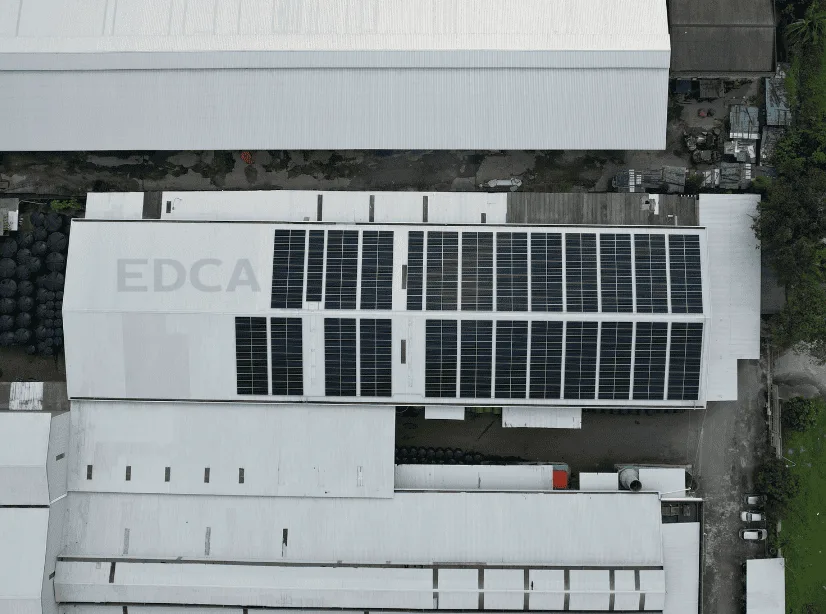
TL;DR: Solar for business in Malaysia works by generating power on your own roof during working hours, so you buy less electricity from TNB at the exact moment your bill is highest. After the RP4 tariff restructuring in July 2025, daytime energy and peak-demand charges hit commercial users harder, which makes a well-sized rooftop system pay back faster than before. You can go zero-upfront (SELCO/SARE), own the system for maximum return, or claim tax relief through GITA. This guide shows where the savings come from, what a realistic payback looks like, and how to pick the right scheme.
Every commercial electricity bill in Peninsular Malaysia now reads differently. Since 1 July 2025, TNB has split the old blended tariff into separate energy, capacity, network and retail charges under Regulatory Period 4. For a shop, office, warehouse or factory that runs mostly in daylight, that change quietly rewards anyone who can shave both the kilowatt-hours used and the afternoon peak demand.
That is exactly what rooftop solar does. This is a practical savings guide for business owners weighing up solar for business in Malaysia — not a sales pitch. We cover how the numbers actually stack up, the three ways to fund a system, the incentives on the table, and the checks worth doing before you sign anything.
The clip below shows how one large Malaysian retail operator has approached commercial solar at scale.
Watch: how a Malaysian business goes solar
AEON Malls Malaysia on adopting rooftop and large-scale solar across its retail operations.
Source: AEON Malls Malaysia’s commitment to sustainability through solar energy (YouTube).
1. What does “solar for business” actually mean in Malaysia?
Quick Answer: Solar for business in Malaysia means installing photovoltaic panels on your roof or land so your premises use that power first during working hours. You buy less from TNB when your demand — and your tariff — is at its highest, which is where the savings come from.
The mechanics of solar for business are simple. Panels produce DC electricity when the sun is up. An inverter turns it into AC and feeds your building’s loads first. Because factories, offices, shops and warehouses run in the daytime, most of that power is used on site straight away. This “self-consumption” is the main source of savings — you are replacing grid electricity you would otherwise pay full tariff for.
When your system makes more than you use at that moment, the surplus can be exported to the grid for credit under the current export scheme, or simply matched to your usage under a self-consumption model. For a fuller primer on the technology and grid rules, our guide to commercial solar power in Malaysia breaks it down step by step, and our commercial solar installation service page covers how a project is delivered end to end.
Not sure if your roof and load profile suit solar?
A quick feasibility review tells you what’s possible before you commit. See how commercial solar installation works →
Key takeaway: The value of business solar is timing — you cut grid purchases during the exact daytime hours when both your usage and your tariff peak.
2. Where your business electricity bill actually goes
Quick Answer: Under the RP4 tariff, a commercial bill is split into energy, network, capacity and retail charges, plus a fuel adjustment. Solar attacks the two biggest slices — the per-kWh energy charge and, if it lowers your afternoon peak, the capacity charge.
Malaysia’s electricity tariff for commercial and industrial customers was restructured on 1 July 2025 into four separate components, replacing the old blended rate and the ICPT surcharge, per the TNB tariff structure. Understanding the split matters, because solar for business does not touch every part of the bill equally. The table below shows an illustrative breakdown for a typical Medium Voltage commercial account.
| Bill component | Charged on | Illustrative share | What solar does |
|---|---|---|---|
| Energy charge | Per kWh used | ~55% | Cut directly by self-consumption |
| Network charge | Per kW | ~20% | Largely fixed |
| Capacity charge | Per kW of peak demand | ~18% | Trimmed if solar lowers daytime peak |
| Fuel adjustment (AFA) | Per kWh, variable | ~5% | Falls with lower kWh |
| Retail charge | Per account | ~2% | Fixed |
Illustrative shares for a Medium Voltage commercial account under the RP4 structure; the actual split varies by site and load. Component structure per TNB.
The lesson is that around three-quarters of a commercial bill sits in charges solar can influence. A system sized to your daytime load chips away at the energy charge continuously, and a well-designed one can also flatten the peak that drives your capacity charge. Sites with large, unshaded roofs get the most out of this — our guide to commercial rooftop solar in Malaysia covers how roof type affects the outcome.
Key takeaway: Solar targets the energy and capacity charges — the largest, most controllable parts of a post-RP4 commercial bill.
3. How much can a business really save with solar?
Quick Answer: Savings scale with how much of your generation you use on site. Larger systems on high-daytime-load premises tend to pay back within roughly three to five years, then keep producing for 20-plus years. The exact figure depends on your roof, tariff category and usage pattern, so it should always come from a proper feasibility study.
Payback on solar for business is really a question of self-consumption. A business that runs hard from morning to evening uses almost everything its panels make, so nearly every solar kilowatt-hour displaces a grid one. The illustrative ladder below shows how indicative annual savings and payback shift with system size — treat it as a shape, not a quote.
| System size | Typical site | Relative annual offset | Illustrative payback |
|---|---|---|---|
| 30 kWp | Shoplot / office | ~4–5 years | |
| 100 kWp | SME warehouse | ~3.5–4.5 years | |
| 300 kWp | Factory | ~3–4 years | |
| 1,000 kWp | Large plant | ~3–4 years |
Illustrative scenario modelled on typical daytime-load offset for Malaysian commercial sites. Bars show relative annual bill offset, not absolute Ringgit. Not a quote — actual results depend on roof, load and tariff.
Two things move these numbers most: the share of power you use directly, and how much your system trims your recorded peak demand. Both are site-specific, which is why any credible installer will model your real load before quoting. EDCA Energy, with 150+ commercial and industrial projects and more than 80 MWp installed, sizes systems to the load profile rather than the roof area alone.
Want a savings estimate built on your actual bill?
Share a recent TNB bill and we’ll model the offset for your site. Get a free quote →
Key takeaway: Payback for business solar clusters around three to five years when self-consumption is high — but only a site-specific study gives a real figure.
4. Which solar scheme fits your business?
Quick Answer: Malaysian businesses have three main routes — a zero-upfront self-consumption model (SELCO via a SARE agreement), an ownership model that exports surplus for credit (Solar ATAP, the NEM successor), or full ownership paired with a tax allowance (GITA). The best fit depends on your cash position and how much surplus your roof can export.
There is no single “right” way to fund solar for business; it comes down to whether you want to preserve capital or maximise long-term return. The table compares the three at a glance.
| Model | Upfront cost | How you save | Best for |
|---|---|---|---|
| SELCO / SARE (zero-CAPEX) | None | Pay for solar power used, below grid tariff | Firms wanting savings with no capital outlay |
| Solar ATAP (NEM successor) | You fund / own the system | Offset usage plus export credits for surplus | Sites with export headroom |
| Self-owned + GITA | Full capital cost | Keep all savings, plus a tax allowance | Profitable firms chasing best long-term ROI |
Scheme details per SEDA Malaysia (Solar ATAP) and TNBX (SARE).
Under SARE, the investor owns and maintains the system while TNB (through TNBX) handles billing, so you pay only for the clean power you consume at a rate below the grid tariff, per TNBX. Ownership models cost more upfront but hand you every Ringgit of saving for decades. Choosing well also means choosing the right partner — our rundown of the best solar panel company in Malaysia explains what separates a solid EPCC provider from a cheap quote, and you can see EDCA’s full scope on the EDCA Energy homepage.
Key takeaway: Preserve cash with SELCO/SARE, or own the system for the biggest lifetime return — the right pick follows your balance sheet, not the other way round.
5. Solar incentives for Malaysian businesses
Quick Answer: The headline incentive for businesses that own their system is the Green Investment Tax Allowance (GITA), which gives a 60% allowance on qualifying solar spending, set off against up to 70% of statutory income. Export credits under the NEM/Solar ATAP framework add further value for eligible sites.
Two government levers make owning solar for business more attractive:
- Green Investment Tax Allowance (GITA). Companies get a 60% investment tax allowance on qualifying capital spending on solar assets, offset against up to 70% of statutory income per year, per the Malaysian Investment Development Authority. Since January 2024, solar own-consumption applications are handled by MGTC rather than MIDA.
- Export credits. Under the net energy metering framework and its Solar ATAP successor, surplus solar can earn credits on your bill, as administered by SEDA Malaysia. NEM 3.0 closed to new applications at the end of June 2025, with Solar ATAP continuing the programme.
Incentive rules and windows change, so confirm current eligibility before you budget. The GITA framework, for instance, runs on a defined timeline and is worth checking against your own capex plans. A good installer will factor the applicable incentives into your feasibility study rather than leaving you to chase them — something we build into every commercial solar installation.
Key takeaway: If you own your system, GITA can return a large share of the cost as tax relief — but check current rules, because incentive windows shift.
6. Malaysia’s solar growth — and why it matters to you
Quick Answer: Malaysia’s installed solar capacity has climbed past 5.7 GW, and national policy targets 70% renewable capacity by 2050. For businesses, that momentum means maturing supply chains, more financing options and rising expectations from customers and supply-chain partners on carbon.
The country added more than 1.4 GW of solar in 2025, pushing cumulative capacity past 5.7 GW across the large-scale, net-metering and feed-in-tariff programmes, per IEA-PVPS. Under the National Energy Transition Roadmap, Malaysia targets 40% renewable capacity by 2035 and 70% by 2050, as tracked by SEDA Malaysia.
| Year | Approx. cumulative solar PV (GW) | Trend |
|---|---|---|
| 2022 | ~1.9 | |
| 2023 | ~2.6 | |
| 2024 | ~4.3 | |
| 2025 | ~5.7 |
Approximate figures, compiled from SEDA and IEA-PVPS public reporting; intermediate years rounded for market context. The 2025 figure reflects the reported ~1.4 GW added that year.
For a business, this trend is more than background. As bigger buyers and multinational supply chains ask suppliers to show lower-carbon operations, solar for business becomes a commercial credential, not just a cost saving. Getting in while incentives and grid access remain open is easier than catching up later.
Thinking about where solar fits in your 2026 plan?
We’ll map a phased rollout to your budget and roof. Get a free quote →
Key takeaway: Solar is now mainstream infrastructure in Malaysia — installing early locks in savings and gives your business a genuine sustainability credential.
7. What to check before you install
Quick Answer: Before committing, check that your roof can carry the load and has the lifespan, that your daytime usage is high enough to absorb the generation, and that your installer is a properly accredited EPCC provider with real project history and after-sales support.
A few checks separate solar for business that performs from a system that disappoints:
- Roof condition and age. Panels last 25-plus years, so the roof underneath should have a matching remaining lifespan and enough structural capacity.
- Daytime load. The more you consume while the sun shines, the faster the payback — night-heavy operations benefit less without storage.
- Accreditation. Look for a SEDA-registered installer with the right certifications; EDCA Energy is a SEDA-registered RPVSP and a TNB partner, with myHijau, ST and CIDB credentials.
- Track record and warranties. Ask about installed capacity, similar projects and what the workmanship and performance warranties actually cover.
Get these right and the rest of the project — design, approvals, installation, commissioning — follows smoothly. Our guide to commercial rooftop solar in Malaysia goes deeper on roof suitability, and you can start a project directly through our commercial solar installation service.
Key takeaway: A performing system starts with a sound roof, high daytime load and an accredited EPCC partner — verify all three before you sign.
8. Conclusion
Solar for business in Malaysia has moved from “nice to have” to a straightforward financial decision. The RP4 tariff rewards cutting daytime energy and peak demand, incentives like GITA soften the cost of ownership, and flexible models such as SELCO let cash-conscious firms start with no upfront spend. The catch is that every good outcome rests on the same foundation — a system sized to your real load, installed by an accredited partner, on a roof that can carry it for decades.
The smartest first step is not choosing a panel brand; it is getting an honest feasibility study on your own building. From there, the numbers speak for themselves.
9. Frequently asked questions
Is solar worth it for a small business in Malaysia?
Yes, if your premises use most of their electricity during daylight hours. A small shoplot or office with steady daytime load can typically expect payback in roughly four to five years on an owned system, or immediate savings with no upfront cost under a SELCO/SARE model. The key factor is self-consumption, not just system size.
How long does a commercial solar system last?
Quality solar panels are built to produce for 25 years or more, with inverters usually replaced once during that life. Because the payback period is far shorter than the lifespan, most of the system’s output over its life is effectively free electricity — which is what makes solar for business in Malaysia so attractive.
Do I need to pay upfront for business solar?
No. Under a zero-CAPEX model such as SELCO through a SARE agreement, an investor funds and maintains the system, and you simply pay for the clean power you use at a rate below the grid tariff. Ownership models cost more upfront but keep every Ringgit of saving for you.
What incentives can Malaysian businesses claim for solar?
The main incentive is the Green Investment Tax Allowance (GITA), a 60% allowance on qualifying solar capital spending offset against up to 70% of statutory income. Eligible sites can also earn export credits under the net energy metering and Solar ATAP framework. Rules change, so confirm current eligibility before budgeting.
How do I know what size system my business needs?
System size should follow your load profile, not just your roof area. An installer reviews your recent TNB bills and daytime usage pattern, then sizes the system so most generation is used on site. This is why a proper feasibility study matters more than a quick quote based on roof size alone.
Ready to see what solar could save your business?
Send us a recent electricity bill and EDCA Energy will model the savings, payback and best scheme for your site — no obligation. We’re a SEDA-registered RPVSP with 150+ commercial and industrial projects delivered.
Get a Free QuoteSee your solar savings in under a minute
Estimate your ideal system size, payback period and monthly bill offset with the EDCA calculator.