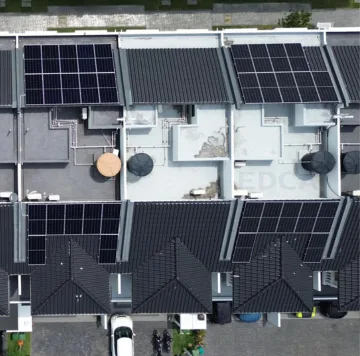
TL;DR: The solar installation cost in Malaysia is the full turnkey price of getting a system on your roof and running, not just the panels. As illustrative market context, most homes land around RM3,000–4,500 per kWp installed, so a typical 6–8 kWp home system sits in the RM18,000–36,000 band. Hardware is the biggest slice, but labour, mounting, wiring and SEDA/TNB registration all sit inside the number. Because every roof differs, honest pricing is quote-based after a site survey.
When people ask about the solar installation cost in Malaysia, they usually picture the price of the panels. That is only part of it. Installation cost is the whole job, the hardware, the labour to mount and wire it safely, the paperwork to connect it to the grid, and the after-sales cover. Miss those parts and a cheap-looking quote can quietly cost you more later.
This guide breaks down where your money actually goes in a solar installation, what a system costs by size, what pushes the price up or down, and what you get back at today’s tariffs. Every ringgit figure here is illustrative market context, because EDCA Energy prices each home solar panel installation after a proper site survey. First, a short video on how installers build up a solar price.
Watch: how installers build a solar price
A UK cost guide from My Home Improvements. Useful for seeing the cost structure — the Malaysian ringgit figures are below.
Source: My Home Improvements on YouTube — How much do solar panels cost? UK Cost Guide
1. What goes into a solar installation cost in Malaysia?
Quick Answer: A solar installation cost in Malaysia bundles four things: the hardware (panels and inverter), the balance-of-system parts (mounting, cabling, protection), the labour to install and commission it, and the soft costs of SEDA and TNB registration. Hardware is the largest slice at roughly half the total, but the other three still make up a real part of the price.
The panel price you see advertised is not the installed price. A finished, safe, grid-connected system needs several parts working together, and each one carries a cost. Knowing the split helps you read a quote and spot when something important has been left out to make the headline look cheaper.
| Cost component | Illustrative share | Relative size | What it pays for |
|---|---|---|---|
| Solar panels | ~40% | The modules that generate power | |
| Inverter | ~15% | Converts DC to usable AC power | |
| Mounting & cabling | ~15% | Rails, brackets, wiring, protection | |
| Labour & commissioning | ~20% | Install, testing, safe switch-on | |
| Registration & metering | ~10% | SEDA and TNB paperwork, meter |
Illustrative cost split modelled by EDCA Energy from typical residential projects; actual EDCA pricing is quote-based after a site survey.
Notice that non-panel items add up to roughly 60% of the job. That is why comparing quotes on panel brand alone misleads you. The pure hardware “how much” side lives in our solar panel cost guide, while the logic behind how installers build a number is in the solar panel pricing explainer.
Want your installation cost itemised properly? Share your last few TNB bills and we will size a system and quote every line. See how home solar installation works →
Key takeaway: An installation cost is hardware plus mounting, labour and registration. Panels are only about 40% of the job, so judge a quote on the whole system, not the panel badge.
2. How much does solar installation cost by system size?
Quick Answer: As illustrative market context, home solar installation in Malaysia runs about RM3,000–4,500 per kWp installed. That puts a small 4 kWp system near RM13,000–18,000, a common 6 kWp system near RM19,000–27,000, and a larger 10 kWp system near RM32,000–45,000. Your real figure depends on roof, hardware tier and how you finance it.
System size is the biggest single lever on the total, and it should be set by your electricity use, not a round number. The illustrative ladder below shows how installed cost scales with size, so you can sanity-check where a quote sits before you dig into the detail.
| System size | Illustrative installed cost | Suits a home with |
|---|---|---|
| 4 kWp | ~RM13,000–18,000 | Bill around RM250–400/month |
| 6 kWp | ~RM19,000–27,000 | Bill around RM400–600/month |
| 8 kWp | ~RM25,000–36,000 | Bill around RM600–850/month |
| 10 kWp | ~RM32,000–45,000 | Bill around RM850–1,100/month |
Illustrative size-to-cost ranges modelled by EDCA Energy for planning only; not a quote. Actual pricing depends on roof and hardware.
Bigger is not automatically better. A system sized well above your usage costs more upfront and exports cheap surplus, while an undersized one leaves you buying grid power at the new tariff. Right-sizing against your bills is the job of a good solar panel company before any number is quoted. For a fuller ringgit breakdown by size, see our companion solar panel installation cost guide.
Key takeaway: Installed cost scales with kWp, roughly RM3,000–4,500 per kWp. Size the system to your actual bill, not to a headline figure, so you neither overspend nor under-cover.
3. What drives your solar installation cost up or down?
Quick Answer: Two homes of the same size can pay different solar installation costs because of roof type, roof height, hardware tier, and whether battery storage is added. A simple single-storey metal roof is cheapest to work on; tiled or double-storey roofs, premium hardware and added batteries all raise the price, while a straightforward roof and standard kit lower it.
Once size is fixed, these factors explain most of the gap between quotes. None of them are hidden tricks, they are real cost differences in the work, so it helps to know which apply to your home before comparing prices.
| Factor | Lowers cost | Raises cost |
|---|---|---|
| Roof material | Metal / IBR roof | Clay tile or concrete tile |
| Roof height | Single storey | Double or triple storey (more scaffolding) |
| Hardware tier | Standard panels, string inverter | High-efficiency panels, hybrid inverter |
| Battery storage | None (grid-tied only) | Battery added for backup |
| Roof condition | Sound, ready to mount | Repairs or reinforcement first |
Illustrative cost-driver directions compiled by EDCA Energy; the actual effect of each factor is confirmed at site survey.
The single biggest optional add is battery storage. It raises the upfront installation cost noticeably but buys backup during outages and more self-use of your own power, which matters more now that grid power is dearer. Whether it pays off depends on your usage pattern, so treat it as a separate decision, not a default.
Key takeaway: Roof type, roof height, hardware tier and batteries explain most price gaps between same-size quotes. Know which apply to your home before you judge one quote against another.
4. What do you get back for the installation cost?
Quick Answer: A solar installation cost in Malaysia usually pays itself back in roughly 5–8 years through lower TNB bills, then delivers largely free power for the rest of a 25-year panel life. The July 2025 tariff rise made each unit your panels replace worth more, so today’s system pays back faster than one bought a few years ago.
Cost only makes sense next to return. The value of solar rose when grid power got dearer: TNB’s domestic base tariff moved to 45.4 sen/kWh from July 2025, about 13.6% up from 39.95 sen. The illustrative table below shows how a system’s cost turns into savings and payback across common sizes.
| System size | Illustrative cost | Est. yearly saving | Simple payback |
|---|---|---|---|
| 4 kWp | ~RM15,000 | ~RM2,400 | ~6–7 years |
| 6 kWp | ~RM22,000 | ~RM3,600 | ~6 years |
| 8 kWp | ~RM30,000 | ~RM4,800 | ~6 years |
| 10 kWp | ~RM38,000 | ~RM6,000 | ~6–7 years |
Illustrative savings and payback modelled by EDCA Energy at prevailing tariffs and typical self-consumption; not a guaranteed result. Your figures are quote-based.
Payback is stable for new installs too, because the export side is now structured: Solar ATAP began on 1 January 2026 with no quota limit and SEDA as the implementing agency. After payback, the same system keeps cutting bills for many more years, which is the real return on the installation cost.
Want your own payback worked out? We will model savings against your actual bill and roof, then quote the install. Get a free quote and savings estimate →
Key takeaway: Judge the installation cost by its payback, typically 5–8 years, then years of largely free power. Higher tariffs since July 2025 shorten payback, not lengthen it.
5. How to keep your solar installation cost fair
Quick Answer: To keep a solar installation cost fair, get an itemised quote in RM per kWp, confirm SEDA and TNB registration sit inside the price, compare quotes within the same hardware tier, and use a SEDA-registered installer. A slightly higher price from an accredited provider usually costs less across the system’s 25-year life.
A fair price is a complete price, not just the lowest one. Run every quote through the same short checklist before you decide, so you compare like with like and nothing important is missing.
- Ask for RM per kWp. Divide the total by system size so every quote sits on one scale.
- Check registration is included. SEDA and TNB paperwork should be inside the price, not billed later.
- Match the hardware tier. Compare standard with standard, premium with premium, never across tiers.
- Confirm accreditation. A SEDA-registered installer protects your grid connection and warranty claims.
- Read the warranty. Check panel, inverter and workmanship cover, and who you call when something trips.
Clarity in the quote is itself a sign of a serious installer. If you want to compare providers properly, our guide on choosing the best solar panel company in Malaysia walks through what to check, and a proper home solar panel installation should tick every box above.
Key takeaway: Normalise every quote to RM per kWp, confirm registration and warranty are included, and stay within one hardware tier. The cheapest headline rarely wins over 25 years.
6. Conclusion
Quick Answer: The solar installation cost in Malaysia is best understood as a full turnkey job, hardware, labour and registration together, priced per kWp and sized to your bill. Most homes sit around RM3,000–4,500 per kWp and pay back in 5–8 years. A site survey turns that market context into a real, honest price.
The honest answer to “what does solar installation cost in Malaysia?” is that it depends on choices you can now see clearly, system size, roof, hardware tier and whether you add storage. Read a quote through those lenses and you will spot the cheap-but-incomplete traps and the worth-it options with equal ease.
The smartest next step is a proper site survey, so your price reflects your actual roof, bill and goals rather than a national average.
Get an honest, itemised solar installation cost for your roof.
EDCA Energy is a SEDA-registered solar EPCC provider. We size your system, handle the TNB and SEDA paperwork, and give you a clear, itemised installation price with no hidden line items.
Get a Free Quote →7. Frequently asked questions
How much does solar installation cost in Malaysia?
As illustrative market context, home solar installation runs about RM3,000–4,500 per kWp installed. A common 6 kWp home system therefore sits near RM19,000–27,000, and a larger 10 kWp system near RM32,000–45,000. Your real figure depends on roof, hardware tier and financing, so honest pricing is always quote-based after a site survey.
What is included in a solar installation cost?
A full installation cost covers the panels, the inverter, the mounting and cabling, the labour to install and commission the system, and the SEDA and TNB registration and metering. Panels are only about 40% of the total, so a quote that lists only panel price is incomplete. Ask for every line to be itemised.
Why do two solar quotes for the same size differ?
Same-size quotes differ because of roof material, roof height, hardware tier and whether battery storage is added. A single-storey metal roof with standard hardware is cheapest to install; a tiled double-storey roof, premium panels or an added battery all raise the cost. Convert each quote to RM per kWp and compare within one tier.
How long does a solar installation take to pay back?
Most home systems pay back in roughly 5–8 years through lower TNB bills, then deliver largely free power for the rest of a 25-year panel life. The July 2025 tariff rise made each replaced unit worth more, so today’s installation pays back faster than one bought a few years ago. All figures are illustrative and quote-based.
Does the installation cost include SEDA and TNB registration?
With a proper installer it should. Registration and metering are part of getting your system safely grid-connected, so they belong inside the quoted price rather than as a surprise extra. Always confirm this in writing. If a quote leaves registration out, the low headline is misleading because that work still has to be paid for.
See your solar savings in under a minute
Estimate your ideal system size, payback period and monthly bill offset with the EDCA calculator.