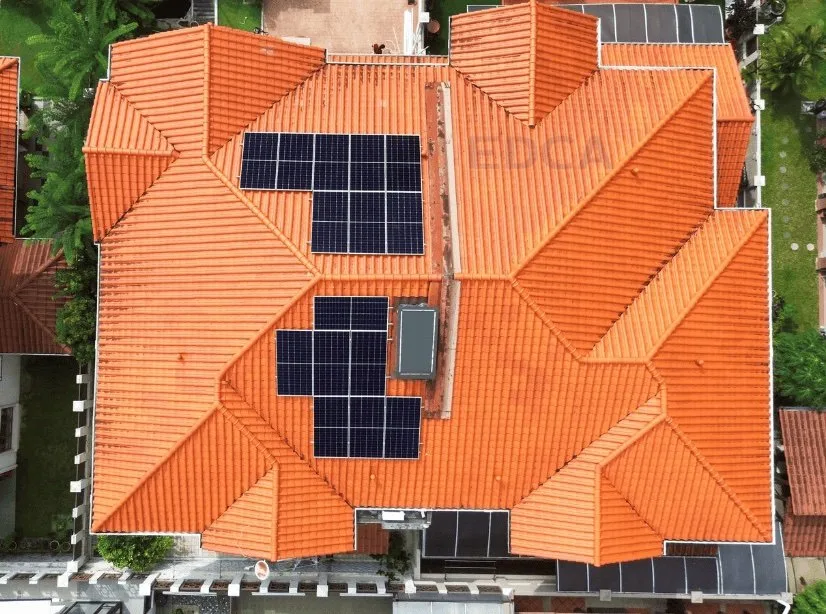
Electricity bills in Malaysia keep climbing, and a rooftop full of panels looks like an easy fix. But most homeowners still aren’t sure what a residential solar system actually is, what sits inside it, or how the numbers really work once TNB and SEDA are involved.
This guide explains the whole thing in plain terms: the parts, how they connect to the grid under NEM 3.0, what size your home needs, and the savings you can realistically expect. It’s a companion to our home solar panel installation service, so you’ll understand the system before you ever ask for a quote. Let’s start with a quick video that shows how sunlight becomes usable power.
Watch: how solar panels turn sunlight into electricity
A short, beginner-friendly explainer of the science behind every rooftop system.
Source: History of Simple Things — “From Sunlight to Power: How Solar Panels Work”
1. What is a residential solar system?
Quick Answer: A residential solar system is a rooftop photovoltaic (PV) setup on a home that converts sunlight into electricity for the household and connects to the TNB grid. It powers your appliances during the day and exports surplus energy for bill credits, cutting your reliance on grid power.
In everyday terms, it’s a grid-connected power plant on your roof. Sunlight hits the panels, an inverter converts that energy into the alternating current your home already uses, and whatever you don’t use flows back to the grid. There’s no separate meter to read or generator to refuel — the system runs quietly in the background while you go about your day.
Almost all Malaysian homes use a grid-tied system (connected to TNB, no battery required) rather than an off-grid one. Grid-tied is cheaper and simpler because the grid acts as your “virtual battery” through net metering. If you’re weighing solar for the first time, our residential installation service and the wider EDCA Energy team handle the design, paperwork and grid connection end to end.
A quick site check confirms your roof orientation, shading and usable space before you commit. Get a free quote and site assessment →
2. What parts make up a residential solar system?
Quick Answer: A home solar system has six core parts: solar panels, an inverter, mounting and racking, protective wiring, a bi-directional NEM meter, and a monitoring app. Battery storage is an optional add-on. Together they capture sunlight, convert it, deliver it safely, and track your import and export.
Each part does one job, and the quality of each affects how much power you keep over 25 years. Panels and the inverter are the two components worth spending on — they carry the longest warranties and do the heaviest lifting. Here’s how the pieces fit together and roughly how they split a typical system’s cost.
| Component | What it does | Illustrative cost share |
|---|---|---|
| Solar panels (PV modules) | Convert sunlight into DC electricity | ~40–50% |
| Inverter | Converts DC into the AC your home uses | ~15–20% |
| Mounting & racking | Secures panels firmly to the roof | ~10% |
| Wiring, isolators & protection | Connects everything safely and to code | ~10% |
| Bi-directional NEM meter | Records energy imported and exported | Installed by TNB |
| Monitoring system | Tracks generation and faults via an app | ~5% |
| Battery storage (optional) | Stores surplus for night-time use | Add-on |
Illustrative cost split for a typical Malaysian grid-tied home system; actual proportions vary by roof, brand and system size. EDCA pricing is quote-based — figures shown are market context only.
Because panels and the inverter decide long-term output, the brand and warranty behind them matter more than the sticker price. For a deeper look at panel choices for houses, see our guide on solar panels for the home in Malaysia.
3. How does a home solar system work with NEM 3.0?
Quick Answer: Under NEM 3.0, your home uses solar power first, and any surplus is exported to TNB and credited against your bill at a one-to-one rate. A bi-directional meter tracks both flows, and unused export credits roll over to the next month, so the grid acts like a free battery.
The scheme rewards self-consumption. Every unit you use the moment your panels make it is a unit you don’t buy from TNB at the retail tariff. Export credits help, but they’re the bonus, not the main event — which is why matching system size to your daytime usage matters so much.
Here’s the flow in practice:
- Daytime, low usage: panels cover the house and push surplus to the grid, earning a 1:1 credit.
- Daytime, high usage: panels feed appliances directly; you draw little or nothing from TNB.
- Night: with no sun, you draw from the grid and spend the credits you banked earlier.
The residential programme sits under SEDA’s NEM 3.0 framework, administered with TNB. Quotas are limited and get taken up quickly, so timing your application matters. For the panel-level detail behind this, read our 2026 guide to residential solar panels in Malaysia.
4. What size solar system does a Malaysian home need?
Quick Answer: Most Malaysian homes need a system between 3 kWp and 12 kWp, sized to their monthly TNB bill and available roof space. A rough rule: the higher your daytime usage and bill, the larger the system that pays back well. Your roof area and NEM cap set the ceiling.
Start from your bill, not from a package. A home paying RM250 a month has a very different sweet spot to one paying RM800. The chart below maps typical bills to a sensible system size, panel count and roof space so you can place yourself on the ladder before an engineer visits.
| Monthly TNB bill | System size & relative scale | Approx. panels | Roof space |
|---|---|---|---|
| RM150–250 | 3 kWp |
~7 | ~18 m² |
| RM250–400 | 4–5 kWp |
~10 | ~28 m² |
| RM400–600 | 6–8 kWp |
~15 | ~42 m² |
| RM600–1,000 | 8–12 kWp |
~22 | ~60 m² |
Illustrative sizing for planning only; final design depends on your roof, shading and NEM cap (residential Tariff A is capped at 12 kW single-phase or 75% of approved load, whichever is lower). EDCA sizing is confirmed by site survey and quote.
Roof orientation and shading can shift these numbers, which is why a real design always beats a rule of thumb. Our step-by-step home solar installation guide walks through how sizing is confirmed on site.
5. How much can a residential solar system save?
Quick Answer: Savings depend on system size and how much power you use during daylight. Malaysia gets roughly 3.7–4 peak sun hours a day, so a well-designed home system can offset a large share of a typical bill. Bigger systems with high daytime use save the most per month.
The table below models the daily generation and monthly bill offset you might expect at each system size. Treat these as planning ranges — your real result swings with weather, appliance timing and how much you shift usage into daylight hours.
| System size | Est. daily generation | Est. monthly bill offset |
|---|---|---|
| 3 kWp | ~11 kWh/day | ~RM120–180 |
| 5 kWp | ~19 kWh/day | ~RM200–320 |
| 8 kWp | ~30 kWh/day | ~RM350–520 |
| 12 kWp | ~45 kWh/day | ~RM520–800 |
Modelled projection based on ~3.7–4 peak sun hours in Malaysia and typical self-consumption; not a guaranteed result. Your exact saving is confirmed only by a bill analysis and quote.
Notice the offset isn’t linear with size — the more of your own power you consume live, the better every kilowatt-hour performs. That’s the single biggest lever a homeowner controls.
Send us a recent TNB bill and we’ll model your real offset and payback. Request a free savings estimate →
6. How fast is home solar adoption growing in Malaysia?
Quick Answer: Home solar has grown quickly under NEM Rakyat. The residential net-metering quota of 350 MW was fully subscribed by September 2024, with 306.07 MW already approved, after a rebate scheme pushed daily applications sharply higher. Demand is now outpacing quota releases.
The timeline below tracks how residential quota filled up — a useful signal that solar has moved from early-adopter novelty to mainstream household upgrade in just a few years.
| When | Milestone | Residential quota status |
|---|---|---|
| 2021 | NEM Rakyat opens for households | Quota allocated |
| Nov 2023 | Initial quota filled, extensions added | 150 MW filled |
| Apr 2024 | SolaRIS rebate (up to RM4,000) launched | Applications rise |
| Sep 2024 | Residential quota fully subscribed | 350 MW (306.07 MW approved) |
Aggregated from SEDA and pv magazine’s September 2024 report. Quotas are periodically refreshed by SEDA; check current availability before applying.
The 350 MW residential quota being fully taken up tells you two things: solar’s payback is now convincing enough for ordinary households, and quota can run out — so working with an established installer who tracks releases matters. If you’re comparing providers, our guide to the best solar panel company in Malaysia lays out what to look for.
7. How do you get a residential solar system installed?
Quick Answer: Getting home solar installed follows a set sequence: site assessment, system design and quote, SEDA NEM application, TNB approval, installation, then TNB inspection and meter change. The full process typically takes about 6 to 12 weeks from application to a live system.
You don’t manage most of this yourself — a registered installer handles the applications and paperwork. Knowing the order still helps you set expectations and spot delays.
- Site assessment. The installer checks roof condition, orientation, shading and your usage to confirm feasibility.
- Design and quote. You receive a system size, layout, output estimate and a fixed quote.
- SEDA NEM application. The installer submits for quota under NEM Rakyat on your behalf.
- TNB connection approval. TNB reviews and approves the grid connection.
- Installation. Panels, inverter and wiring are fitted, usually in one to three days.
- Inspection and meter change. TNB inspects and swaps in the bi-directional meter, and your system goes live.
Choosing a SEDA-registered installer (EDCA is a registered RPVSP) keeps every step compliant and warranty-backed. You can start the whole process from our home solar installation page, and the detailed installation walkthrough covers what happens on the day.
8. Conclusion
A residential solar system isn’t complicated once you break it down: panels and an inverter turn sunlight into home electricity, NEM 3.0 lets you offset your bill with any surplus, and the right size comes from your own usage and roof. The savings are real, the technology is proven, and adoption across Malaysia shows households have already done the maths.
The one thing a guide can’t do is design your system — that needs your bill and your roof. When you’re ready, EDCA Energy handles the sizing, the SEDA and TNB paperwork, and the install from start to finish.
Ready to see what solar could do for your home?
Get a free, no-obligation quote and savings estimate tailored to your TNB bill and roof.
Get a Free Quote9. Frequently asked questions
Do I need a battery for a home solar system in Malaysia?
No. Most Malaysian homes run grid-tied systems without a battery, because NEM 3.0 lets the grid store your surplus as bill credits. A battery is an optional add-on for backup power or higher night-time self-use, not a requirement to start saving.
How long does a residential solar system last?
Solar panels typically carry performance warranties of 25 years or more, while inverters usually last 10 to 15 years before replacement. With basic cleaning and monitoring, a well-installed home system keeps producing for decades.
Will solar cover my whole electricity bill?
Rarely 100%, but a well-sized system can offset a large share of it. How much depends on your system size and how much power you use during daylight, when the panels are generating. Night-time use still draws from the grid.
Is my roof suitable for solar?
Most pitched and flat Malaysian roofs work. What matters is usable unshaded area, roof condition and orientation. A site assessment confirms suitability and how many panels will fit before you commit to anything.
How much does a residential solar system cost in Malaysia?
Cost depends on system size, roof type and components, so pricing is quote-based rather than fixed. The clearest way to know your figure is a bill analysis and site survey — request a free quote to get an exact number for your home.
See your solar savings in under a minute
Estimate your ideal system size, payback period and monthly bill offset with the EDCA calculator.