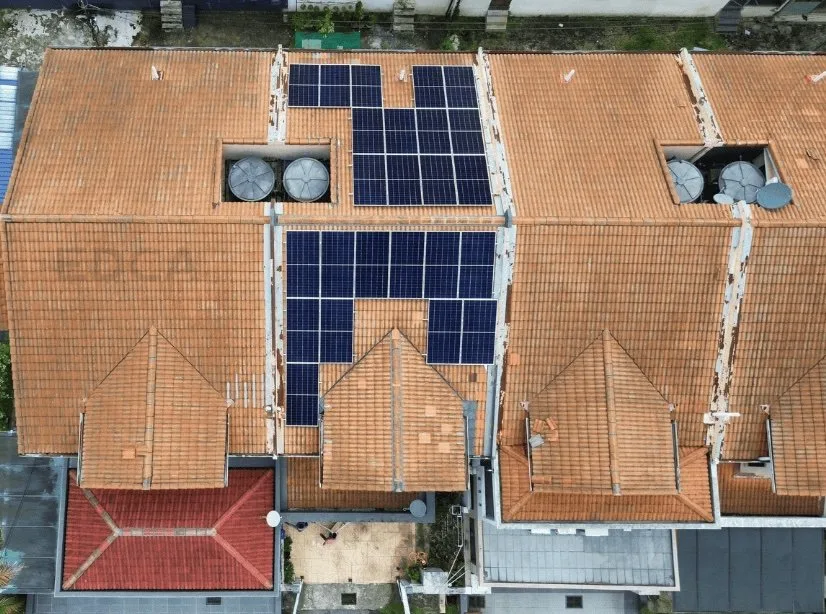
When people picture solar, they picture the roof-work day: panels going up in the sun. That day is real, but it is a small slice of the whole job. Most of the work happens before and after the installers ever climb a ladder — in surveys, drawings, and applications to SEDA and TNB.
This guide walks through the whole process in plain terms, so you know what to expect at each stage and how long it takes. It sits alongside our home solar panel installation service — read this first to understand the journey, then ask us for a quote. To start, here is a short video on how a solar panel turns sunlight into power.
Watch: how solar panels turn sunlight into electricity
A quick, beginner-friendly explainer of the science behind the panels you are about to install.
Source: History of Simple Things — “From Sunlight to Power: How Solar Panels Work”
1. What does a residential solar panel installation involve?
Quick Answer: A residential solar panel installation is the full process of putting a grid-connected solar system on your home — from the first site survey and system design, through SEDA and TNB approval, to mounting the panels, wiring the inverter, and switching on. The roof work is only one day or two of a six-to-ten-week project.
It helps to see the installation as a project with a start and an end, not a single event. A good installer manages five things for you: the site survey, the engineering design, the regulatory applications, the physical build, and the final connection to the grid. Skip or rush any one of them and the system either fails inspection or underperforms for years.
If you are still weighing up whether solar suits your home at all, start with our beginner overview of solar panels for your home. This guide assumes you have decided to go ahead and want to know exactly how the installation unfolds.
A free site check confirms your roof, layout and TNB supply before anything is ordered. See our home solar installation service →
2. How long does a residential solar panel installation take?
Quick Answer: Most residential solar panel installations in Malaysia take six to ten weeks from signing to switch-on. The physical work on the roof is only one to three days. The bulk of the calendar time goes to the SEDA net-metering application, TNB approval, and the utility meter change-over — stages you wait on rather than watch.
This is the single most useful thing to understand before you start: the timeline is dominated by approvals, not by labour. Homeowners often expect a week; the reality is closer to two months, mostly spent waiting for the grid paperwork to clear. The chart below breaks a typical project into its six stages.
| Stage | Typical duration | Relative calendar time |
|---|---|---|
| Consultation & site survey | 1–3 days | ~2 days |
| System design & proposal | 3–7 days | ~5 days |
| SEDA application & TNB approval | 3–6 weeks | ~5 weeks |
| Physical installation | 1–3 days | ~2 days |
| Testing & commissioning | 1–2 days | ~1 day |
| Meter change-over & switch-on | 1–3 weeks | ~2 weeks |
Illustrative market timeline for planning; actual durations vary by roof, system size and approval queue. Bars show relative calendar time, not working hours.
The lesson is to be patient with the approval stages and demanding about the build. A step-by-step view of what you personally need to do at each stage is covered in our companion guide on home solar installation.
3. What actually happens on installation day?
Quick Answer: On installation day, a crew arrives in the morning, sets up safety gear, fixes the mounting rails and roof anchors, lifts and clamps the panels, then wires the inverter and connects the DC and AC sides. For an average home system the whole job is done in a single day, ending with a functional test before the crew leaves.
Installation day is the visible, satisfying part. For a typical home system it runs from morning to late afternoon. Bigger arrays or awkward roofs stretch into a second day. Here is how a standard single-day install usually flows.
| Time | Activity | What is happening |
|---|---|---|
| 8–9am | Setup & safety | Scaffolding or harness lines, tool staging, roof inspection |
| 9–11am | Mounting rails | Roof anchors and aluminium rails fixed and levelled |
| 11am–1pm | Panels fixed | Modules lifted, clamped to rails, string cabling routed |
| 2–4pm | Inverter & wiring | Inverter mounted; DC and AC wiring run to the board |
| 4–5pm | Connect & test | System energised, output checked, handover walk-through |
Illustrative schedule for a typical home system; larger arrays, tiled roofs or wet weather can extend the work into a second day.
Note that “energised” on install day does not always mean “exporting to the grid”. Your system can often power the home the same day, but full net-metering only begins after the meter change-over. The hardware behind all of this is explained in our guide to residential solar panels in Malaysia.
4. What happens before the installers arrive?
Quick Answer: Before installation day, your installer surveys the roof, designs the system to match your TNB bill, and submits the net-metering application to SEDA plus a connection request to TNB. These pre-work stages decide whether the install goes smoothly — a rushed survey or a weak design causes most on-site problems.
The quiet weeks before the crew arrives are where a professional installer earns their fee. Three things get done, and the order matters.
- Site survey. An engineer measures your usable roof, checks orientation and shading, inspects the roof structure and your TNB distribution board, and confirms whether your supply is single- or three-phase.
- System design. Your array size is set from your actual electricity bill and daytime usage, then laid out to fit the roof. This is where panel count, inverter size and string layout are locked in.
- Applications. The installer files the net-metering application with SEDA and a connection request with TNB. Approval must land before the meter can be changed.
Because this stage sets everything downstream, the quality of your installer matters more here than anywhere else. Our guide to the best solar panel company in Malaysia explains how to tell a thorough installer from a box-shifter. A registered player such as EDCA Energy, a SEDA-registered RPVSP, handles the SEDA and TNB paperwork on your behalf so nothing stalls.
5. What affects how long your installation takes?
Quick Answer: Roof type, system size, your electrical supply, roof condition, and the approval queue all move the timeline. A small system on a sound pitched metal roof with single-phase supply installs fastest; a large array on a tiled or flat roof needing a supply upgrade or roof repair takes longest.
No two homes install on the same schedule. If you want to know why one neighbour was switched on in six weeks and another waited three months, it usually comes down to the five factors below.
| Factor | Faster | Slower |
|---|---|---|
| Roof type | Pitched metal roof | Clay-tile or flat concrete roof |
| System size | Small (around 4 kWp) | Large (12 kWp and above) |
| Electrical supply | Single-phase, adequate board | Three-phase or board upgrade needed |
| Roof condition | Sound, no repairs | Needs waterproofing or repair first |
| Approval queue | Quota open, quiet period | Quota busy, application backlog |
Illustrative comparison for planning; your installer confirms which factors apply after the site survey.
Most of these are known after the site survey, so a good installer will give you a realistic date range rather than a hopeful one. Sizing your system correctly also affects the timeline, which is why matching the array to your bill — covered in our guide to residential solar panels — is worth getting right the first time.
We flag any roof, supply or approval issues at the survey stage, before you commit. Get a free quote and timeline estimate →
6. How many Malaysian homes are installing solar?
Quick Answer: Residential solar has moved from niche to mainstream in Malaysia. The household net-metering quota (NEM Rakyat) has filled repeatedly since 2021 and needed several extensions, showing strong and steady demand. For homeowners, the practical point is that quota can run out — so applying early matters.
You are not an early adopter any more. Home solar has become a normal upgrade, and the clearest proof is how fast the government’s residential net-metering quota keeps getting used up. The table below tracks the NEM Rakyat scheme’s take-up.
| Milestone | Residential quota subscribed | Relative level |
|---|---|---|
| 2021 — NEM Rakyat opens | Scheme launched | start |
| Nov 2023 — first quota filled | ~150 MW | ~150 MW |
| Sep 2024 — fully subscribed | 350 MW (306 MW approved) | 350 MW |
Figures per pv magazine, reporting SEDA data (Sept 2024): 350 MW residential quota fully subscribed, 306 MW approved; initial 150 MW filled by Nov 2023.
Demand was strong enough that the government also launched the Solar for Rakyat (SolaRIS) rebate of up to RM 4,000 for household installs, which pushed daily applications higher still. The takeaway for you is simple: schemes and quotas change, so the best time to lock in your residential solar panel installation is when a quota is open.
7. How to prepare your home for installation
Quick Answer: To prepare for a residential solar panel installation, gather a year of TNB bills, clear roof access, confirm your roof is in good condition, and keep someone home on install day. A little preparation lets the survey and the build run without avoidable delays.
You do not need to do much, but a few simple steps make the whole installation smoother for everyone.
- Collect your electricity bills. Twelve months of TNB bills let the installer size the system to your real usage, not a guess.
- Clear roof and board access. Trim overhanging branches and clear the space around your distribution board so the crew can work safely.
- Check your roof’s condition. If the roof is old or leaking, repair it before panels go up — retrofitting later is costly.
- Confirm the paperwork. Make sure your name matches the TNB account holder, as the net-metering application relies on it.
- Be available on the day. Someone should be home to give roof access and take the handover walk-through.
Do these and there is little left for you to manage — a full-service installer handles the rest, from design to the SEDA and TNB submissions through to switch-on.
8. Conclusion
A residential solar panel installation is best understood as a six-stage project. The survey and design set it up, the SEDA and TNB approvals set the pace, the roof work takes a day or two, and the meter change-over switches you into net metering. Knowing that sequence turns a confusing wait into a predictable plan — and helps you judge whether a contractor is being straight with you.
The one thing a guide cannot do is match this process to your actual roof, bill and TNB supply. That needs a site survey and a proper design. When you are ready, EDCA Energy manages the whole job from first survey to switch-on, including all the SEDA and TNB paperwork.
Ready to start your home solar installation?
Get a free, no-obligation quote with a clear timeline and a system sized to your TNB bill.
Get a Free Quote9. Frequently asked questions
How long does a residential solar panel installation take in Malaysia?
Most installations take six to ten weeks from signing to switch-on. The physical roof work is only one to three days; the rest is the SEDA net-metering application, TNB approval, and the utility meter change-over, which you wait on rather than watch.
Do I need approval to install solar panels on my house?
Yes. To connect a grid-tied home system and use net metering, your installer submits an application to SEDA and a connection request to TNB. Only after approval and the meter change-over does your system start exporting excess power to the grid.
How long does the roof installation itself take?
For an average home system, the on-roof work is done in a single day — mounting, panels, inverter and wiring, ending with a functional test. Larger arrays or tiled and flat roofs can stretch into a second day.
Can I install solar panels myself?
For a grid-connected home system, no. Net metering requires a registered installer to file the SEDA and TNB paperwork, and the electrical connection must be done by a qualified professional to be safe and compliant. DIY forfeits both the approval and the warranty support.
How much does a residential solar panel installation cost?
Cost depends on system size, roof type and your electrical supply, so pricing is quote-based rather than fixed. The clearest way to get your figure is a bill analysis and site survey — request a free quote for an exact number for your home.
See your solar savings in under a minute
Estimate your ideal system size, payback period and monthly bill offset with the EDCA calculator.