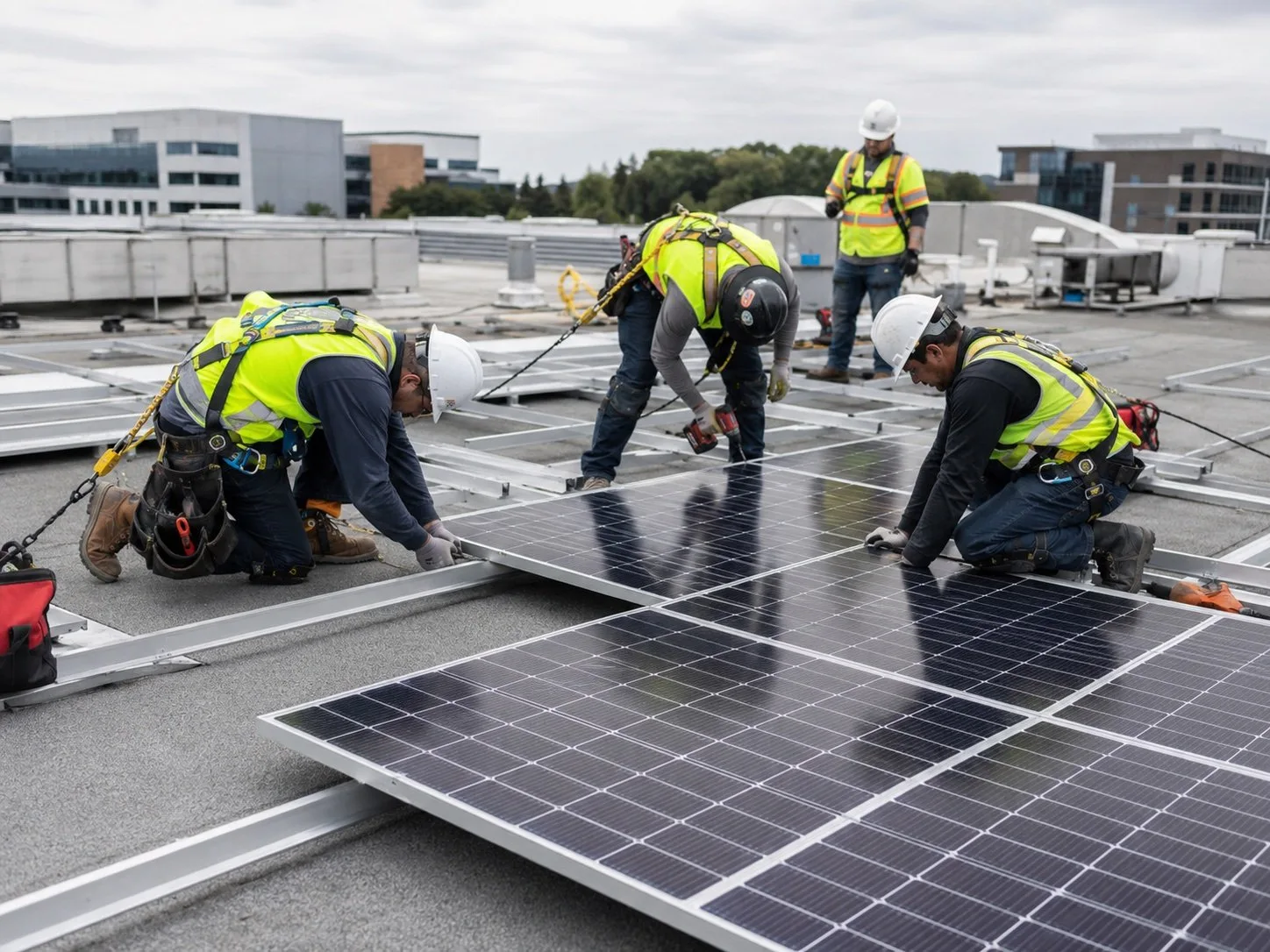
TL;DR: Commercial solar power lets a Malaysian business generate its own electricity from rooftop panels and shave the daytime portion of its TNB bill. Under NEM 3.0’s NOVA programme, commercial and industrial users self-consume their solar output and export the excess to the grid, while Green Investment Tax Allowance (GITA) improves the payback. This guide walks through how commercial solar power works, what size system a business needs, the schemes that fund it, and the returns to expect.
Electricity is one of the few running costs a Malaysian business can actually cut without cutting output. Between the base TNB tariff and the fuel-cost surcharge that moves with global energy prices, a factory, warehouse or shoplot can watch its monthly bill climb for reasons that have nothing to do with how it runs. That is why so many owners are now looking up at their own rooftops.
This guide is written for the people who sign those bills: SME owners, factory and warehouse operators, retail and F&B chains, and property managers weighing up whether commercial solar power is worth it. We will keep it practical and Malaysian — real schemes, real sizing logic, and honest numbers. If you would rather talk specifics for your own building, EDCA Energy runs a commercial solar installation service and offers a free assessment. First, though, here is a short overview before we get into the detail.
Watch: commercial solar in action on Malaysian rooftops
A look at how a large Malaysian retail operator moved to rooftop solar across its sites.
Source: AEON Malls Malaysia’s commitment to sustainability through solar energy (YouTube, 15 April 2025).
2. What is commercial solar power, and how does it work?
Quick Answer: Commercial solar power means a solar photovoltaic (PV) system installed on a business premises to generate electricity during daylight hours. The building uses that power first, so it draws less from the grid. Any surplus is exported. It is a grid-tied setup, not an off-grid one, so the business keeps its TNB supply for nights and cloudy spells.
The mechanics are simple. Panels on the roof turn sunlight into direct current. An inverter converts that into the alternating current your machines, lights and air-conditioning already use. Because a business runs hardest in daylight — exactly when the sun is up — most of that solar energy is consumed on site, directly reducing what you buy from the grid.
Three things separate a commercial system from a home one:
- Scale. Commercial roofs carry far more panels, so systems run from tens of kilowatts to well over a megawatt.
- Load match. A business’s daytime demand lines up neatly with solar output, so self-consumption is high.
- Scheme and tax treatment. Commercial users sit under the NOVA arm of NEM 3.0 and can claim green tax allowances a household cannot.
EDCA Energy is a SEDA-registered RPVSP (Registered Photovoltaic Service Provider) and a TNB partner, with more than 150 projects and 80-plus MWp installed. If you want to see how providers differ before you commit, our guide on commercial solar panel companies in Malaysia is a useful next read, and the broader EDCA Energy site covers the full solutions range.
Key takeaway: Commercial solar power is a grid-tied rooftop system that lets a business self-consume most of its own generation during working hours, cutting daytime grid draw while keeping TNB as backup.
Not sure if your roof is a good fit?
A quick site check tells you fast. Explore EDCA’s commercial solar installation options →
3. What size commercial solar system does your business need?
Quick Answer: System size is driven by your daytime electricity use and your available roof area, not by a fixed rule. A good installer sizes the system so that most of the output is self-consumed during working hours, which gives the best return under NEM 3.0. The bands below are for orientation only — a proper energy audit sets the real number.
The single biggest sizing input is your load profile: how much power you draw, and when. A business that runs machines all day suits a bigger system than a 9-to-5 office of the same floor area. Roof strength, orientation and shading then cap what actually fits. The table gives a feel for how commercial solar power scales across common Malaysian business types.
| Business type | Typical daytime pattern | Indicative system band |
|---|---|---|
| Shoplot, office, small retail | Steady light load, lighting + aircon | 30–100 kWp |
| Supermarket, showroom, clinic | High cooling + refrigeration load | 100–300 kWp |
| Light manufacturing, cold storage | Continuous daytime machinery | 300 kWp–1 MWp |
| Factory, warehouse, large plant | Heavy, sustained industrial load | 1 MWp and above |
Illustrative sizing bands based on EDCA project experience across Malaysian commercial and industrial sites. Every system is sized to the actual bill and roof — figures are for orientation, not a quote.
Notice the pattern: the heavier and more continuous the daytime load, the larger the viable system. That is also why commercial rooftops often justify solar more easily than homes — the energy is used the moment it is made. For a deeper look at picking the right partner for a system this size, see our guide to the best solar panel company in Malaysia.
Key takeaway: Size follows your daytime load and roof, not floor area alone. The best-returning commercial solar power systems are the ones sized so nearly all output is used on site.
4. NEM 3.0, NOVA and green incentives explained
Quick Answer: Commercial and industrial businesses join solar through the NOVA (Net Offset Virtual Aggregation) arm of NEM 3.0, administered by SEDA. NOVA is built around self-consumption, with surplus energy exported at a market-based rate. On top of that, businesses can claim the Green Investment Tax Allowance (GITA) on qualifying solar assets, which shortens the payback.
Malaysia’s rooftop solar sits under Net Energy Metering (NEM) 3.0, which SEDA splits into three streams. Knowing which one you fall under matters, because it decides how your exported energy is valued.
| Programme | Who it is for | How surplus / benefit works |
|---|---|---|
| NEM Rakyat | Residential homeowners | One-to-one net energy metering credit |
| NEM GoMEn | Government ministries and entities | Net metering for public buildings |
| NEM NOVA | Commercial & industrial users | Self-consume first, export surplus at market/system marginal price |
| GITA (tax route) | Businesses investing in solar assets | Tax allowance on qualifying green capital expenditure |
Sources: SEDA Malaysia, NEM 3.0; MIDA, Green Technology incentives.
Two points do most of the work for a commercial buyer. First, the NEM NOVA programme allocates a large quota specifically for commercial and industrial systems and lets you export unused solar at a market-based rate rather than wasting it. Second, under the green incentive rules, renewable-energy assets can qualify for a Green Investment Tax Allowance of 100% of the qualifying capital spend, set off against 70% of statutory income over five years, per MIDA’s green technology incentive. Quotas and application windows change, so confirm current status before you plan a commercial solar system for your premises.
Key takeaway: Commercial users go through NEM NOVA — designed around self-consumption plus market-priced export — and can stack GITA tax relief on top, which is what makes commercial solar power pencil out.
5. What financial returns can commercial solar power deliver?
Quick Answer: The return comes mainly from avoided grid purchases, so the bigger and steadier your daytime bill, the faster the payback. Panels typically carry 25-plus-year performance warranties, so once the system pays for itself, the remaining years are largely free energy. The illustrative ranges below show how payback tends to shorten as monthly spend rises — your real figure needs a quote.
Because a business self-consumes most of its solar output, every kilowatt-hour generated at midday is one you did not buy from TNB at the commercial tariff. Larger bills mean more expensive grid energy to displace, which is why payback usually gets shorter as consumption climbs. The chart shows the pattern, not a promise.
| Monthly bill band | Illustrative payback | Relative speed |
|---|---|---|
| RM 3,000–5,000 | ~6–7 years | |
| RM 5,000–15,000 | ~5–6 years | |
| RM 15,000–50,000 | ~4–5 years | |
| RM 50,000 and above | ~3.5–4.5 years |
Illustrative modelled scenario based on typical NEM self-consumption savings and GITA relief. Actual payback depends on your tariff, roof, usage and financing — get a free quote for a figure specific to your site.
Payback is only half the story. After it, the system keeps producing for the balance of its warrantied life, and it hedges you against future tariff and surcharge rises — a saving that grows as grid prices do. To pressure-test any provider’s numbers, compare quotes carefully; our piece on commercial solar panel companies in Malaysia covers what to check.
Key takeaway: Commercial solar power pays back faster the larger and steadier the daytime bill, then delivers years of low-cost energy and a hedge against rising tariffs. Treat any single payback figure as illustrative until it is quoted for your building.
Want the real payback for your building?
Share your last bill and roof size, and we will model it. Get a free quote →
6. Where Malaysia’s energy transition is heading
Quick Answer: Malaysia’s National Energy Transition Roadmap (NETR) sets a rising share of renewable energy in the national capacity mix — targeting 31% by 2025, 40% by 2035 and 70% by 2050. For businesses, that direction of travel means more support for rooftop solar and a growing expectation that companies show real emissions action.
Commercial solar is not just a private cost decision anymore; it sits inside a national plan. The NETR lays out how the country intends to shift its grid over the coming decades, and rooftop solar on commercial and industrial buildings is one of the fastest levers to pull.
| Year | RE capacity target | Share |
|---|---|---|
| 2025 | 31% | |
| 2035 | 40% | |
| 2050 | 70% |
Source: MIDA — renewable energy capacity targeted at 70% by 2050, drawn from the National Energy Transition Roadmap.
For a business, the practical read is straightforward: a rising renewable share means solar-friendly policy is likely to continue, and buyers, landlords and lenders increasingly ask about emissions. Installing commercial solar power now positions a company ahead of that curve rather than scrambling later.
Key takeaway: National policy is pointed firmly toward renewables — 70% capacity by 2050 — so commercial solar is a move with the grain of Malaysia’s energy direction, not against it.
7. How a commercial solar installation actually happens
Quick Answer: A commercial solar project follows a clear path: energy assessment, system design, scheme and utility applications, installation, and commissioning. A registered EPCC provider handles the SEDA and TNB paperwork for you, so the business mostly signs off at each stage rather than chasing approvals itself.
Knowing the steps helps you judge whether a provider is thorough or cutting corners. A proper commercial solar installation runs roughly like this:
- Energy audit and site survey. The provider studies your bills and load profile, then checks roof structure, orientation and shading.
- System design and proposal. You get a sized system, a production estimate, and an illustrative payback for your building.
- Scheme and utility applications. The EPCC lodges the NEM/NOVA application with SEDA and coordinates the TNB connection approval.
- Installation. Mounting, panels, inverters and wiring are installed to the design, with safety and structural sign-offs.
- Testing and commissioning. The system is inspected, connected, and switched on, with monitoring set up so you can track output.
Because a registered provider like EDCA manages the SEDA and TNB steps end to end, the business avoids the regulatory legwork. If you are still shortlisting installers, our guide to the best solar panel company in Malaysia lays out the checks that matter for a project this size.
Key takeaway: A commercial solar project moves through audit, design, approvals, installation and commissioning — and a registered EPCC handles the SEDA and TNB paperwork so the business simply approves each stage.
8. Conclusion: is commercial solar power right for your business?
Quick Answer: If your business runs a meaningful daytime electricity load and has usable roof space, commercial solar power is very likely worth a proper assessment. The schemes, the tax relief and the policy direction all point the same way. The only reliable way to know your numbers is a site-specific quote.
Commercial solar power in Malaysia has moved from a nice-to-have to a straightforward cost decision. You self-consume most of what you generate, export the rest under NEM NOVA, claim GITA relief on the asset, and lock in a hedge against rising tariffs — all while meeting the emissions expectations that customers and lenders now bring. The businesses that benefit most are the ones with steady daytime demand and roof to spare.
The next step is simple: get your load profile and roof assessed by a registered provider so the payback stops being illustrative and becomes a real figure for your site.
9. Frequently asked questions
What counts as commercial solar power?
Commercial solar power is a rooftop or ground-mounted PV system installed on a business premises — a shop, office, showroom, factory or warehouse — to generate electricity the business uses itself. It is grid-tied, so TNB supply continues for nights and cloudy periods, and it falls under the commercial NOVA stream of NEM 3.0.
Does commercial solar power need a battery?
Usually not. Because a business consumes most of its solar output during working hours, a grid-tied system without batteries already captures the bulk of the savings. Batteries can be added where a site needs backup or wants to store surplus, but they are an option, not a requirement, for most commercial solar power projects.
How long does a commercial solar installation take?
The physical installation is often a matter of weeks, but the full timeline depends on system size and the SEDA and TNB approval process. A registered EPCC provider manages those applications, which keeps the project moving and removes the paperwork burden from the business.
Can a business claim tax benefits for solar?
Yes. Qualifying solar assets can attract the Green Investment Tax Allowance (GITA), which offsets a share of the capital spend against statutory income over five years. Because incentive rules and windows change, confirm current eligibility with MIDA or your provider before you plan the investment.
How much does commercial solar power cost in Malaysia?
There is no single price — it depends on system size, roof type, equipment and financing. Rather than a fixed figure, a proper quote models your bill and roof to show the investment and expected payback. Reputable providers give this assessment free, so you can compare options before committing.
Ready to see what commercial solar power could save your business?
EDCA Energy is a SEDA-registered RPVSP and TNB partner with 150+ projects and 80+ MWp installed across Malaysia. Share your bill and roof, and we will model your system, incentives and payback — no cost, no obligation.
Get a Free QuoteSee your solar savings in under a minute
Estimate your ideal system size, payback period and monthly bill offset with the EDCA calculator.