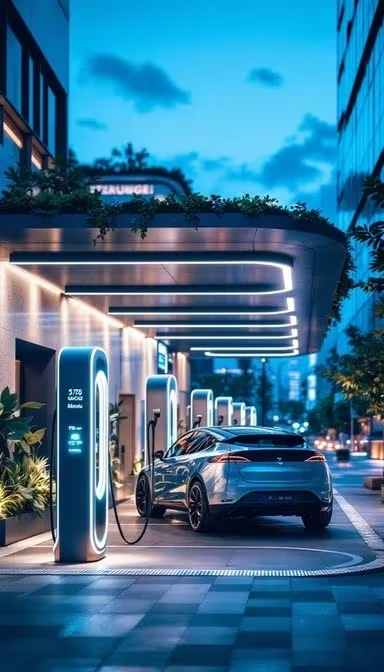
TL;DR: An EV home charger installation is not a plug-and-play job — it is a dedicated electrical circuit run safely from your distribution board to a wallbox at your parking bay. A proper install covers a site check, the charger unit, protected cabling, isolation devices, testing, and certification by a competent electrical team. Most Malaysian homes use a 7.4kW single-phase AC wallbox that charges overnight. What differs between homes is the cable run, board capacity, and supply phase — which is why EDCA Energy assesses your site before quoting rather than quoting blind.
Owning an electric vehicle changes where you “refuel” — the driveway replaces the petrol station. But getting reliable power to that driveway takes more than an extension cord. A safe EV home charger installation means a dedicated circuit, the right protection, and work signed off by someone qualified to do it. Skip any of that and you risk nuisance tripping at best, and a real safety hazard at worst.
This guide walks you through what a home EV charger installation actually involves in Malaysia — what happens on the job, what you need in place first, how single-phase and three-phase setups differ, the steps from enquiry to switch-on, and how to choose an installer you can trust. It complements EDCA Energy’s EV charger installation service rather than repeating it, and pairs well with our home car charging station overview if you are still weighing your options.
Before the detail, here is a short primer on the EV charging levels — because the level you choose is the first thing that shapes how your home install is done.
EV charging levels explained: Level 1, Level 2 and DC fast charging
A quick walkthrough of the three charging levels and why the one you choose shapes both charging speed and how your home installation is wired.
Video: “Level 1 vs. Level 2 vs. DC Fast Charging Explained For EVs”. Watch on YouTube.
1. What does a home EV charger installation involve?
Quick Answer: A home EV charger installation has five real parts: a site assessment, the charger (wallbox) unit, a dedicated protected cable run from your board to the parking bay, isolation and earth-leakage protection, and testing plus certification. The wallbox is the visible bit, but the electrical work behind it is what makes the install safe and compliant.
People often picture an EV home charger installation as bolting a box to the wall. The box is real, but it is the smaller half of the job. The bigger half is delivering safe, dedicated power to it and proving that power is protected. That is why a good installer talks about your board and cable run before they talk about the charger.
Here is what a proper home installation is actually made up of:
| Part of the job | What it covers | Why it matters |
|---|---|---|
| Site assessment | Checking your board, supply, and parking spot | Sets the true scope and price |
| Charger unit | The wallbox — power rating, smart features, cable type | Decides charging speed and features |
| Dedicated cabling | A protected run from the board to the bay, in conduit | Carries the load safely, no sharing |
| Protection devices | Dedicated MCB/RCBO and earth-leakage protection | Prevents shock and fire risk |
| Testing & certification | Commissioning, testing, and sign-off | Confirms the install is compliant and safe |
Source: EDCA Energy EV charger installation experience, Malaysia. Scope varies by site.
Seen this way, the job makes sense. The cost and effort sit in the electrical work, not the plastic box — which is also why quotes differ between homes. If you want to understand how those parts translate into a price, our EV charger installation cost guide breaks it down further.
Key takeaway: A home EV charger installation is a dedicated electrical circuit with its own protection and certification — the wallbox is just the visible endpoint of a properly engineered job.
Not sure what your home actually needs?
A site check turns guesswork into a clear scope. Explore EDCA’s EV charger installation options to see what a compliant home setup looks like.
2. What you need in place before installation
Quick Answer: Before a home EV charger installation, you need three things sorted: enough spare capacity on your distribution board, a suitable parking spot with a clear cabling path, and the right electrical supply for the charger you want. For strata homes and condos, you also need management or JMB approval before any work begins. A site assessment confirms all of this.
A smooth install starts with a few basics being ready. None are hard to arrange, but each one can stall the job if missed. Here is the checklist a competent installer runs through:
| Requirement | Why it matters | Who handles it |
|---|---|---|
| Board capacity | A free way and headroom for a dedicated circuit | Installer confirms; may upgrade |
| Parking & cable path | A fixed bay and a route for the cable run | Homeowner + installer |
| Supply phase | Single-phase suits most; 22kW needs three-phase | Installer assesses; TNB if upgrading |
| Strata / JMB approval | Consent for condos and gated communities | Homeowner secures |
Source: EDCA Energy, Malaysia. Requirements vary between landed and strata properties.
If you live in a landed home, the first three points usually cover you. If you are in a condo or gated development, add management approval to the top of the list — arranging it early avoids the most common delay. A full EV charger installation assessment checks every item here before any cable is pulled.
Key takeaway: Board capacity, a fixed parking bay with a clear cable path, the right supply, and (for strata homes) management approval are the four things to line up before installation day.
3. Single-phase or three-phase: matching the charger to your home
Quick Answer: Most Malaysian homes run on single-phase supply, and a 7.4kW single-phase wallbox charges a typical EV fully overnight. A 11–22kW three-phase charger only makes sense if you already have three-phase supply and genuinely need faster top-ups. Choosing the right one is the biggest decision in a home EV charger installation, because it sets both the wiring and any supply upgrade.
The single-versus-three-phase choice sounds technical, but for a home it comes down to how much power you can draw and how fast you actually need to charge. Here is how the two compare:
| Factor | Single-phase | Three-phase |
|---|---|---|
| Typical power | 3.7–7.4 kW | 11–22 kW |
| Best for | Most homes; overnight charging | High mileage; fast daytime top-ups |
| Supply needed | Standard home supply | Three-phase (may need a TNB upgrade) |
| Install complexity | Lower | Higher |
Source: EDCA Energy, Malaysia. Illustrative categories; the right spec depends on your vehicle and supply.
For nearly every household, a 7.4kW single-phase wallbox is the sensible answer — it refills an EV overnight and keeps the install straightforward. Stepping up to 22kW pays off only if you already have three-phase supply and a genuine need for speed. If you are still choosing the unit itself, our EV car charger buyer’s guide covers the specs before you commit.
Key takeaway: Single-phase 7.4kW suits most Malaysian homes and charges overnight; three-phase only earns its extra cost when you truly need faster charging and already have the supply.
Unsure which phase your home has?
EDCA checks your supply and recommends the right charger for it. Get a free quote and we will match the spec to your home.
4. The home EV charger installation process, step by step
Quick Answer: A typical home EV charger installation runs through five stages: enquiry and site assessment, quotation and charger selection, the physical install, testing and commissioning, then handover and a usage walkthrough. The install itself is often a single-day job once the assessment is done and any approvals are in place.
Knowing the sequence helps you plan and spot a provider who cuts corners. Here is how a well-run home install unfolds:
| Stage | What happens | Typical timeframe |
|---|---|---|
| 1. Enquiry & site assessment | Board, supply, and parking spot are checked | Same visit or a short site call |
| 2. Quote & charger choice | Itemised scope, unit selected, approvals if needed | A few days |
| 3. Installation | Cabling, protection, and wallbox mounted | Often one day |
| 4. Testing & commissioning | Circuit tested, charger configured and verified | Same day as install |
| 5. Handover | Walkthrough, app setup, warranty and support | Same day as install |
Source: EDCA Energy installation workflow, Malaysia. Timeframes vary with approvals and any supply upgrade.
The physical work is usually the quickest part — most delay sits in approvals or a supply upgrade, both of which the assessment flags early. A single accountable team keeps the stages joined up, which is how EDCA runs every EV charger installation from first visit to switch-on.
Key takeaway: The install itself is often a one-day job; the timeline stretches only when approvals or a supply upgrade are needed — and a good assessment surfaces those upfront.
Want to know your install timeline?
Start with an assessment and EDCA will map the stages for your home. Get a free quote to begin.
5. Safety, certification and who may install
Quick Answer: A home EV charger installation is safety-critical wiring and must be done by a competent, registered electrical team — never a general handyman. In Malaysia, fixed electrical work falls under the Electricity Supply Act and Suruhanjaya Tenaga (the Energy Commission) framework, and your install should include correct protection, testing, and proper certification before it is energised.
An EV charger draws a heavy, sustained load for hours at a time — far more demanding than a typical appliance. That is exactly why the wiring, protection, and earthing have to be done properly. Cutting corners here is not a cosmetic risk; it is an electrical safety one.
- Competent installer. Fixed electrical installation work in Malaysia is regulated under the Electricity Supply Act and Suruhanjaya Tenaga, so insist on a properly registered electrical team, not a handyman.
- Dedicated protection. The charger needs its own circuit with the correct MCB/RCBO and earth-leakage protection — never a shared or improvised connection.
- Testing before use. The circuit must be tested and the charger commissioned before it is handed over as safe to use.
- Documentation. Keep the install records — they matter for warranty, for any future property sale, and for your own peace of mind.
The same care you would apply to choosing the best solar panel company in Malaysia — checking credentials and insisting on proper certification — applies just as much to an EV home charger installation. Both put permanent electrical equipment on your property, so the standard of work should be identical.
Key takeaway: Home EV charging is a heavy, sustained load — treat the install as regulated electrical work, use a registered team, and insist on protection, testing, and certification before switch-on.
6. How to choose a home EV charger installer
Quick Answer: Choose a home EV charger installer who does a real site assessment, gives an itemised scope, uses a registered electrical team, and stands behind the work with warranty and support. Also check they can advise on the personal income tax relief for EV charging facilities, which can lower your net cost. A quote given sight-unseen is a warning sign, not a bargain.
The right installer saves you from the two classic traps: a headline price that balloons on install day, and a vague scope that skips essential safety work. Ask these before you commit:
- Is a site assessment included? A firm figure needs someone to see your board and parking bay. Prices given without a visit almost always move later.
- Is the scope itemised? The cable run, protection, mounting, testing, and certification should all be listed — not added afterwards as extras.
- Who does the wiring? Insist on a competent, registered electrical team for this safety-critical work.
- What warranty and support follow? Confirm the charger warranty and who you call if a fault appears after install.
- Can they advise on incentives? A personal income tax relief of up to RM2,500 for EV charging facilities — covering purchase, installation, rental, or subscription — is available through the 2027 assessment year, per LHDN. Keep your receipts and confirm eligibility.
A serious provider welcomes these questions because a clear scope protects both sides. EDCA Energy works as a single accountable clean-energy team, applying the same standard to EV chargers that it brings to its solar work at EDCA Energy. Get the installer right, and the rest of the job follows.
Key takeaway: The best installer offers a site visit, an itemised scope, registered electricians, real warranty support, and honest advice on the EV charging tax relief — insist on all five.
7. Conclusion
A home EV charger installation in Malaysia is a proper electrical job, not a plug-in accessory. The wallbox is the visible part, but the value sits in a dedicated, protected circuit run safely to your parking bay and certified before use. Get the basics ready — board capacity, a fixed bay, the right supply, and any strata approval — and most homes are a straightforward, often single-day install.
Choose a single-phase 7.4kW charger if it fits how you drive, use a registered electrical team, and lean on a provider who assesses your site before quoting. Do that, and you end up with reliable overnight charging on your own driveway — plus a possible tax relief that softens the spend.
Ready for a safe, certified home EV charger installation?
EDCA Energy is a SEDA-registered clean-energy provider installing home EV chargers across Malaysia. Get your charger, cabling, and any upgrade assessed and priced in one clear quotation — sized to your site, with no fixed price list.
Get a Free Quote8. Frequently asked questions
What does a home EV charger installation involve?
It involves a site assessment, the charger unit, a dedicated protected cable run from your distribution board to the parking bay, isolation and earth-leakage protection, and testing plus certification. The wallbox is the visible part, but the electrical work behind it is what makes the install safe and compliant. A proper install is engineered to your specific home, not fitted from a template.
Can I install a home EV charger myself?
No. A home EV charger is a heavy, sustained electrical load and its wiring is safety-critical. In Malaysia, fixed electrical installation work is regulated, so it must be carried out by a competent, registered electrical team with the correct protection, testing, and certification. A DIY or handyman job risks nuisance tripping, voided warranty, and a genuine safety hazard.
Do I need three-phase supply to install a home charger?
Usually not. Most Malaysian homes run on single-phase, and a 7.4kW single-phase wallbox charges a typical EV overnight. You only need three-phase for an 11–22kW charger, which suits high-mileage owners who need faster daytime top-ups. Upgrading to three-phase adds cost and lead time, so most households are well served by a single-phase unit.
How long does a home EV charger installation take?
The physical install is often a single day once the site assessment is done and any approvals are in place. The overall timeline can be longer if you need strata management consent or a supply upgrade from single-phase to three-phase. A good installer flags both during the assessment, so you know the timeframe before work begins.
Is there any incentive for installing a home EV charger?
Yes. A personal income tax relief of up to RM2,500 for EV charging facilities — covering the purchase, installation, rental, or subscription of home charging equipment — is available through the 2027 assessment year, per LHDN. Keep your invoices and installation receipts, and confirm the current relief and eligibility with LHDN or a tax adviser before you file.
See your solar savings in under a minute
Estimate your ideal system size, payback period and monthly bill offset with the EDCA calculator.