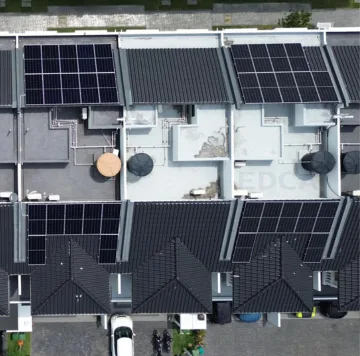
TL;DR: A home solar panel in Johor makes strong financial sense because the state sits near the equator and gets steady, high sunlight all year. Most Johor homes fit a 3–10 kWp rooftop system, offset a big chunk of their TNB bill through NEM 3.0, and see the investment pay back in roughly five to eight years. The key steps are securing SEDA’s NEM quota first, sizing the system to your bill, and choosing a SEDA-registered installer.
If your TNB bill keeps climbing every hot month, you are not imagining it. Johor homes run air-conditioning hard, and daytime electricity is the single biggest line on most household bills here. Rooftop solar answers that problem directly: it turns the sun that already lands on your roof into free daytime power.
Johor is one of the better states in Malaysia for a home solar panel. It gets consistent irradiance, has plenty of landed housing with usable roof space, and falls under the same national Net Energy Metering (NEM) rules that let you offset your bill. This guide walks through why it works, what a system typically costs, how much you can save, and how to pick the right installer — without the sales spin.
Before we get into the numbers, here is a short independent checklist of what to settle before panels go on your roof.
Watch: ten things to know before you get solar installed
A pre-installation checklist from Artisan Electrics, a UK electrical contractor. Johor-specific approvals, NEM and costs follow below.
Source: Artisan Electrics on YouTube — 10 Things You Need To Know Before Getting Solar Panels Installed (YouTube).
2. Why a home solar panel in Johor makes sense
Quick Answer: Johor sits close to the equator and receives steady sunlight of roughly 4.5–5.5 peak sun hours a day, with little seasonal swing. That gives a home solar panel in Johor a high, predictable yield — typically around 1,400–1,600 kWh per kWp each year — making rooftop solar one of the most reliable home upgrades in the state.
Unlike countries with long winters, Malaysia gets usable sun almost every day of the year. For a Johor homeowner, that means your panels generate meaningfully every month, not just in a short summer window. The main variable is cloud cover during the monsoon, not the length of the day.
Two things make Johor especially suitable: the housing stock and the roof orientation. Much of Johor Bahru, Iskandar Puteri, Kulai, Skudai and the outlying towns is landed terrace, semi-detached and bungalow housing — exactly the roof types that take panels well. The table below shows illustrative annual yield across Johor locations so you can see how little it varies.
| Location | Relative yield | kWh/kWp/yr |
|---|---|---|
| Johor Bahru | 1,480 | |
| Iskandar Puteri | 1,500 | |
| Kulai | 1,490 | |
| Batu Pahat | 1,510 | |
| Muar | 1,520 | |
| Kluang | 1,530 |
Illustrative market context based on typical Malaysian peninsular irradiance (~4.5–5.5 peak sun hours/day). Actual yield depends on roof pitch, shading and system design — confirm with a site assessment.
The takeaway is that wherever you are in Johor, the sunlight is broadly the same. What changes your result is roof design and system quality, not your postcode. That is why the installer you choose matters more than the town you live in — a point we cover in detail when comparing the best solar panel company in Malaysia.
Key takeaway: Johor’s sunlight is high and steady statewide, so a well-designed rooftop system performs reliably almost anywhere in the state. Roof quality and installer workmanship decide your result far more than location.
Not sure if your roof is suitable?
EDCA runs a proper site assessment before recommending any system size. See how our home solar panel installation works →
3. How much does a home solar system cost in Johor?
Quick Answer: The cost of a home solar panel in Johor depends mainly on system size, which is set by your monthly TNB bill. Most Johor homes fit a 3–10 kWp system. Because pricing moves with panel choice, roof complexity and inverter type, the honest answer is that it is quote-based — but payback commonly lands in the five-to-eight-year range.
Solar is not sold like a fixed product off a shelf. The right system for a small single-storey terrace is very different from what a double-storey bungalow with three air-conditioners needs. So instead of a sticker price, think in terms of matching system size to your bill. The bigger your daytime usage, the more panels pay off.
Here is an illustrative guide to how home profiles map to system size and payback in Johor. Treat these as market context to orient yourself — your actual figures come from a site-specific quote.
| Home profile | Typical bill | System size | Est. daily output | Indicative payback* |
|---|---|---|---|---|
| Small terrace | RM150–250 | 3 kWp | ~11–12 kWh | 6–8 years |
| Standard terrace / semi-D | RM250–450 | 4–6 kWp | ~15–24 kWh | 5–7 years |
| Large semi-D / bungalow | RM450–800 | 8–10 kWp | ~32–40 kWh | 5–6 years |
*Illustrative market context, not an EDCA quote. Payback varies with system price, financing, self-consumption pattern and future tariffs. Get a free quote for figures specific to your home.
A few things shift the number in the real world. Three-phase homes can run larger systems than single-phase ones. A cluttered or multi-pitch roof costs more to mount than a clean single slope. And higher-efficiency panels cost more upfront but generate more over 25 years. This is the same cost logic that applies to a home solar panel in Kuala Lumpur — the framework is national, only the roof is local.
Key takeaway: Do not shop on price alone. Size the system to your bill and daytime usage first, then compare quotes on equipment quality and workmanship warranty — that is what protects your payback.
4. How NEM 3.0 works for a Johor homeowner
Quick Answer: Net Energy Metering 3.0 lets a Johor home offset its TNB bill with rooftop solar. Daytime power is used first by your appliances, and any excess is exported to the grid and credited on a one-to-one basis. Domestic users apply under the NEM Rakyat category, get a ten-year offset period, and must secure a SEDA quota before installation.
NEM 3.0 is the scheme that makes home solar worth it in Malaysia. Administered by SEDA, it works on a simple principle: the units your panels export are credited against the units you draw from the grid at night. That one-to-one offset is what turns daytime generation into real bill savings.
For a Johor home, the practical rules matter more than the policy detail:
- Capacity limits. Domestic users can install up to 4 kWac on single-phase supply or 10 kWac on three-phase — enough for almost every household.
- No battery required. Under NEM, you do not need a battery to benefit, because the grid effectively acts as your storage. Batteries are optional for backup.
- Quota first, then install. You must hold a SEDA NEM approval before TNB fits the bi-directional meter. Install without it and your exported power is not credited.
- Ten-year offset. The bill-offset arrangement runs for ten years, after which the system continues for self-consumption.
You can confirm the meter and billing mechanics on the TNB solar FAQ. A good installer handles the SEDA application and TNB paperwork as part of the home solar panel installation process, so you are not chasing forms yourself.
Key takeaway: The NEM quota must be approved before installation, or your exports will not be credited. Choose an installer who manages the SEDA and TNB applications end to end.
Want the NEM paperwork handled for you?
EDCA manages the SEDA quota and TNB metering application as part of every home install. Get a free quote for your Johor home →
5. What a Johor home can save each month
Quick Answer: Savings scale with your bill. A small Johor terrace might trim its monthly TNB bill from around RM220 to RM90, while a large bungalow could drop from roughly RM650 to RM200. The higher your daytime air-conditioning use, the larger the saving, because that is exactly when your panels generate most.
Solar saves the most for homes that use electricity during the day — families with someone home in the afternoon, home offices, or heavy daytime cooling. The illustrative figures below show how monthly bills typically shift after a right-sized home solar system.
| Household | Bill before | Bill after | Est. monthly saving |
|---|---|---|---|
| Small terrace (3 kWp) | RM220 | RM90 | RM130 |
| Standard semi-D (5 kWp) | RM380 | RM130 | RM250 |
| Large bungalow (10 kWp) | RM650 | RM200 | RM450 |
Illustrative market context, not guaranteed results. Actual savings depend on usage pattern, system size, tariff and self-consumption. Request a free quote for a personalised estimate.
One point often missed: because Malaysia’s domestic tariff is tiered, solar shaves off your most expensive units first. Cutting the top of your bill delivers a bigger proportional saving than the raw kWh figure suggests. Over a 25-year panel life, that compounds into a substantial sum — and it rises further whenever TNB tariffs go up.
Key takeaway: Solar cuts your priciest tiered units first, so the proportional saving beats the raw kWh number — and it grows every time electricity tariffs rise.
6. Rooftop solar in Johor is accelerating
Quick Answer: Home solar adoption across Malaysia, Johor included, has climbed steadily as panel prices fell and NEM matured. Rising electricity tariffs and stronger awareness mean quota rounds fill quickly — so the practical risk for a Johor homeowner is waiting too long and missing an allocation, not moving too early.
Residential solar has shifted from novelty to mainstream. The modeled trend below illustrates the momentum of home NEM uptake nationally over recent years, indexed to a recent peak.
| Year | Relative uptake | Index |
|---|---|---|
| 2021 | 35 | |
| 2022 | 52 | |
| 2023 | 70 | |
| 2024 | 85 | |
| 2025 | 100 |
Modeled illustration of directional trend, indexed to 2025 = 100; not official installation counts. Directionally consistent with falling module prices and rising NEM participation.
Two forces drive this. Equipment keeps getting cheaper and better, and grid tariffs keep drifting upward, so the payback maths improves each year. Because NEM operates on periodic quota rounds rather than an always-open tap, allocations for popular categories can close fast. For a Johor homeowner, that is the real reason not to sit on the fence — the sun is not going anywhere, but the quota round might.
Key takeaway: Cheaper panels plus rising tariffs make each year’s payback better, but NEM quota is finite and periodic. The timing risk is waiting too long, not acting too soon.
Thinking about it for your business too?
The same economics scale up — see our guide to commercial solar panel in Kuala Lumpur for the business case.
7. How to choose a home solar installer in Johor
Quick Answer: Choose a SEDA-registered installer who does proper site assessment, sizes the system to your bill, uses tier-one equipment, and gives clear warranties on both panels and workmanship. In Johor, prioritise installers who handle the full NEM application and offer local after-sales support, so help is close when you need it.
The installer decides whether your system delivers for 25 years or becomes a roof problem. Follow these steps to choose well:
- Check SEDA registration. Only a SEDA-registered PV service provider can lawfully handle your NEM application and grid connection. This is non-negotiable.
- Insist on a site assessment. A credible installer inspects your roof, shading and switchboard before quoting — not a price over the phone.
- Compare equipment, not just price. Ask which panel and inverter brands they use, and check the product plus performance warranties.
- Confirm workmanship warranty. Panels may carry a 25-year warranty, but the mounting and wiring are only as good as the installer’s own guarantee.
- Ask about after-sales. Monitoring, cleaning and fault response matter over decades — local Johor support beats a distant call centre.
EDCA Energy is a SEDA-registered solar EPCC provider with a track record across residential, commercial and industrial projects. That depth means your home system is designed to proper engineering standards, not fitted as an afterthought. If you are still comparing providers, our breakdown of the best solar panel company in Malaysia lays out what separates a reliable installer from a cheap one.
Key takeaway: SEDA registration, a real site assessment, tier-one equipment and a solid workmanship warranty are the four non-negotiables. Local after-sales support is what keeps the system performing for decades.
8. The bottom line for Johor homeowners
Quick Answer: A home solar panel in Johor is a sound long-term investment: strong sunlight, a supportive NEM 3.0 scheme, and payback in roughly five to eight years. Get your system sized to your bill, secure the SEDA quota early, and work with a SEDA-registered installer who supports you locally.
Johor gives homeowners almost everything solar needs — consistent sun, roof-friendly housing, and access to the national NEM scheme. The economics already work today, and they improve each year as tariffs rise. The decision is less about whether solar makes sense and more about sizing it correctly and choosing the right team to install it.
Start by understanding your daytime usage, then get a proper site assessment. From there, a well-designed system quietly pays you back month after month for decades. You can explore the full scope of EDCA Energy’s solar solutions or dive into the details of home solar panel installation to see what fits your home.
Ready to cut your TNB bill with rooftop solar?
EDCA Energy designs, installs and services home solar systems across Johor — site assessment, NEM paperwork and after-sales all handled. Get a no-obligation quote sized to your home.
Get a Free Quote →9. Frequently asked questions
Is Johor a good place for home solar panels?
Yes. Johor sits near the equator and gets steady, high sunlight of about 4.5–5.5 peak sun hours a day with little seasonal variation. Combined with plenty of landed housing and access to NEM 3.0, it is one of the more favourable states in Malaysia for a home solar panel.
How much does a home solar panel system cost in Johor?
Cost is quote-based because it depends on system size, roof complexity, phase type and equipment choice. Most Johor homes fit a 3–10 kWp system, with payback commonly landing in the five-to-eight-year range. The most accurate figure comes from a site-specific quote.
Do I need SEDA approval to install solar in Johor?
Yes. To benefit from NEM, you must secure a SEDA quota and approval before installation, so TNB can fit the bi-directional meter. Installing without approval means your exported energy is not credited. A good installer manages this application for you.
How long does a home solar installation take?
The physical installation on a typical Johor home usually takes one to three days. The longer part is the approval process — SEDA quota and TNB metering — which can take several weeks depending on the quota round. Your installer coordinates the timeline.
Will my solar system work during a power cut or at night?
A standard grid-connected NEM system does not run during a blackout, for safety reasons, and it does not generate at night. It relies on the grid for night-time power under the one-to-one offset. If you want backup during outages, you can add a battery, though NEM does not require one.
See your solar savings in under a minute
Estimate your ideal system size, payback period and monthly bill offset with the EDCA calculator.