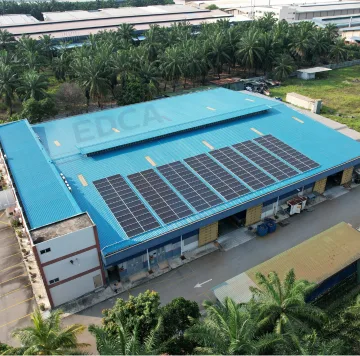
TL;DR: Industrial solar in Johor lets factories, warehouses and plants cut daytime grid costs by generating power on their own rooftops. With TNB’s higher medium-voltage tariffs and the Net Energy Metering NOVA scheme for commercial and industrial users, well-sized systems in Johor often reach payback in roughly 3 to 5 years. This guide explains the real costs, the savings, how much fits on a factory roof, and the incentives that fund the switch. For a site-specific figure, get a free quote.
Johor runs on industry. From the manufacturing estates of Pasir Gudang and Senai to the logistics hubs feeding Singapore and the wider region, the state’s factories draw huge amounts of daytime power. That power now costs more than it did a year ago, and it keeps climbing. This is exactly why industrial solar in Johor has moved from a nice-to-have to a core cost decision for plant owners and finance managers.
A rooftop system turns a factory’s biggest unused asset — its roof — into a power station that runs whenever the sun is up, exactly when a plant needs the most electricity. The result is a lower monthly bill, a hedge against tariff rises, and a cleaner operation that customers and auditors increasingly ask about. Below we walk through what industrial solar in Johor looks like in practice: the grid costs you pay now, what solar saves, how much your roof holds, and the schemes that fund it.
Here is a short overview of how commercial and industrial solar works before we get into the Johor-specific detail.
Watch: commercial and industrial solar, explained
An overview from Pivot Energy, a US commercial solar developer. The incentives named are American — Malaysian GITA and NEM detail follows below.
Source: Pivot Energy on YouTube — Commercial Solar Explained: Solar Energy for Businesses
1. Why Johor factories are turning to industrial solar
Quick Answer: Johor factories are adopting industrial solar because their electricity use peaks in daylight hours — the same hours solar produces — and TNB’s restructured medium-voltage tariff has pushed grid costs higher since July 2025. On-site solar shaves the energy portion of the bill and reduces exposure to future rate rises.
A factory’s load curve is a solar installer’s dream. Machines run through the working day, so demand peaks from morning to late afternoon — almost the same shape as solar output. That overlap means most of the power a rooftop system makes is used on-site straight away, and self-used solar is where the savings are largest.
The cost pressure is real and recent. Malaysia restructured its non-domestic tariff from 1 July 2025 under the regulator’s fourth Regulatory Period, changing how capacity, network and energy charges are billed for commercial and industrial users; you can read the current structure on the official TNB tariff portal. For a plant on a heavy daytime load, even a modest rate rise adds up to a large annual figure.
Johor adds its own reasons. Its proximity to Singapore has drawn export-focused manufacturers whose overseas buyers now ask for carbon reporting and renewable sourcing, and industrial solar in Johor is one of the clearest, most auditable ways to answer them. If you are comparing providers first, our guide to the best solar panel company in Malaysia is a useful starting point.
2. What grid power costs a Johor factory today
Quick Answer: A Johor factory’s electricity bill is built from several parts — an energy charge per kWh, a maximum-demand or capacity charge per kW, network charges and periodic fuel adjustments. Solar directly attacks the energy charge, which is usually the largest single line for a daytime-heavy operation.
To understand what solar saves, first see what you pay for. A medium-voltage industrial account is not one flat rate — it is a stack of charges, each behaving differently. The table below shows where industrial solar in Johor helps most.
| Bill component | What it charges for | Solar reduces it? |
|---|---|---|
| Energy charge (per kWh) | Every unit of electricity you consume | Yes — directly |
| Maximum demand / capacity (per kW) | Your highest power draw in the month | Partly — if solar trims peaks |
| Network / system charge | Use of the grid infrastructure | No |
| Fuel / automatic adjustment | Periodic pass-through of fuel cost | Indirectly — fewer units billed |
Illustrative market context for a medium-voltage industrial account under Malaysia’s July 2025 non-domestic tariff structure. Actual line items and rates vary by account and month; see the TNB tariff portal for current figures. Your exact numbers come with a free quote.
The lesson is simple: solar bites hardest on the energy charge, because every kilowatt-hour your panels supply is one you do not buy from the grid. It can also nudge demand charges down when production peaks line up with strong sun. Network charges stay, so no honest installer promises a zero bill — but the largest, most controllable slice is exactly the one solar removes.
3. What solar can save — payback by load profile
Quick Answer: The single biggest driver of solar payback for a Johor factory is how much of its power it uses during daylight. A plant running two daytime shifts self-consumes most of its solar output and typically sees the fastest return; a single-shift or export-heavy site takes a little longer.
Self-consumption is the whole game. Power you make and use on the spot is worth the full retail rate you avoided; power you export earns a lower credit. So the more of your load that sits under the midday sun, the better the economics of industrial solar in Johor. The table below models three common factory profiles.
| Factory profile | Daytime self-consumption | Indicative payback |
|---|---|---|
| Two daytime shifts (e.g. plastics, food processing) | ~90% | Shortest (~3–4 yrs) |
| Single day shift (e.g. light assembly) | ~75% | Medium (~4–5 yrs) |
| Warehouse / low daytime load | ~50% | Longer (~5–7 yrs) |
Modelled illustrative scenarios based on typical Malaysian industrial load patterns and the NEM NOVA self-consumption model described by SEDA. Not a quote or a guarantee; your payback depends on roof, load and tariff. EDCA provides a modelled figure for your site free of charge.
For high daytime users, the NEM scheme’s own design points to payback of roughly three to five years, after which the power is close to free for the panels’ remaining life — which is why factories with strong daytime demand move first. A warehouse with little daytime load still benefits, but the right system design — and sometimes battery storage — matters more there.
4. How much solar fits on your factory roof
Quick Answer: As a rough rule, every 1,000 square metres of usable factory roof holds roughly 100 to 150 kilowatt-peak of solar. A typical Johor manufacturing shed with 5,000 square metres of roof can therefore carry a system of several hundred kilowatt-peak — enough to cover a large share of daytime demand.
Factory roofs are large and mostly flat or low-pitched, which makes them ideal for solar. The usable area is a little less than the total roof because of walkways, skylights, plant equipment and setbacks. The chart below shows an indicative system size for common Johor factory roof footprints.
| Usable roof area | Indicative capacity |
|---|---|
| 2,000 m² | ~250 kWp |
| 5,000 m² | ~625 kWp |
| 8,000 m² | ~1,000 kWp |
| 10,000 m² | ~1,250 kWp |
Illustrative estimates using a planning figure of roughly 125 kWp per 1,000 m² of usable roof. Real capacity depends on roof structure, orientation, shading and load. EDCA confirms your exact figure during a free site assessment.
Two things shape the final number. Roof condition matters — an older metal roof may need minor strengthening before panels go on, which a structural check flags early. And you rarely want to fill every square metre; sizing to your daytime load usually beats maximising panels. The same roof-first thinking applies to homes, as our guide to home solar panels in Kuala Lumpur explains.
5. Incentives and schemes that fund industrial solar in Johor
Quick Answer: Johor factories can use several national schemes to fund industrial solar in Johor — Net Energy Metering NOVA for commercial and industrial self-consumption, SelCo for pure self-use, and green tax incentives like GITA. These are administered by SEDA and delivered through TNB, and they apply state-wide, including across Johor.
The policy support is what turns a good idea into a funded project. The main routes an industrial site in Johor will consider are:
- NEM NOVA (Net Offset Virtual Aggregation). The commercial and industrial track of Net Energy Metering. You self-consume your solar and export surplus for credits at the prevailing market price. Details are published by SEDA.
- SelCo (Self-Consumption). For sites that use all their solar on-site with no grid export — simple and well suited to high-daytime factories.
- Green Investment Tax Allowance (GITA). A tax allowance on qualifying green assets that can improve the after-tax return on a solar investment.
- Financing routes. Beyond outright purchase, some operators use a power purchase agreement or lease to install solar with little or no upfront capital.
The NEM programme has been in high demand. Malaysia upgraded its net-metering scheme for rooftop PV in mid-2025, as reported by pv magazine, and the earlier rooftop quota was heavily subscribed, prompting an extension covered by The Edge Malaysia. Because quotas and terms change, lock in your eligibility early with an installer who handles the SEDA and TNB paperwork for you.
6. Industrial solar uptake in Johor is accelerating
Quick Answer: Commercial and industrial solar adoption in Malaysia has climbed steadily as tariffs rose and NEM quotas filled. The commercial-and-industrial NEM NOVA allocation was more than 90% subscribed by 2025, a sign that factories — including many in Johor’s manufacturing belt — are moving quickly.
Momentum matters for two reasons: it shows the model works, and it signals that scheme quotas are a finite resource worth claiming early. The trend below traces the direction of industrial and commercial solar interest over recent years.
| Year | Relative interest (indexed) | Key driver |
|---|---|---|
| 2023 | Baseline | NEM 3.0 rollout |
| 2024 | Rising | Quota filling, export focus |
| 2025 | High | Tariff restructure, NEM upgrade |
| 2026 | Sustained | Carbon reporting, cost pressure |
Indicative trend compiled from publicly reported NEM subscription levels and tariff changes, per SEDA and pv magazine. A directional index, not precise volumes.
The pattern repeats across Johor’s industrial estates: as grid costs climbed and buyers pressed for greener supply chains, factories that once treated solar as optional now treat it as standard. The same shift shows in the capital, in our look at industrial solar in Kuala Lumpur. Sites electrifying their fleets are also pairing panels with EV charger installation to run vehicles on their own clean power.
7. How to choose an industrial solar partner in Johor
Quick Answer: For an industrial system, choose an EPCC provider with SEDA registration, a real track record of large rooftop projects, in-house engineering, and full handling of SEDA and TNB approvals. On a factory roof, structural competence and long-term service matter as much as panel price.
A home system is forgiving; a several-hundred-kilowatt factory array is not. The stakes — roof integrity, production uptime, grid compliance, a 20-plus-year asset — reward experience. When you shortlist providers for industrial solar in Johor, weigh these:
- Accreditation. Look for a SEDA-registered photovoltaic service provider — EDCA Energy is a registered RPVSP — plus the usual CIDB and industry credentials.
- EPCC capability. One partner handling engineering, procurement, construction and commissioning avoids the gaps that appear when work is split across subcontractors.
- Track record at scale. Ask for delivered megawatt-peak, not just years in business. EDCA has 150-plus projects and 80-plus MWp installed, within a group track record of 200 MW-plus.
- Structural and safety engineering. Proper roof load assessment, certified mounting, and safe cabling protect both your building and your workers.
- Service after handover. Monitoring, cleaning and maintenance keep output high across the system’s life.
Dig deeper into what separates a strong installer from a weak one in our guide to the best solar panel company in Malaysia, or go straight to our industrial solar installation service to see how EDCA delivers projects end to end. To learn more about the company and our accreditations, visit our home page.
8. Conclusion
For a factory, industrial solar in Johor is one of the few investments that lowers a fixed monthly cost, hedges against rising tariffs, and strengthens your standing with export customers all at once. The maths is strongest for heavy daytime loads, but almost any well-run site benefits when the system is sized to real demand and backed by the right schemes. The two moves that matter: get an honest, site-specific model of your savings, and claim your NEM or SelCo eligibility before quotas tighten.
Turn your factory roof into a power station.
EDCA Energy designs, builds and maintains industrial solar systems across Johor — from load study and structural check to SEDA and TNB approvals and long-term service. Get a clear, no-obligation figure for your site.
Get a Free Quote9. Frequently asked questions
How long does industrial solar take to pay back in Johor?
For a factory with heavy daytime use, payback is commonly around three to five years, based on the self-consumption model behind the NEM NOVA scheme. Sites with lower daytime load take a little longer. The exact figure depends on your bills, roof and tariff, so a site-specific model is worth doing first.
Do I need Net Energy Metering to install solar on my factory?
Not always. NEM NOVA lets you export surplus for credits, while SelCo suits sites that use all their solar on-site with no export. A high-daytime factory often works well on self-consumption alone. Your installer will advise which route fits your load and handle the SEDA and TNB applications either way.
Will solar damage or overload my factory roof?
Not when it is engineered properly. A structural assessment checks that the roof can carry the extra load, and certified mounting spreads weight safely. Older metal roofs sometimes need minor strengthening or resheeting first, which a good EPCC provider flags early rather than after installation.
How much of my electricity bill can industrial solar in Johor remove?
Solar mainly cuts the energy charge — usually the largest line on a daytime-heavy bill — and can trim demand charges when peaks align with strong sun. Network charges remain. A well-sized system covering most daytime load typically removes a large share of the total bill, though the precise percentage varies by site.
Can EDCA handle the SEDA and TNB paperwork for us?
Yes. As a SEDA-registered photovoltaic service provider, EDCA manages the applications, approvals and grid connection as part of an end-to-end EPCC package, so your team can stay focused on production. Contact us for a free quote to get started.
See your solar savings in under a minute
Estimate your ideal system size, payback period and monthly bill offset with the EDCA calculator.