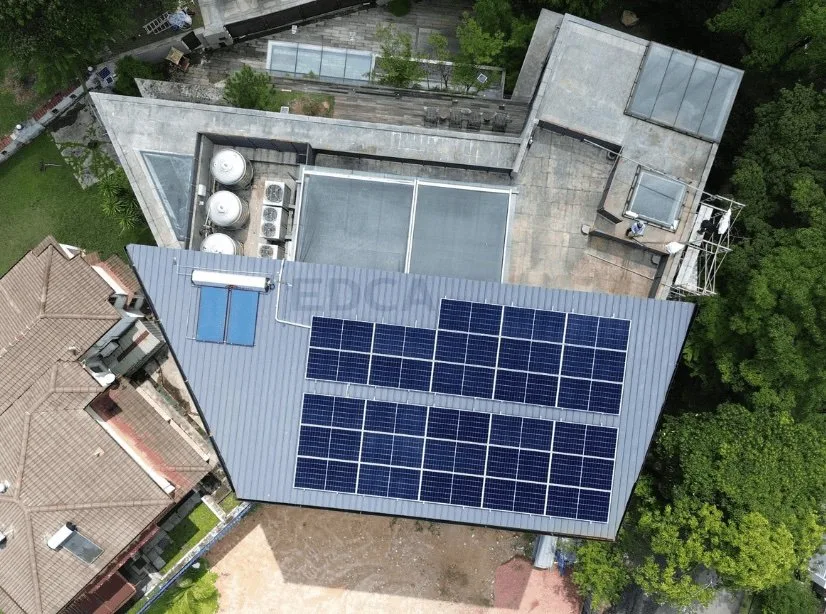
Search “best solar panel for home” and you will get a dozen ranked brand lists, each pointing to a different winner. That is because “best” depends on your roof, your budget and, above all, Malaysia’s tropical heat. A panel that tops the charts in temperate Europe can lose more output on a 65°C Klang Valley rooftop than one with a lower headline efficiency but a stronger temperature coefficient.
This guide skips the brand horse-race and gives you the framework installers actually use to choose panels for Malaysian homes: the factors that matter, the panel types that suit our climate, how efficiency has moved, and how to size a system to your own bill. For the full step-by-step on getting a system onto your roof, see our companion guide to solar panels for the home in Malaysia. Let us start with what “best” really means.
Watch: how to choose the right solar panels for your home
Independent panel-selection guidance from SolarQuotes (Australia). The selection criteria apply to Malaysian homes too; our climate notes follow below.
Source: SolarQuotes on YouTube — How to Choose the RIGHT Solar Panels for Your Home
1. What makes a solar panel “best” for a Malaysian home?
Quick Answer: The best home solar panel in Malaysia is the one that holds its output in heat, fits your roof space, and comes with a warranty you can actually rely on for 25 years. Heat tolerance and degradation matter more here than a headline efficiency figure alone, because our rooftops run far hotter than the lab conditions panels are rated in.
Panel data sheets are measured under Standard Test Conditions — a cell temperature of 25°C. Malaysian rooftops routinely hit 60–70°C at midday. Every panel loses a little output as it heats up, and how much it loses is set by its temperature coefficient. That single spec often separates a panel that performs on paper from one that performs on your roof.
So instead of chasing the highest efficiency number, weigh the factors below. The illustrative weighting reflects how EDCA prioritises panel selection for residential jobs, where long-term yield in real heat matters more than a marginal spec-sheet edge.
| Heat tolerance (temp coefficient) | 25% | |
| Efficiency (watts per m²) | 22% | |
| Warranty & bankability | 20% | |
| Degradation (output at year 25) | 18% | |
| Price per watt | 15% |
Illustrative weighting based on EDCA residential installation experience and Malaysian market context — not a formal survey. Your priorities may shift the order.
Notice that price per watt sits last, not first. A cheaper panel that fades faster in the heat costs you more over 25 years of generation than a slightly dearer one that holds its output. This is the same logic behind choosing a reputable solar panel company in Malaysia — the equipment and the installer both decide your long-term yield.
2. Which panel type wins in Malaysia’s climate?
Quick Answer: For almost every Malaysian home in 2026, a monocrystalline N-type (TOPCon) panel is the best choice. It offers the highest efficiency, the lowest temperature coefficient and the slowest degradation, which is exactly what our hot rooftops and limited roof space demand. Polycrystalline and thin-film panels rarely make sense for a modern home installation.
There are three broad panel families you will still see quoted, plus the newer N-type variant of monocrystalline. The illustrative comparison below shows the trade-offs at a glance — figures are typical market ranges, not a single product spec.
| Panel type | Typical efficiency | Behaviour in heat | Typical warranty | Best for |
|---|---|---|---|---|
| Mono N-type (TOPCon) | 21–23% | Best — lowest temp coefficient | 25–30 years | Hot roofs, limited space |
| Mono PERC (P-type) | 19–21% | Good | ~25 years | Budget builds with ample roof |
| Polycrystalline | 15–17% | Weaker in heat | ~25 years | Large low-cost ground mounts |
| Thin-film | 10–13% | Handles heat/shade well | 10–25 years | Niche or curved surfaces |
Illustrative market ranges for Malaysia, 2026 — for comparison, not a specific product data sheet.
The reason polycrystalline has all but disappeared from residential quotes is simple: it needs more roof area for the same output and fades faster in heat. Thin-film stays a niche product for special surfaces. For a normal terrace, semi-D or bungalow roof, the real decision is between mono PERC and mono N-type — and N-type usually wins on hot Malaysian roofs where every degree of heat tolerance protects your afternoon generation.
3. How has panel efficiency improved, and why does it matter?
Quick Answer: Top residential monocrystalline efficiency has climbed from around 16% a decade ago to roughly 22–23% in 2026. On a fixed roof, higher efficiency means more kilowatt-hours from the same space — which is the single biggest advantage for Malaysian homes with limited or partly shaded rooftops.
Efficiency is the share of sunlight a panel converts to electricity. It matters most when roof space is the constraint, which it usually is on Malaysian homes. A more efficient panel lets you fit more capacity onto the same roof, or reach your target system size using fewer panels. The illustrative trend below shows how far top residential mono panels have moved.
| Year | Typical top efficiency | Relative output per m² |
|---|---|---|
| 2016 | ~16.0% | |
| 2018 | ~18.0% | |
| 2020 | ~19.5% | |
| 2022 | ~21.0% | |
| 2024 | ~22.0% | |
| 2026 | ~22.8% |
Illustrative market trend for Malaysia, based on typical tier-1 residential panels — directional, not a product specification.
There is a practical upside beyond the numbers. Because a modern panel produces more from each square metre, a right-sized system today uses fewer panels than the same capacity would have a few years ago — simpler mounting, less roof clutter and a tidier install. If you want the mechanics of getting panels fixed and wired, our walkthrough on how to install solar panels at home covers the process.
4. What size system does your home actually need?
Quick Answer: Size your system to your monthly TNB bill, not to your roof size. A typical terrace home paying RM400–RM600 a month usually needs a 6–9 kWp system, roughly 11–16 modern panels. The right panel choice then decides how much roof that capacity takes up.
Choosing the “best” panel is only half the job — you also need the right amount of it. Oversizing wastes money; undersizing leaves savings on the table. Under Malaysia’s Net Energy Metering (NEM 3.0) programme administered by SEDA, excess daytime energy is credited against your bill, so most homes size to offset a large share of daytime usage rather than to cover the entire roof.
The illustrative ladder below maps common bill bands to a sensible system size, roof area and panel count. It assumes modern ~580–620 W panels; higher-efficiency panels sit at the lower end of each area range.
| Monthly TNB bill | Suggested size | Approx. roof area | Approx. panels |
|---|---|---|---|
| RM250–400 | 4–6 kWp | 24–36 m² | 7–11 |
| RM400–600 | 6–9 kWp | 36–54 m² | 11–16 |
| RM600–900 | 9–13 kWp | 54–78 m² | 16–23 |
| RM900+ | 13 kWp+ | 78 m²+ | 23+ |
Illustrative sizing guide for Malaysian homes — actual sizing depends on your usage pattern, roof orientation and shading. Not a price quote.
Use this as a starting point, not a final answer. Your day-versus-night usage split changes everything: a household that runs air-conditioning and appliances during the day offsets far more than one that consumes mostly at night. A proper assessment measures your load profile before recommending capacity.
5. Efficiency or durability — what should you prioritise in the tropics?
Quick Answer: In Malaysia’s heat and humidity, durability and heat tolerance should edge out raw efficiency once you are already choosing a tier-1 monocrystalline panel. A panel that degrades slowly and shrugs off high roof temperatures will out-generate a marginally more efficient one over 25 years.
Most online rankings lead with efficiency, because it is the easiest number to sort a list by. That is the angle to push back on. Once you have narrowed to tier-1 mono panels, the gap in headline efficiency between good brands is small — a point or two. The gap that compounds over decades is in degradation and heat behaviour, and that is where tropical climates punish weaker panels.
Two panels rated within a percent of each other on the data sheet can diverge sharply on a real roof:
- Heat losses stack up daily. A lower temperature coefficient means less lost output every hot afternoon — the exact hours when your panels should be working hardest.
- Degradation compounds yearly. A panel losing 0.4% a year versus 0.6% a year is meaningfully ahead by year 25, when both are still on your roof.
- Humidity and PID resistance matter. Our humid coastal air rewards panels built to resist moisture ingress and potential-induced degradation.
This is why EDCA weighs heat tolerance and degradation above a marginal efficiency edge for residential jobs. The best panel is the one still performing strongly in year 20, not just the one that tested highest in a lab at 25°C.
6. Why the panel alone doesn’t decide your results
Quick Answer: Even the best panel underperforms with a weak inverter, poor workmanship or thin after-sales support. The panel is one part of a system — the inverter, mounting, wiring and installer quality decide whether that panel ever delivers its rated output on your roof.
It is tempting to obsess over the panel and forget it only works as part of a system. A few components matter almost as much:
- Inverter quality. The inverter converts DC to usable AC and is often the first thing to fail. A reliable inverter with a solid warranty protects the whole system’s output.
- Mounting and workmanship. Correct tilt, orientation and secure mounting protect both generation and your roof. Sloppy waterproofing causes leaks that cost more than the panels saved.
- Shading and layout. Even a small shadow across one panel can drag down a whole string. Good design routes around chimneys, water tanks and neighbouring trees.
- After-sales and monitoring. A 25-year asset needs a company that will still be around to service it and monitor performance.
This is the anti-cannibalisation truth of solar shopping: the “best panel” question quietly becomes a “best installer” question. That is why picking a SEDA-registered EPCC provider with a real track record protects your investment more than agonising over two similar data sheets.
7. How EDCA helps you pick the right panel
Quick Answer: EDCA Energy is a SEDA-registered RPVSP solar EPCC provider. Rather than pushing one brand, we assess your roof, bill and shading, then recommend a tier-1 monocrystalline panel and inverter sized to your home — so “best panel” means best for your situation, not a generic ranking.
As a Malaysian EPCC provider with 150+ completed projects and 80+ MWp installed, EDCA specifies panels the way this guide describes: heat tolerance and durability first, efficiency and warranty close behind, price weighed against 25-year yield. We are SEDA-registered, myHijau-listed, and work as a TNB partner, so your system meets the standards that keep NEM and warranties valid.
Every recommendation starts with a site assessment, because the best panel for a shaded double-storey terrace is not the same as for an unobstructed bungalow roof. You can start from our EDCA Energy home page to see the full range of solar solutions, or go straight to a conversation about your roof.
8. Conclusion
There is no single “best solar panel for home” in Malaysia — only the best panel for your roof, your bill and our climate. For most homes in 2026 that points to a tier-1 monocrystalline N-type panel, sized to your TNB bill, paired with a quality inverter and installed by a SEDA-registered provider. Weigh heat tolerance, degradation and warranty above a marginal efficiency figure, and remember the install matters as much as the module. Get those right and your system will still be earning its keep two decades from now.
9. Frequently asked questions
Which type of solar panel is best for a home in Malaysia?
A monocrystalline N-type (TOPCon) panel is the best all-round choice for most Malaysian homes in 2026. It combines the highest efficiency with the lowest temperature coefficient and slowest degradation, which suits our hot rooftops and limited roof space. Monocrystalline PERC is a solid budget alternative when roof area is generous.
Is a higher-efficiency solar panel always better?
Not always. Once you are choosing among tier-1 monocrystalline panels, efficiency differences are small. Heat tolerance, degradation rate and warranty matter more over a 25-year life on a hot Malaysian roof. A slightly less efficient panel that holds its output in heat can out-generate a higher-rated one that fades.
How many solar panels does a Malaysian home need?
It depends on your monthly TNB bill and daytime usage, not your roof size. A home paying RM400–RM600 a month typically needs a 6–9 kWp system, or roughly 11–16 modern panels. A site assessment measuring your load profile gives the precise number.
Do the best panels still qualify for NEM in Malaysia?
Yes. NEM 3.0 eligibility depends on your system being installed by a registered provider and meeting SEDA and TNB requirements, not on choosing a particular premium panel brand. Any compliant tier-1 panel installed correctly can participate in net energy metering.
Does the solar panel brand matter more than the installer?
Both matter, but the installer often decides your real-world results. Even the best panel underperforms with a weak inverter, poor mounting or inadequate after-sales support. Choosing a SEDA-registered EPCC provider with a track record protects your investment more than a marginal difference between two good panels.
Ready to find the best panel for your home?
Get a tailored recommendation and system design matched to your roof, bill and budget — no guesswork, no generic rankings.
Get a Free QuoteSee your solar savings in under a minute
Estimate your ideal system size, payback period and monthly bill offset with the EDCA calculator.