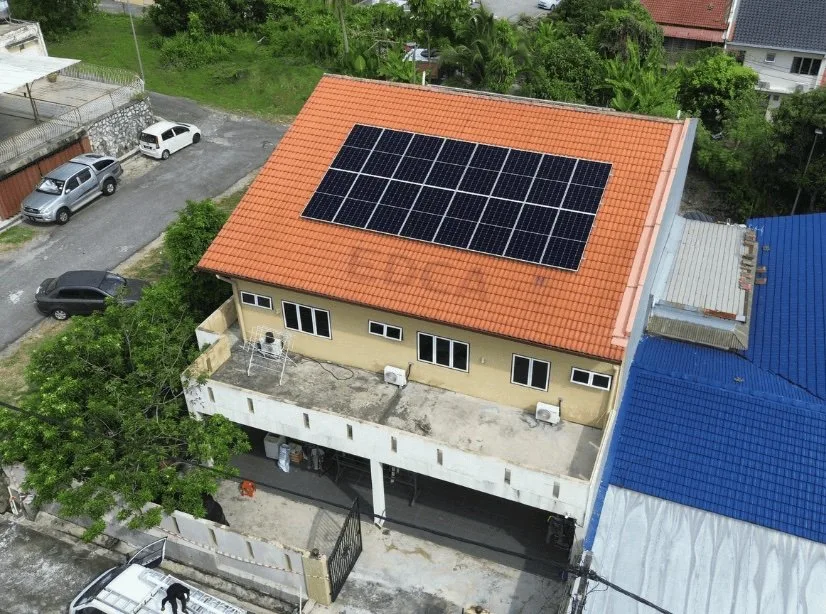
TL;DR: To install solar panels at home in Malaysia you follow a set path: a site survey, a system design from a SEDA-registered installer, a TNB technical check, the physical install, then testing and a Solar ATAP contract. Grid-tied home solar is not a do-it-yourself job — a competent person must wire and commission it. This guide walks through the whole process, the 2026 rules, and what to expect at each stage.
1. Introduction
More Malaysian homeowners want to cut their TNB bill and take control of their power. Rooftop solar is the most common way to do it. But the moment you decide to install solar panels at home, a fair question follows: what actually happens, and in what order?
This guide answers that. It is written for owners of landed homes and larger stratas in Peninsular Malaysia who want a clear, honest picture before they commit to install solar panels at home — not a sales pitch. We cover who is allowed to do the work, the step-by-step install, how long it takes, the 2026 Solar ATAP rules, and the roof and cost factors that decide your result. If you want the fuller service view, our home solar panel installation page sits alongside this, and our guide to the key steps of home solar installation goes deeper on sequencing.
Before we start, here is a short independent walkthrough of what a properly executed rooftop installation looks like.
Watch: what a gold-standard rooftop installation looks like
An independent Australian walkthrough of a best-practice install, from SolarQuotes. Workmanship standards translate directly; Malaysian approvals are covered below.
Source: SolarQuotes on YouTube — Watch A Gold-Standard Solar Installation – Start To Finish
2. Can you install home solar panels yourself in Malaysia?
Quick Answer: No — you cannot legally install a grid-connected home solar system yourself in Malaysia. The wiring and commissioning must be done by a competent person, and a registered contractor must sign off the works. Choosing an experienced solar panel company is the practical starting point.
Plenty of overseas videos show a homeowner bolting panels on a roof over a weekend. That model does not apply when you install solar panels at home in Malaysia. A rooftop system that connects to the grid touches your main electrical supply, so it falls under Malaysia’s electricity safety rules.
Two things make DIY a non-starter for grid-tied home solar:
- A competent person must do the electrical work. Connecting an inverter to your consumer unit and the TNB supply requires a registered electrical worker, with the installation certified on Form G and Form H.
- Only a registered provider can lodge your scheme application. Under the current programme you must appoint a SEDA-registered PV Service Provider (RPVSP) to submit the paperwork on your behalf.
You can still be hands-on. You choose the panels, the inverter brand, the layout, and the budget. What you hand over is the licensed electrical work and the regulatory filing — the two parts where a mistake is dangerous or gets your application rejected.
Key takeaway: Home solar in Malaysia is a “hire the licensed parts, own the decisions” job. Pick your system and installer carefully; leave the wiring, certification, and scheme filing to registered professionals.
Not sure your home is a good fit for solar?
A proper site assessment settles it in one visit — see how our home solar panel installation service handles the survey and design.
3. How solar panels get installed at home: the step-by-step process
Quick Answer: A home solar install runs through five stages — assessment, design and quote, technical check and Solar ATAP application, physical installation, then testing, commissioning and the TNB contract. Our home solar installation key-steps guide covers each stage in more detail.
Most Malaysian homeowners are surprised that the roof work is the fastest part. The approval and connection steps take the most calendar time. Here is the full sequence to install solar panels at home:
- Book a site assessment and load review. The installer inspects your roof, checks your consumer unit, and reviews recent TNB bills to size the system to your usage.
- Get a system design and quote. A SEDA-registered installer proposes panel count, inverter, layout, and expected output, then gives you a written quote.
- Complete the technical assessment and Solar ATAP application. Where required, TNB runs a connection check; the installer lodges your application through the SEDA eATAP system.
- Install the mounting, panels, inverter and wiring. A competent person mounts the rails, fixes the panels, sets the inverter, and connects everything safely.
- Test, commission and sign the TNB contract. The system is tested, certified on Form G and Form H, the export meter is set, and your Solar ATAP contract begins.
The order matters. Skipping the technical assessment or starting the filing late is the usual reason a project drags. A good installer runs the paperwork in parallel with ordering equipment so nothing sits idle.
Key takeaway: Five stages, but the roof work is only one of them. Plan around the approval and connection steps, which set your real timeline.
4. How long does home solar installation take?
Quick Answer: The physical work usually takes one to three days, but the full journey from first survey to a live, grid-connected system typically runs six to ten weeks because of technical checks and TNB processing. See how this fits the wider home solar installation workflow.
The table below shows a typical timeline for a straightforward landed home. Treat the durations as illustrative market context — your actual timing depends on roof complexity, supply phase, and how busy TNB is in your area.
| Stage | What happens | Typical duration |
|---|---|---|
| Site survey | Roof, wiring and load check | 1–3 days |
| Design & quote | System sizing and written proposal | 3–7 days |
| Technical check & application | TNB connection check and Solar ATAP filing | 2–6 weeks |
| Physical installation | Mounting, panels, inverter, wiring | 1–3 days |
| Testing & commissioning | Certification, metering, contract start | 2–4 weeks |
Illustrative timeline based on EDCA Energy project experience; regulatory steps follow the SEDA Solar ATAP process.
The lesson: if someone promises a live system in a week, they are describing the roof work only. When you install solar panels at home, the regulated steps are where realistic expectations matter.
Key takeaway: Budget six to ten weeks end to end, not a weekend. The install is quick; the approvals set the pace.
5. Home solar rules under Solar ATAP (2026)
Quick Answer: Since 1 January 2026, home solar runs under Solar ATAP, which replaced net energy metering. Homes can install up to 5 kW on single-phase supply or 15 kW on three-phase, export surplus to the grid as an offset, and the contract runs for 10 years. Our home solar panel installation team handles the full application.
The Solar Accelerated Transition Action Programme (Solar ATAP) took effect on 1 January 2026, replacing the net energy metering scheme that ended in June 2025. It keeps the core idea: your panels power your home first, and excess energy is exported to the grid as an offset. The table below sets out the domestic rules that matter when you install solar panels at home.
| Rule | Single-phase home | Three-phase home |
|---|---|---|
| Maximum system size | Up to 5 kW | Up to 15 kW |
| Technical study needed | Only if above 5 kW | Only if above 15 kW |
| Connection check fee | RM1,000 (when a study applies) | RM1,000 (when a study applies) |
| Contract length | 10 years | 10 years |
| Who files it | A SEDA-registered installer (RPVSP) | A SEDA-registered installer (RPVSP) |
Source: SEDA Malaysia, Solar ATAP programme.
Two practical points. First, you must be a registered TNB consumer and not already on the older SelCo or NEM schemes. Second, after the 10-year term the system stays yours but shifts to strict self-consumption, so sizing it to your daytime usage pays off long term.
Key takeaway: Solar ATAP has no quota and clear domestic caps. Match your system to your supply phase and daytime use, and let a registered installer handle the filing.
6. What affects how much electricity your panels produce
Quick Answer: Malaysian rooftops typically produce 3.5 to 4.5 kWh per day for every kWp installed, but shading, roof angle and orientation move the number a lot. Choosing the best solar panel for your home and a clean layout protects your output.
Malaysia sits near the equator, so it gets strong, steady sun — around 4.5 peak sun hours a day on average. Real systems here generate roughly 3.5 to 4.5 kWh per kWp each day. Where your roof lands in that band comes down to a few conditions:
| Roof condition | Relative output | kWh/kWp/day |
|---|---|---|
| Unshaded, good angle | ~4.2 | |
| Minor shading | ~3.8 | |
| Typical rooftop | ~3.5 | |
| Partial shade / poor angle | ~2.8 |
Illustrative figures modelled on the 3.5–4.5 kWh/kWp Malaysian range; actual output confirmed at site survey.
When you install solar panels at home, the big three levers are shading (from trees, water tanks, or a neighbour’s wall), roof tilt (flat to about 15 degrees works well here), and orientation. A shaded corner drags down a whole string, so panel placement is a design decision, not an afterthought.
Key takeaway: Sunlight is not your limit in Malaysia — shading and layout are. A careful survey is what turns good irradiance into real savings.
Want a real output estimate for your own roof?
Skip the guesswork — get a free solar quote and we will model your rooftop before you spend a ringgit.
7. Is your roof ready? A pre-install checklist
Quick Answer: A roof is solar-ready when it is structurally sound, has enough clear space, and won’t need replacing soon. Malaysian metal, tile and concrete roofs all take panels well. Our solar panel for home guide covers roof types in more depth.
Before you install solar panels at home, run through this quick readiness check. It catches the problems that cause delays or reduce output:
- Roof age and condition. If your roof needs replacing within a few years, do that first — removing and refitting panels later costs money.
- Structural strength. Panels and mounting add weight. A survey confirms your trusses can carry it, especially on older homes.
- Clear, usable area. Water tanks, vents, and skylights break up a roof. You need enough unbroken space for a sensible panel string.
- Roof type. Metal, clay tile, and concrete flat roofs are all common in Malaysia and all workable, each with its own mounting method.
- Monsoon and drainage. Good installers plan cable routing and fixings around heavy rain so nothing leaks or loosens.
If a few boxes don’t tick, that rarely means “no solar”. It usually means a small fix first or a slightly different layout. A survey turns these unknowns into a clear plan.
Key takeaway: Most Malaysian roofs are solar-ready. Sort out roof age and shading before install day and the rest is routine.
8. Home solar cost and savings: an illustrative view
Quick Answer: Home solar cost is quote-based — it depends on system size, roof type and equipment. As a rough guide, the bigger your TNB bill, the bigger the system that makes sense. Compare your options on the EDCA Energy home page or ask for a tailored quote.
There is no fixed price to install solar panels at home, and anyone quoting one sight-unseen is guessing. What we can share is how system size usually tracks your monthly bill. The table below is illustrative market context to help you picture the scale — your real figures come from a site quote.
| Monthly TNB bill | Typical home | Indicative system size |
|---|---|---|
| RM200–350 | Small terrace / apartment | ~3–4 kWp |
| RM350–600 | Mid-size landed home | ~5–8 kWp |
| RM600–1,000 | Large home, heavy aircon use | ~8–12 kWp |
Illustrative EDCA Energy market context; not a price quote. Larger three-phase homes can go up to the 15 kW Solar ATAP cap.
Payback depends on how much of your generation you use during the day versus export. Homes with daytime load — retirees, home offices, families with daytime aircon — see the fastest returns because self-consumed solar offsets your most expensive units.
Key takeaway: Size the system to your bill and your daytime usage, not to your roof’s maximum. That is where the savings actually come from.
9. Conclusion
Installing solar panels at home in Malaysia is a defined, regulated process — not a weekend DIY project. You choose the system and the installer; a registered professional handles the wiring, certification, and Solar ATAP filing. Plan for six to ten weeks end to end, size the system to your bill and daytime use, and settle roof and shading questions before install day.
Get those basics right and rooftop solar is one of the most reliable ways to cut a Malaysian household’s power bill for decades. The best next step is a proper site survey, which removes the guesswork and gives you real numbers for your own roof.
10. Frequently asked questions
Can I install solar panels at home without an approved installer?
No. For a grid-connected home system, the electrical work must be done by a competent person and a SEDA-registered provider must lodge your Solar ATAP application. You choose the equipment and design, but the licensed work and filing are handled by professionals.
How long does it take to install home solar in Malaysia?
The physical installation is usually one to three days. The full process from survey to a live, grid-connected system typically takes six to ten weeks, mostly because of the technical check and TNB processing.
What is the maximum home solar size under Solar ATAP?
Domestic limits are up to 5 kW for single-phase supply and up to 15 kW for three-phase, per SEDA. A technical study applies only if you exceed those limits.
Do I need to replace my roof before installing solar?
Only if it is near the end of its life. Panels last 25 years or more, so fitting them on a roof you will soon replace means paying to remove and refit them. A survey confirms whether your roof is ready.
How much does it cost to install solar panels at home?
Cost is quote-based and depends on system size, roof type and equipment. As a guide, larger monthly bills justify larger systems. The most accurate figure comes from a free site quote for your specific home.
Ready to install solar panels at home?
EDCA Energy is a SEDA-registered solar EPCC provider with 150+ projects across Malaysia. We handle the survey, design, Solar ATAP filing, and installation end to end.
Get a Free QuoteSee your solar savings in under a minute
Estimate your ideal system size, payback period and monthly bill offset with the EDCA calculator.