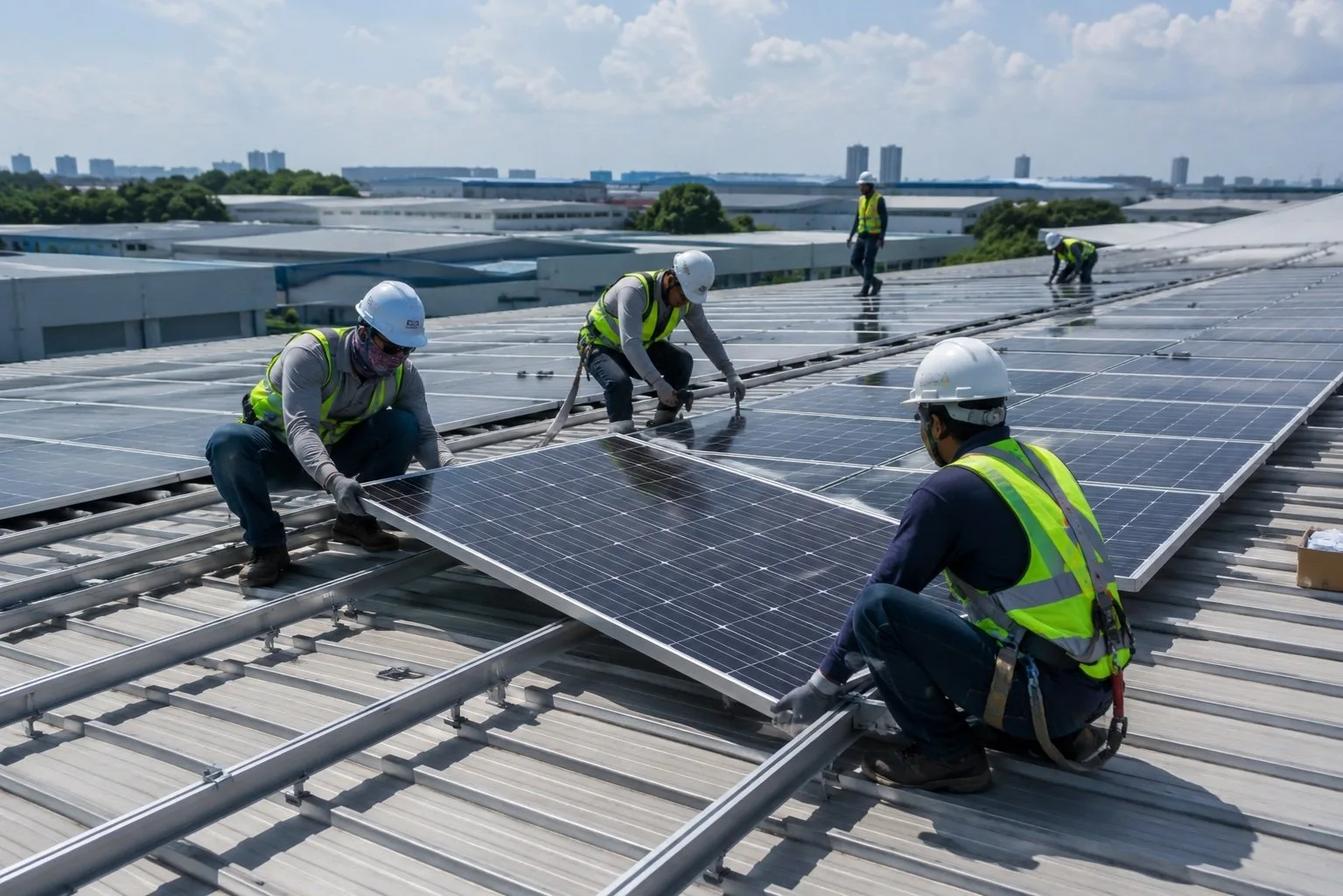
TL;DR: Factory solar installation in Malaysia lets manufacturers cut a large share of their daytime electricity bill by generating power on their own roof. Most factories run heavy loads during daylight, so self-consumption is high and payback is faster than for homes. Under NEM 3.0’s NEM NOVA scheme, excess power can be offset against your bill. Roof condition, system size, tariff, and daytime load drive the return. EDCA Energy handles the full EPCC scope — industrial solar installation from feasibility to grid connection.
Electricity is one of the biggest fixed costs on a Malaysian factory floor. Compressors, chillers, motors, and production lines run for most of the working day, and after the TNB tariff restructuring under Regulatory Period 4 in July 2025, that cost has only climbed. Factory solar installation in Malaysia has become one of the clearest ways to bring it back down — because a factory’s load profile is almost perfectly matched to when the sun is up.
This guide is written for factory owners, plant managers, and finance teams weighing up rooftop solar. It explains how factory solar installation in Malaysia actually works, what decides your payback, how the NEM 3.0 rules apply to commercial and industrial users, and how to size a system to your roof. We keep it practical and Malaysian — the schemes, the tariffs, and the numbers that matter here, not generic global advice. For the full engineering scope, our industrial solar installation service covers design, procurement, construction, and commissioning end to end.
Before we get into sizing and payback, here’s a short look at what an industrial rooftop install involves on the ground.
Watch: solar installation on an industrial roof, step by step
A walkthrough of a rooftop solar install on an industrial unit, from mounting to wiring — useful context for what happens on a factory roof.
Source: Solar Installation on Industrial Unit Roof (YouTube)
1. Why Malaysian factories are switching to solar
Quick Answer: Factories switch to solar because their electricity demand peaks during the day, exactly when a rooftop system generates most. That means most solar power is used on-site rather than exported, so the savings are large and immediate. With rising commercial tariffs and demand charges, a well-sized industrial solar system now pays back faster than most other plant upgrades.
The economics come down to timing. A home uses most of its electricity at night; a factory uses most of it while machines run through the day. Solar generation follows the same daylight curve, so a factory consumes its own solar directly instead of selling it back cheaply. This “high self-consumption” is the single biggest reason factory solar in Malaysia performs so well.
That is why factory solar installation in Malaysia has shifted from a nice-to-have into a core cost decision. Three pressures push manufacturers toward it:
- Rising grid costs. The RP4 tariff restructuring from 1 July 2025 raised the base tariff and separated out capacity and network charges for commercial and industrial users. You can check the current structure on the official TNB tariff page.
- Demand charges. Medium-voltage factories pay a maximum-demand (kW) charge on top of energy (kWh). Solar shaves daytime consumption, which helps manage both.
- Sustainability pressure. Multinational buyers increasingly ask suppliers for cleaner operations, and solar is a visible, verifiable step.
Key takeaway: A factory’s daytime load makes solar unusually efficient in Malaysia — most of what you generate is used on the spot, turning sunlight straight into bill reduction rather than low-value export.
2. How factory solar installation works, step by step
Quick Answer: A factory solar installation follows a fixed EPCC path: site and roof assessment, system design and energy modelling, SEDA/NEM application, procurement, construction, then testing and grid connection. A provider like EDCA Energy runs all six stages under one contract, so the factory deals with a single accountable party from feasibility to switch-on.
EPCC stands for Engineering, Procurement, Construction, and Commissioning. For an industrial roof, the sequence usually runs like this:
- Site and roof survey. Engineers check roof structure, sheet type, age, load capacity, and shading, and confirm the roof can carry a solar array for its full life.
- System design and energy modelling. The team sizes the array to your daytime load and roof area, then models expected generation and self-consumption.
- Application and approvals. The provider handles the SEDA NEM application, TNB paperwork, and any local authority requirements.
- Procurement. Panels, inverters, mounting, and cabling are sourced to the approved design.
- Construction and installation. Mounting, panel fixing, DC and AC wiring, and inverter setup are carried out with minimal disruption to production.
- Testing and commissioning. The system is tested, connected to the grid, and handed over with monitoring and a maintenance plan.
Because these steps are ordered and each depends on the last, choosing a single EPCC contractor avoids the finger-pointing that happens when design, supply, and install sit with different vendors.
Key takeaway: The roof survey and energy model at the start decide the whole project’s return. Get these right and the rest is execution; skip them and you risk an oversized or underperforming array.
Not sure if your roof is solar-ready? A quick feasibility check tells you your usable area, likely system size, and rough savings before you commit. Get a free factory solar quote →
3. How much roof space and system size does a factory need?
Quick Answer: As a rough planning rule, a factory needs about 6 square metres of usable roof per kWp of solar, and each kWp generates roughly 1,300–1,400 kWh a year in Peninsular Malaysia. So a 500 kWp system needs around 3,000 m² and produces about 675,000 kWh yearly. Your real figure comes from an industrial solar site assessment.
Roof area and daytime load together set the system size. The table below is an illustrative planning guide — actual output depends on roof orientation, shading, panel choice, and location.
| System size | Usable roof area | Approx. annual generation | Typical factory profile |
|---|---|---|---|
| 100 kWp | ~600 m² | ~135,000 kWh | Small workshop / light manufacturing |
| 300 kWp | ~1,800 m² | ~405,000 kWh | Mid-size factory |
| 500 kWp | ~3,000 m² | ~675,000 kWh | Large single-shift plant |
| 1,000 kWp (1 MWp) | ~6,000 m² | ~1,350,000 kWh | Large / multi-line manufacturing |
Illustrative planning figures modelled by EDCA Energy at ~6 m²/kWp usable roof and ~1,350 kWh/kWp annual yield; actual results vary by site.
Most factories cannot fill their entire roof — you leave space for skylights, walkways, HVAC units, and safety access. That’s why usable area is always smaller than total roof area.
Key takeaway: Size to your daytime consumption first, roof area second. A system larger than your load exports cheaply and dilutes your return, so the sweet spot is one that your factory can absorb during working hours.
4. What drives factory solar payback in Malaysia?
Quick Answer: The biggest lever on factory solar payback is how much of the solar you use on-site during the day. After that come system scale, your electricity tariff and demand charges, roof condition, and financing. A factory that consumes nearly all its solar internally sees a much shorter payback than one exporting a large share to the grid.
Payback is not a single fixed number — it moves with the factors below. The chart shows their relative influence, based on EDCA project experience rather than a lab study.
| Factor | Relative influence |
|---|---|
| Daytime self-consumption ratio | Very high |
| System size / scale | High |
| Tariff & demand charges | High |
| Roof condition & orientation | Moderate |
| Financing structure | Moderate |
Directional, illustrative ranking based on EDCA Energy factory project experience; not a measured study.
The pattern is clear: behaviour and load shape matter more than the hardware brand for factory solar in Malaysia. Two identical systems on two factories can have very different paybacks purely because one runs two shifts and the other one.
Key takeaway: If you want the fastest payback, focus on matching system size to your daytime load, not on chasing the cheapest panel. Self-consumption is where the money is.
5. NEM 3.0 and NEM NOVA: how factories get credited for export
Quick Answer: Commercial and industrial users join solar under the NEM NOVA sub-scheme of NEM 3.0, administered by SEDA. Excess energy exported to the grid is credited against your bill. Because factories self-consume most of their solar, export is usually a small slice — but the scheme still lets nothing go to waste. Details are on the SEDA NEM portal.
NEM 3.0 splits its quota across sub-schemes. For factories, the relevant one is NEM NOVA (Net Offset Virtual Aggregation), the commercial and industrial track that lets PV owners offset exported energy against consumption. SEDA Malaysia is the implementing agency, with the Energy Commission as regulator.
What this means in practice for a factory:
- Self-consumption comes first. The solar you use on-site directly avoids grid electricity at your full tariff — the highest-value outcome.
- Export is credited, not sold at retail. Surplus sent to the grid is offset per the scheme rules, so a well-sized system keeps export modest and self-use high.
- Quota and eligibility apply. NEM operates within a national quota, so applying early through a registered provider matters.
Because the rules and quota change over time, always confirm the current position via SEDA and work with a SEDA-registered installer who submits the application correctly the first time.
Key takeaway: NEM NOVA rewards factories for using solar rather than exporting it. Design around self-consumption, treat export as a bonus, and let a registered installer handle the SEDA paperwork.
6. Where does a factory’s solar energy actually go?
Quick Answer: It depends on your shift pattern. A two-shift factory with heavy daytime load can self-consume around 90% of its solar and export only about 10%. A single daytime shift self-consumes roughly 75%, while a low-load warehouse may export closer to 45%. The more you run during daylight, the more value you keep.
The split below is illustrative, modelled on typical Malaysian factory load shapes. It shows why the same system performs differently depending on how the plant operates.
| Operating pattern | Self-consumed on-site | Exported (NEM NOVA) |
|---|---|---|
| Two-shift, high daytime load | ~90% | ~10% |
| Single daytime shift | ~75% | ~25% |
| Warehouse / low daytime load | ~55% | ~45% |
Illustrative modelling by EDCA Energy based on typical Malaysian factory load profiles; actual split varies by site and season.
This is also why we recommend reviewing your operating pattern before deciding on choosing an industrial solar panel company — the right installer designs to your load, not to a generic template.
Key takeaway: Your shift pattern is a design input, not an afterthought. Share your real load profile early so the system is sized to keep self-consumption high.
Want a savings estimate matched to your shift pattern? Share your monthly TNB bill and roof size and we’ll model it for you. Request a free factory solar assessment →
7. What does the savings trajectory look like over time?
Quick Answer: A factory solar system recovers its cost gradually through avoided electricity, then keeps saving for the rest of its 25-plus-year life. In an illustrative model, a well-matched system recovers its upfront cost around year six and delivers well over its cost again by year ten. Your exact figure is quote-based and depends on tariff, load, and financing.
The table below tracks the illustrative cumulative cost recovered for a 300 kWp factory system, expressed as a share of the upfront investment. It is a modelled scenario, not a fixed EDCA price.
| Year | Cumulative cost recovered | Position |
|---|---|---|
| Year 1 | ~15% | Early savings begin |
| Year 3 | ~45% | Nearly half recovered |
| Year 5 | ~78% | Approaching breakeven |
| Year 6 | ~95% | At breakeven |
| Year 8 | ~130% | Net positive |
| Year 10 | ~165% | Strong net gain |
Illustrative modelled scenario by EDCA Energy; assumes steady tariff and high self-consumption. Not a quote or guaranteed return — request a tailored estimate.
After breakeven, the panels keep producing for the rest of their life, so the later years are close to pure saving aside from light maintenance. That long tail is what makes solar a plant asset rather than a running cost.
Key takeaway: Judge factory solar over its full 25-year life, not year one. The early years pay it off; the later years are where the compounding savings sit.
8. How to choose a factory solar installer
Quick Answer: Choose a SEDA-registered EPCC provider with a real industrial track record, in-house engineering, and a clear maintenance plan. For factories, structural roof competence and load-matched design matter more than a low headline price. Our guide to the best solar panel company in Malaysia walks through the checks in detail.
When you compare quotes for factory solar installation in Malaysia, the stakes on an industrial roof are higher than for a home, so weigh installers on:
- Accreditation. SEDA registration (RPVSP) and relevant CIDB and ST credentials are non-negotiable.
- Industrial experience. Ask for factory and warehouse projects at a similar scale, not just residential rooftops.
- Structural and electrical competence. The installer must assess roof loading and integrate safely with your switchgear.
- Aftercare. Monitoring, cleaning, and a documented maintenance schedule protect your generation for decades.
EDCA Energy is a SEDA-registered EPCC provider with a group track record spanning hundreds of sites and hundreds of MW installed, which is the kind of depth an industrial roof warrants.
Key takeaway: Pick the installer on engineering depth and track record, not the cheapest quote. A poorly designed factory array underperforms for 25 years — a well-designed one pays you back for 25.
9. Conclusion
Factory solar installation in Malaysia works so well because a manufacturer’s load and the sun’s schedule line up almost perfectly. High daytime self-consumption turns most generated energy into direct bill savings, NEM NOVA handles the rest, and a well-designed system pays for itself well inside its life. The decisions that matter — roof survey, system sizing to your load, and picking an experienced EPCC installer — all happen before a single panel goes up.
If you’re weighing it for your plant, start with a feasibility check on your own roof and load. EDCA Energy delivers the full scope through its industrial solar installation service, from first survey to grid connection.
Ready to cut your factory’s electricity bill?
Get a free, no-obligation assessment of your roof, load, and expected savings from EDCA Energy’s industrial solar team. We handle the design, the SEDA application, and the full installation.
10. Frequently asked questions
How long does a factory solar installation take in Malaysia?
From signed contract to grid connection, most factory projects run a few months, depending on system size, roof complexity, and how quickly the SEDA NEM application and TNB approvals clear. The physical installation itself is usually the shortest part; approvals and design often take longer.
Will solar disrupt my production during installation?
A competent installer plans works to avoid halting production. Rooftop mounting happens above the shop floor, and the final grid tie-in is scheduled for a short, agreed window. Good planning keeps downtime minimal.
Do I need a battery for factory solar?
Usually not for bill savings, because factories consume most of their solar during the day when it’s generated. Batteries make sense for backup power or specific demand-management goals, but many factories get strong returns from a grid-tied system alone.
How much can a factory save with solar?
Savings depend on your tariff, daytime load, and system size, so figures are quote-based. Because self-consumption is high for most factories, a well-sized system can offset a large share of daytime grid consumption. Ask for a tailored estimate rather than relying on a generic percentage.
Is my factory roof suitable for solar?
Most industrial metal and concrete roofs suit factory solar installation in Malaysia if they’re structurally sound and not heavily shaded. A site survey confirms roof loading, sheet condition, and usable area before design begins.
See your solar savings in under a minute
Estimate your ideal system size, payback period and monthly bill offset with the EDCA calculator.