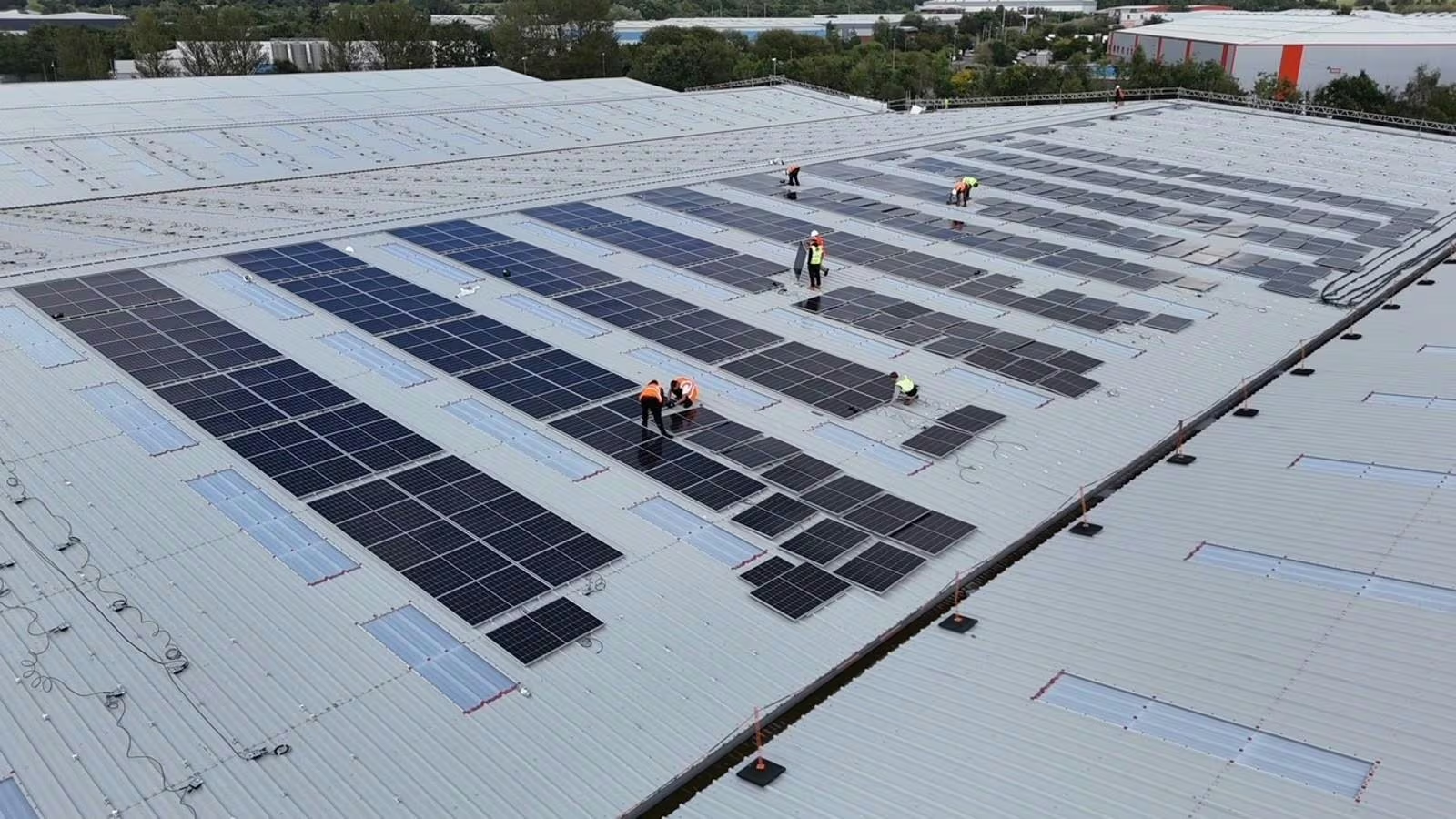
TL;DR: An industrial solar panel company designs, builds and maintains large rooftop or ground-mounted solar systems for factories, plants and warehouses. The right partner is an EPCC provider that handles engineering, SEDA and TNB approvals, and long-term upkeep — not just panel supply. This guide explains what an industrial solar panel company does, how industrial projects differ from home or shop systems, the credentials that separate a serious contractor from a broker, and how the numbers stack up under Malaysia’s new RP4 tariff.
For a Malaysian factory, electricity is a fixed cost that behaves like a variable one. Machines, compressors and chillers run all day, and the monthly TNB bill moves with tariff changes and fuel surcharges plant managers cannot control. Since the RP4 tariff restructuring took effect in July 2025, industrial users are watching those bills closely — and looking hard at their own roofs.
This guide is for the people who carry that cost: plant managers, factory owners, operations directors and finance leads weighing whether an industrial solar panel company can turn unused roof space into cheaper power. We keep it practical and Malaysian — real schemes, real credentials, honest numbers — with EDCA’s industrial solar installation service as one reference point. First, a short look at industrial rooftop solar in action.
Watch: large-scale rooftop solar on Malaysian buildings
How a major Malaysian operator rolled out rooftop solar across large sites — the same engineering an industrial solar panel company applies to factories.
Source: AEON Malls Malaysia’s commitment to sustainability through solar energy (YouTube, 15 April 2025).
2. What does an industrial solar panel company actually do?
Quick Answer: An industrial solar panel company is an EPCC provider — engineering, procurement, construction and commissioning — that delivers a complete solar system for heavy-load sites like factories and warehouses. It surveys the roof and load, designs the system, sources tier-one equipment, lodges the SEDA and TNB applications, installs, and maintains the plant. Supplying panels is only a fraction of the job.
The word “company” hides a lot of variation. At one end sits a broker who resells panels and subcontracts the labour; at the other, a full EPCC contractor that owns the whole chain from the first structural survey to the monitoring dashboard. For an industrial site, that difference decides whether the system performs for 25 years or becomes a maintenance headache.
A capable industrial solar panel company carries four core responsibilities:
- Engineering. Load-profile analysis, roof structural checks, single-line diagrams and system design sized to how the plant actually runs.
- Procurement. Sourcing bankable panels, inverters and mounting that suit an industrial roof and a decades-long warranty.
- Construction. Safe installation on large or high roofs, cable routing, and grid interconnection to the plant’s switchgear.
- Commissioning and care. Testing, SEDA and TNB sign-off, monitoring setup, and ongoing industrial solar maintenance.
EDCA Energy is a SEDA-registered RPVSP (Registered Photovoltaic Service Provider) and a TNB partner, with more than 150 projects and 80-plus MWp installed. If you are still mapping the wider market first, our guide to the best solar panel company in Malaysia lays out how the tiers of provider differ, and the main EDCA Energy site covers the full solutions range.
Key takeaway: The right partner is a full EPCC company, not a panel reseller. The value sits in engineering, approvals and long-term care — the parts that keep a factory system producing for its whole warranted life.
Curious what your factory roof could carry?
A quick site check gives you a real answer. Explore EDCA’s industrial solar installation options →
3. How industrial electricity costs changed under RP4
Quick Answer: Malaysia’s RP4 tariff restructuring, effective 1 July 2025, broke the old blended industrial tariff into separate energy, capacity, network and retail charges and replaced the ICPT surcharge with an automatic fuel adjustment. For a factory, the bill is now itemised by how much power you draw and when — which makes self-generated solar more valuable, not less.
Under the old system, most of an industrial bill hid inside one energy rate plus a moving surcharge. RP4, which applies to all non-domestic users in Peninsular Malaysia until the end of 2027, unbundles that into distinct components — and knowing them shows exactly where rooftop solar bites.
| Bill component | What it covers | Does solar help? |
|---|---|---|
| Energy charge | Cost per kWh of electricity consumed | Yes — every solar kWh self-consumed avoids this |
| Capacity & network charge | Grid access based on your demand profile | Partly — lower daytime peaks can reduce it |
| Retail charge | Fixed account and billing cost | No — a flat administrative fee |
| Automatic fuel adjustment | Fuel-price pass-through (replaces ICPT) | Yes — less grid energy means less exposure |
Structure based on the RP4 non-domestic tariff, effective 1 July 2025. See TNB — Understand Your Electricity Tariff. Component impact is general guidance, not a bill estimate.
The practical read is simple: the largest, most controllable slice of an industrial bill is energy used during working hours — exactly when a rooftop array produces most. A good installer designs around that overlap. For factories specifically, our factory solar installation guide digs deeper into matching output to a production schedule.
Key takeaway: RP4 makes an industrial bill transparent — and the biggest, most reducible component is daytime energy. That is precisely the part rooftop solar displaces, which strengthens the case for industrial solar rather than weakening it.
4. What size system does an industrial site need?
Quick Answer: Industrial systems are sized by daytime load and available roof area, and they run large — commonly from several hundred kilowatts to multiple megawatts. The goal is to self-consume nearly all output during production hours. The bands below are for orientation only; an energy audit sets the real figure.
Industrial roofs are the biggest asset most factories forget they own — a single warehouse roof can carry a system many times larger than a whole street of houses. The limiting factors are structural capacity, roof condition and how steadily the plant draws power. The table gives a feel for how industrial systems scale.
| Facility type | Indicative system band | Relative scale |
|---|---|---|
| Light manufacturing / SME workshop | 100–300 kWp | |
| Logistics / cold-storage warehouse | 300 kWp–1 MWp | |
| Mid-size factory / plant | 1–3 MWp | |
| Large / heavy industrial plant | 3 MWp and above |
Illustrative sizing bands based on EDCA project experience across Malaysian industrial sites. Every system is sized to the actual load and roof — figures are for orientation, not a quote.
The heavier and more continuous the daytime load, the larger the system that pays for itself — the power is used the instant it is made. Sizing a multi-megawatt plant is a very different engineering problem to a home array, which is why an experienced industrial solar panel company matters so much at this scale.
Key takeaway: Industrial systems are sized to load and roof, not floor area — and they run from hundreds of kilowatts to several megawatts. The best return comes when almost all output is consumed on site during production hours.
Want your plant’s real system size?
Share your load profile and roof plan, and we will size it. Get a free quote →
5. How to choose an industrial solar panel company
Quick Answer: Choose on engineering depth and staying power, not headline price. The strongest signals are SEDA registration, a real track record at your scale, in-house EPCC capability, bankable equipment, and a maintenance plan. A cheap quote from a broker who disappears after commissioning is the most expensive option over 25 years.
Because an industrial system is a 25-year asset bolted to your production roof, the real question is who will still stand behind it in year ten. Weigh candidates against a consistent checklist, not the first proposal that lands:
- SEDA registration. A registered RPVSP is authorised to design and certify grid-connected systems — a baseline, not a bonus.
- Track record at scale. Ask for commissioned megawatts and reference sites of a similar size to yours.
- In-house EPCC. Companies that engineer and build with their own teams control quality; brokers who subcontract everything cannot.
- Bankable equipment. Tier-one panels and inverters with warranties from manufacturers likely to still exist in 15 years.
- Maintenance and monitoring. A named O&M plan, response times, and a dashboard you can actually see.
Price still matters, but read it in context — the lowest bid often quietly drops structural reinforcement, quality mounting or a maintenance commitment. For the full comparison framework, our guide to the best solar panel company in Malaysia walks through the checks step by step, and the factory solar installation guide covers the on-site build.
Key takeaway: Pick an industrial solar panel company for its engineering, track record and after-sales commitment. Over a 25-year asset life, the partner who stays is worth far more than the one who quotes cheapest.
6. Which accreditations and credentials matter?
Quick Answer: The credentials that count are SEDA RPVSP registration (authorises grid-connected work), a TNB partnership (smooths interconnection), CIDB registration (legal for construction work), and industry memberships such as MPIA. Together they show an industrial solar panel company is licensed, insurable and accountable — not just enthusiastic.
Accreditation is boring right up until something goes wrong on a live industrial roof. Each credential below maps to a specific risk it removes — treat the list as a due-diligence filter before you sign anything.
| Credential | What it proves | Issued / recognised by |
|---|---|---|
| RPVSP registration | Authorised to design and certify grid-tied PV | SEDA Malaysia |
| TNB partnership | Familiar with interconnection and approvals | Tenaga Nasional Berhad |
| CIDB registration | Legally able to carry out construction work | CIDB Malaysia |
| Electrical competency (ST) | Qualified to work on HV/LV installations | Suruhanjaya Tenaga |
| Industry membership (e.g. MPIA) | Accountability to sector standards | Malaysian PV Industry Association |
Credential guide compiled by EDCA Energy from Malaysian regulatory requirements. Registration for grid-connected solar is administered through SEDA Malaysia.
EDCA holds SEDA RPVSP registration, is a TNB partner, and carries CIDB, myHijau and MPIA credentials — the same checklist above. If a prospective industrial solar panel company hesitates when you ask for registration numbers, treat that as your answer.
Key takeaway: SEDA, TNB, CIDB and ST credentials are the difference between a licensed, accountable contractor and an uninsured risk on your roof. Ask for the registration numbers before you compare prices.
Want a fully accredited partner on your project?
EDCA is a SEDA-registered RPVSP and TNB partner. See our industrial solar credentials and scope →
7. Financing and incentives for industrial solar
Quick Answer: Industrial users join solar mainly through self-consumption, with the NOVA arm of NEM 3.0 covering commercial and industrial systems, and can claim the Green Investment Tax Allowance (GITA) on qualifying assets. Where a business prefers no upfront cost, a solar power purchase agreement (PPA) lets a developer own the system while the plant buys the cheaper power.
Two questions decide how a factory funds solar: which scheme governs the export, and who owns the asset. Commercial and industrial systems sit under NEM NOVA, administered by SEDA and built around self-consuming your output and exporting the surplus. Separately, GITA lets qualifying solar CAPEX offset a large share of statutory income.
- NEM NOVA. The commercial and industrial track of NEM 3.0 — self-consume first, export surplus at a market-based rate. Confirm current quota with SEDA before planning.
- GITA. Green Investment Tax Allowance of 100% of qualifying solar CAPEX, set off against 70% of statutory income, with the incentive window extended to 31 December 2026.
- Cash purchase. The plant owns the system outright and keeps all the savings — shortest long-run cost, highest upfront outlay.
- Solar PPA / lease. A developer funds and owns the system; the factory buys the generated power at an agreed rate with no capital cost.
The right structure depends on your balance sheet and appetite for ownership, and a good provider will model both routes rather than pushing one. Incentive rules and quotas change, so verify eligibility through SEDA’s fiscal-incentive guidance or your provider before committing.
Key takeaway: Industrial solar runs on self-consumption under NEM NOVA, with GITA improving the payback and a PPA offering a zero-CAPEX route. Match the funding structure to your finances — and confirm current incentive windows before you plan.
8. What returns can an industrial system deliver?
Quick Answer: Return comes mainly from avoided grid purchases, so the larger and steadier the daytime load, the faster the payback. Industrial panels typically carry 25-plus-year performance warranties, so once the system pays for itself, the remaining years are largely free power. The illustrative ranges below show how payback tends to shorten as system size rises — your real figure needs a quote.
Because a plant self-consumes most of its output, every midday kilowatt-hour generated is one not bought from TNB at the industrial rate. Bigger, steadier loads displace more expensive grid energy, so payback usually shortens as the system grows. The chart shows the pattern, not a promise.
| System size band | Illustrative payback | Relative speed |
|---|---|---|
| 100–300 kWp | ~5–6 years | |
| 300 kWp–1 MWp | ~4.5–5.5 years | |
| 1–3 MWp | ~4–5 years | |
| 3 MWp and above | ~3.5–4.5 years |
Illustrative modelled scenario based on typical industrial self-consumption savings and GITA relief. Actual payback depends on tariff, roof, load and financing — get a free quote for a figure specific to your plant.
Payback is only half the story. After it, the system keeps producing for the rest of its warranted life and hedges you against future tariff and fuel-adjustment rises — a saving that grows as grid prices do. Treat any single projection with healthy caution until it is quoted for your site.
Key takeaway: Industrial solar pays back faster the larger and steadier the load, then delivers years of low-cost power and a tariff hedge. Treat any single payback figure as illustrative until an industrial solar panel company quotes it for your plant.
9. Conclusion: choosing the right partner
Quick Answer: The right industrial solar panel company is defined by engineering depth, accreditation and after-sales commitment — not the lowest quote. If your plant runs a meaningful daytime load and has usable roof, an industrial system is very likely worth a proper assessment. The only reliable way to know your numbers is a site-specific quote.
Industrial solar in Malaysia has moved from optional to obvious for plants with steady daytime demand. Under RP4 the biggest slice of the bill is daytime energy, NEM NOVA and GITA improve the economics, and a full EPCC partner removes the regulatory and construction burden. What separates a good outcome from a poor one is the company you choose — its engineering, its credentials, and whether it will still stand behind the system in year ten.
As a SEDA-registered RPVSP and TNB partner with 150+ projects and 80+ MWp installed, EDCA Energy handles engineering, approvals and maintenance as a single accountable partner. The next step is simple: get your load profile and roof assessed by a registered provider so the payback stops being illustrative and becomes a real figure for your site.
10. Frequently asked questions
What does an industrial solar panel company do?
An industrial solar panel company is an EPCC provider that delivers a complete solar system for heavy-load sites like factories and warehouses. It surveys the roof and load, engineers and designs the system, sources bankable equipment, lodges the SEDA and TNB applications, installs the array, and then maintains it. Panel supply is only one part of a much larger job.
How is industrial solar different from commercial or home solar?
Scale and complexity. Industrial systems run from hundreds of kilowatts to several megawatts, sit on large or structurally demanding roofs, and connect into heavier switchgear. They are sized to a plant’s continuous daytime load, which usually means higher self-consumption and a stronger case for solar than a home or small shop system.
Does an industrial solar system need a battery?
Usually not. Because a plant consumes most of its output during production hours, a grid-tied system without batteries already captures the bulk of the savings. Batteries can be added where a site needs backup power or wants to store surplus, but for most industrial projects they are an option rather than a requirement.
What incentives are available for industrial solar in Malaysia?
Commercial and industrial users join solar through the NOVA arm of NEM 3.0 and can claim the Green Investment Tax Allowance (GITA) on qualifying assets. A solar PPA offers a zero-upfront route where a developer owns the system. Because quotas and windows change, confirm current eligibility with SEDA or your provider before planning.
How much does an industrial solar system cost in Malaysia?
There is no single price — it depends on system size, roof type, equipment and financing structure. Rather than a fixed figure, a proper quote models your load and roof to show the investment and expected payback. Reputable providers give this assessment free, so you can compare options before committing.
Ready to see what industrial solar could save your plant?
EDCA Energy is a SEDA-registered RPVSP and TNB partner with 150+ projects and 80+ MWp installed across Malaysia. Share your bill and roof plan, and we will model your system, incentives and payback — no cost, no obligation.
Get a Free QuoteSee your solar savings in under a minute
Estimate your ideal system size, payback period and monthly bill offset with the EDCA calculator.