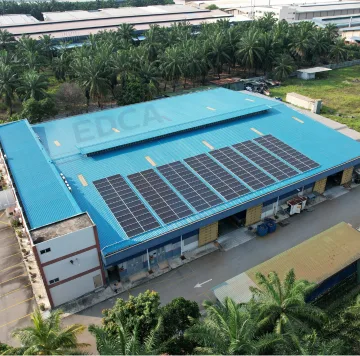
TL;DR: A factory solar panel project in Malaysia is a finance decision first. Size the system in kWp to your daytime base load (not your roof), keep self-consumption above 85%, and model payback on the RP4 tariff with Solar ATAP export credits at the lower system marginal price. Claim GITA before 31 December 2026 to cut the net cost, then use the generation data for buyer audits and sustainability reporting. EDCA Energy delivers the full industrial solar EPCC scope.
Most guides on factory solar panels in Malaysia explain how the panels go up. This one is for the person who signs the capital request: how many kWp to buy, when the money comes back under the new TNB tariff, and what the system is worth beyond the electricity bill.
Those answers changed in 2025 and 2026. RP4 restructured how medium-voltage factories are billed, Solar ATAP replaced NEM for new applications from 1 January 2026, and GITA now has a hard deadline. Buyers and regulators are also asking for emissions data that a factory solar panel Malaysia installation can supply directly. For the installation sequence itself, read our guide to factory solar installation in Malaysia; this article picks up where it ends.
Before the numbers, here is what a large factory rooftop system in Malaysia looks like once it is built.
Watch: a factory rooftop solar farm, start to finish
A timelapse of a rooftop solar farm being built across a car factory’s roofs — useful context for the scale a large factory array can reach.
Source: Bentley Factory Rooftop Solar Farm Timelapse| Lightsource bp (YouTube)
1. Why factory solar panels in Malaysia are now a CFO decision, not a facilities project
Quick Answer: Since 1 July 2025, medium-voltage factories are billed in separate energy, capacity, network and retail components, with a monthly fuel adjustment on top. That makes electricity a variable cost you cannot budget precisely. A factory solar panel Malaysia system fixes the price of a large slice of daytime energy for 25 years, which is why industrial solar now sits in the capex plan rather than the maintenance budget.
The RP4 average base tariff is 45.40 sen/kWh for 1 July 2025 to 31 December 2027, a 13.6% rise on RP3, and medium and high voltage non-domestic users face a higher effective maximum demand charge, as reported by Focus Malaysia. The old six-monthly ICPT surcharge also became a monthly Automatic Fuel Adjustment, so the fuel part of your bill now moves every month.
- Energy is the only component solar removes. Capacity, network and retail charges stay, so savings come from the kWh you no longer buy and the daytime peak kW you no longer pull.
- Volatility is the hidden cost. A monthly fuel adjustment makes next year’s power budget a guess. Self-generated kWh have a known cost: system price divided by lifetime output.
- The asset outlives the tariff period. RP4 ends in 2027; a panel warranty runs 25 years, through several more tariff reviews.
Key takeaway: Treat solar as a hedge on a cost you cannot otherwise fix. The question is not whether it is green, but how much of your energy charge it locks in and at what price per kWh.
2. How many kWp does a factory need? Size to daytime load, not roof area
Quick Answer: Size a factory solar panel Malaysia system at roughly 80–100% of the average daytime base load in kW, then check the roof can carry it. Solar ATAP lets non-domestic users install up to 100% of maximum demand, capped at 1,000 kW. The table below shows illustrative sizing bands; the EDCA solar savings calculator gives a first estimate for your plant.
Under the Solar ATAP guidelines, a non-domestic consumer may install up to 100% of maximum demand, subject to technical assessment and a 1,000 kW ceiling. That is the legal limit. The financial limit is lower: every kWh you export is credited at the average system marginal price, not your retail rate, so oversizing beyond daytime load dilutes the return.
| Avg daytime base load | Suggested system | Approx. annual yield | Expected self-consumption |
|---|---|---|---|
| 150 kW | ~150 kWp | ~195,000 kWh | ~90% |
| 400 kW | ~350 kWp | ~455,000 kWh | ~88% |
| 800 kW | ~650 kWp | ~845,000 kWh | ~85% |
| 1,500 kW | 1,000 kWp (ATAP cap) | ~1,300,000 kWh | ~95% |
Illustrative modelling by EDCA Energy at ~1,300 kWh/kWp annual yield and a single daytime shift; the 1,000 kW cap follows the Solar ATAP guidelines. Actual sizing depends on load data and roof survey.
- Base load, not peak load. Use the average kW drawn between about 9am and 5pm on a normal production day, from your TNB interval data. Compressor-start peaks are not a sizing input.
- Roof is the second check. At roughly 6 m² per kWp, a 650 kWp array needs about 3,900 m² of usable roof. If the roof is smaller, build what fits.
Key takeaway: The kWp figure should come from your interval meter data, not from how many panels fit on the roof. A system your plant absorbs during working hours earns the retail rate on every kWh; a bigger one earns the marginal price on the surplus.
Have your TNB interval data handy? Send us twelve months of bills and we will return a load-matched kWp recommendation with modelled self-consumption. Request a load-matched sizing study →
3. How maximum demand charges change the maths for factory solar panels in Malaysia
Quick Answer: Medium-voltage factories pay a monthly charge on their highest 30-minute kW draw, and a factory solar panel system in Malaysia only reduces it if the peak happens in daylight on a clear day. Treat demand savings as a bonus, not the base case. Where the peak must be cut reliably, pairing panels with solar battery storage gives a controllable result.
Under Solar ATAP, maximum demand is twice the largest kWh used in any consecutive 30 minutes in a month. One cloudy half-hour at 2pm resets your charge for that month. A conservative model therefore assumes:
- Energy savings every working day from self-consumed kWh at your blended energy rate.
- Partial demand savings in months where the peak falls in strong sun. Count a fraction, not the full kW.
- Full demand control only with storage or with production scheduling that moves heavy starts out of the metered peak.
If a factory rooftop solar Malaysia proposal books 100% of the demand charge as saved, ask for the clear-sky assumption behind it.
Key takeaway: Model demand-charge savings as upside. If the business case only works with them, add storage or change the shift plan before you add panels.
4. What does factory solar payback look like under RP4 and Solar ATAP?
Quick Answer: In an illustrative 500 kWp model, factory solar payback in Malaysia runs about five years at 95% self-consumption and stretches past six years at 55%, before GITA and before any demand-charge savings. Self-consumption is the lever that moves it most. Our note on commercial solar power in Malaysia covers the same mechanics for offices and retail.
The chart ranks four self-consumption scenarios for the same system. Self-used kWh are valued at a blended energy rate; exported kWh at a lower marginal price, which is how Solar ATAP credits non-domestic export under the Solar ATAP guidelines (GP/ST/No. 60/2025).
| Self-consumption | Simple payback | Years | Year-1 savings |
|---|---|---|---|
| 95% (two shifts) | ~4.9 | ~RM 266,000 | |
| 85% (single shift) | ~5.1 | ~RM 254,000 | |
| 70% (light load) | ~5.6 | ~RM 234,000 | |
| 55% (warehouse) | ~6.1 | ~RM 215,000 |
Illustrative scenario modelled by EDCA Energy: 500 kWp, ~650,000 kWh/year, RM 1.3 million installed cost, self-used energy valued at a blended RM 0.42/kWh and export at RM 0.22/kWh. Before GITA, demand-charge savings and degradation. Not a quote.
The model leaves out GITA (next section), the demand-charge upside from Section 3, and future tariff rises. A real quote from an industrial solar panel company should show you both the conservative and the expected case.
Key takeaway: Moving self-consumption from 55% to 95% is worth more than a year of payback on the same hardware. For factory solar panels in Malaysia, sizing discipline beats panel price.
5. How GITA cuts the net cost of a factory solar system
Quick Answer: GITA solar for own consumption gives a 60% investment tax allowance on qualifying capital expenditure, set off against up to 70% of statutory income, for applications made by 31 December 2026. On a RM 1.3 million factory solar panel system in Malaysia that is roughly RM 187,000 of tax saved at the 24% corporate rate. EDCA prepares the technical documents as part of its industrial solar installation service.
MIDA’s incentive schedule sets GITA Asset (own consumption) for renewable energy systems at a 60% allowance offset against 70% of statutory income, with applications open to 31 December 2026, per the Malaysian Investment Development Authority. Solar projects built to sell power sit in a separate 100% tier, and GITE covers solar leasing companies, so confirm which track fits your structure.
| Line item | Without GITA | With GITA (60% asset tier) |
|---|---|---|
| Qualifying capital expenditure | RM 1,300,000 | RM 1,300,000 |
| Investment tax allowance (60%) | — | RM 780,000 |
| Tax saved at 24% corporate rate | — | RM 187,200 |
| Effective net cost | RM 1,300,000 | RM 1,112,800 |
| Simple payback at 85% self-use | ~5.1 years | ~4.4 years |
Illustrative modelling by EDCA Energy using the MIDA GITA Asset rate and the LHDN company tax rate of 24%; assumes enough statutory income to absorb the allowance. Not tax advice.
- Taxable profit. The allowance offsets up to 70% of statutory income per year; unused allowance carries forward, so loss-making years delay the benefit rather than lose it.
- Timing. GITA Asset applications go to MGTC and must be lodged within the window, so a project approved in 2027 may not qualify on current terms.
- Ownership. If a third party owns the system under a lease or power purchase deal, the allowance is theirs; the lower tariff you pay is your share of it.
Key takeaway: GITA is worth roughly 14% of the system price to a profitable company, but only with an application lodged before the end of 2026. Build the tax step into the project timeline from day one.
Want to see the GITA line in your own numbers? We model the after-tax case alongside the plain payback so your board sees both. Ask for an after-tax payback model →
6. What ESG value does a factory get from rooftop solar?
Quick Answer: Factory solar panels in Malaysia give a plant metered, auditable Scope 2 reductions it owns outright. That matters for buyer questionnaires, for Bursa-listed groups reporting under the National Sustainability Reporting Framework, and for suppliers to those groups who get asked for the same data. Pair it with renewable energy certificates to cover what the roof cannot.
The Securities Commission’s National Sustainability Reporting Framework phases ISSB-based disclosure in across three groups from 2025, with reasonable assurance targeted from 2027. Even if your factory is private, a listed customer in Group 1 or 2 must report its value chain, which is why supplier energy questionnaires arrived before most suppliers had a sustainability team.
| Company group | 2025 | 2026 | 2027 |
|---|---|---|---|
| Group 1: Main Market, market cap RM 2 bn and above | Reporting starts | Reporting | Reporting |
| Group 2: other Main Market issuers | — | Reporting starts | Reporting |
| Group 3: ACE Market and large non-listed companies | — | — | Reporting starts |
| Reasonable assurance (regulator’s target) | — | — | Aims to mandate |
Source: Securities Commission Malaysia, NSRF media release, 24 September 2024. Reporting periods begin on or after 1 January of the year shown.
What a factory solar panel Malaysia project gives you in that context:
- Metered evidence. Inverter data shows kWh generated and consumed, which an auditor can tie to your TNB bills.
- A lower Scope 2 figure every year. Self-consumed solar is zero-emission electricity under location- and market-based accounting, with no certificate purchase needed.
- A visible asset for buyer audits. Multinational customers walk the plant. Panels on the roof answer the question before it is asked.
Honda Malaysia’s 5.6 MWp rooftop at its Pegoh plant is a public example: Bernama reported it should generate about 7,042 MWh a year and cut roughly 4,584 tonnes of CO2 annually, a figure that goes straight into a sustainability report.
Key takeaway: The ESG value of factory solar is evidence you own. It turns a questionnaire answer into a metered number, which is what listed customers and their assurers increasingly need from suppliers.
7. Own solar, GET or RECss: which should a factory buy?
Quick Answer: Use rooftop solar for the daytime load you can self-consume, because it saves money as well as emissions. Use TNB’s Green Electricity Tariff or standalone RECss for night shifts and leased sites where you cannot build. Most factories end up with both; see our industrial solar guide for Johor for how multi-site groups split it.
Since 1 July 2025 the GET premium is a single tier of 5 sen/kWh for a one-year term, 4 sen for two years and 3 sen for three, down from 20 sen for medium-voltage users, per the PETRA media release. The same release launched GET Greenpath, which routes certificates to tenant accounts for a 0.2 sen/kWh administration charge.
- Own solar panel for factory use. Pays for itself through avoided energy charges; the emissions cut is a by-product you report for free.
- GET subscription. Cheap and capex-free, but a recurring cost with no payback and no bill reduction.
- Standalone RECss. Flexible for hitting a target in a given year; best for the remainder once solar covers the daytime load.
Key takeaway: Certificates buy a claim; a roof buys a claim and a saving. Build first, then certify the gap.
8. Conclusion
A factory solar panel Malaysia investment comes down to four numbers: the kWp you size to daytime load, the share you self-consume, the net cost after GITA, and the emissions you can evidence. Get the first two right and the payback follows; lodge the third before the end of 2026 and it shortens by months; the fourth is what your customers will ask for next.
Any factory solar panel project in Malaysia should start with twelve months of TNB data and a roof survey. EDCA Energy runs the sizing, the Solar ATAP application, the GITA paperwork and the build under one industrial solar panel installation contract; finished plants are in our project portfolio.
Ready to put a payback figure on your factory roof?
Send us your TNB bills and roof plan. We will return a load-matched kWp recommendation, an RP4 and Solar ATAP payback model, and the GITA after-tax case, with no obligation.
9. Frequently asked questions
How many kWp of solar does a factory in Malaysia need?
Size to about 80–100% of your average daytime base load in kW, taken from TNB interval data, then confirm the roof can hold it at roughly 6 m² per kWp. Solar ATAP allows non-domestic systems up to 100% of maximum demand with a 1,000 kW ceiling, but the financially sound size is usually below that.
What is the payback period for factory solar in Malaysia?
In illustrative modelling, a load-matched 500 kWp factory solar panel system in Malaysia pays back in around five years at high self-consumption, before GITA and demand-charge savings. GITA can shorten that by several months for a profitable company. Low self-consumption, shading or a weak roof push it out, so ask for a model built on your own data.
Does Solar ATAP pay factories for exported solar?
Yes, but at the average system marginal price rather than the retail energy rate, and the offset runs for a ten-year contract period. Because export earns less than self-use saves, factories should size to consume most of their generation on-site and treat export credits as a small bonus.
Can a factory still claim GITA for solar in 2026?
Yes. MIDA lists GITA Asset for own-consumption renewable energy systems at a 60% allowance against 70% of statutory income, with applications accepted until 31 December 2026. The allowance belongs to whoever owns the system, so a leased or third-party-owned array passes the benefit to the owner, not the factory.
Does rooftop solar count towards a factory’s ESG or Scope 2 reporting?
Yes. Electricity you generate and consume on-site is zero-emission under both location- and market-based Scope 2 accounting, and the inverter data gives auditors a metered record. For the portion you still draw from the grid, RECss or TNB’s Green Electricity Tariff can cover the balance.
See your solar savings in under a minute
Estimate your ideal system size, payback period and monthly bill offset with the EDCA calculator.