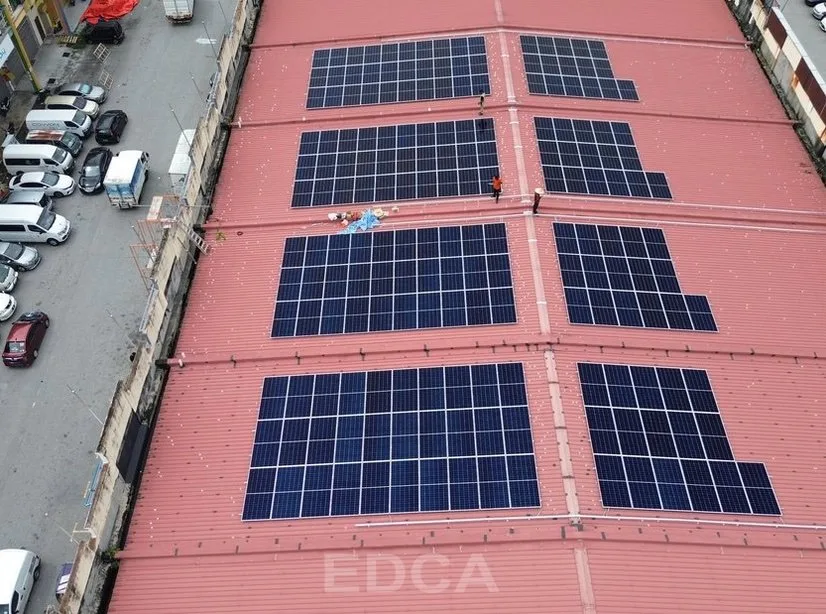
TL;DR: Commercial rooftop solar in Malaysia turns the large, unused roof over a factory, warehouse, office or retail block into a power source that offsets daytime electricity. Whether it works well comes down to the roof itself — its type, its condition, how much clear area it has, and whether the structure can take the extra load. This guide walks through roof suitability, how much space you need per kilowatt, mounting options, and the grid-connection route, so you can judge your own building before you ask for a quote.
Most Malaysian commercial buildings sit under a huge flat or gently sloped roof that does nothing all day. Commercial rooftop solar puts that space to work, generating power exactly when a business uses the most — office hours, production shifts, chillers running through the afternoon heat. Because the electricity is made and used on site, it offsets grid units at the tariff you already pay, which is where the savings come from.
This guide is for the people weighing that decision: facility managers, factory owners, and finance leads looking at a roof and wondering whether solar fits. Rather than repeat the business case — our guide to commercial solar power in Malaysia covers the returns — this piece stays on the roof itself: what makes one suitable, how much you can fit, and what has to be checked before anything gets bolted down. First, a short look at what a real commercial rooftop project involves.
Watch: a commercial rooftop solar project in practice
A walkthrough of an on-grid commercial rooftop system with net metering, showing how panels, mounting and inverters come together on a working building.
Source: Commercial solar rooftop system project | Unique solar + Storage project (YouTube, February 2024).
2. What commercial rooftop solar is — and why the roof decides everything
Quick Answer: Commercial rooftop solar is a grid-tied photovoltaic system mounted on a business’s own roof, sized to offset the building’s daytime electricity use. Unlike a solar farm on open land, it uses space you already own, so the roof’s type, area, condition and structural capacity set the ceiling on how big a system you can install and how well it performs.
A rooftop system has the same core parts wherever it sits: panels, mounting frames, inverters, cabling, and a connection back into your switchboard. What changes on a commercial roof is scale and constraint. You are working with a fixed footprint that was designed to keep rain out, not to carry solar — so the roof leads the design, not the other way round.
That is the key difference from ground-mounted or utility projects. On the ground, you size the system to the budget and buy the land to fit. On a roof, the building is already there, and the panels have to work around its shape, strength and clutter. Everything that follows in this guide — suitability, sizing, mounting, structural checks — flows from that one fact. If you want the full commercial build handled end to end, that is what a commercial solar installation service is for.
Key takeaway: Rooftop solar uses the roof you already own, so the roof — not the budget — sets the limits. Its type, area, age and strength decide the system size and the design before anything else does.
Wondering if your roof is a good fit?
The quickest way to know is a proper site assessment. Explore EDCA’s commercial solar installation service →
3. Which commercial roof types suit solar best
Quick Answer: Most Malaysian commercial roofs can take solar, but some are easier than others. Metal deck and trapezoidal roofs are the friendliest, concrete flat roofs are very workable with ballast or raised frames, and older asbestos or badly corroded roofs usually need attention or replacement first. The roof material decides which mounting system you use and how much preparation the job needs.
Malaysian factories, warehouses and shoplots come with a handful of common roof types, and each behaves differently under a solar install. The table below lays out the main ones you will meet, how well they suit rooftop solar, and the practical catch to watch for on each.
| Roof type | Solar suitability | Main consideration |
|---|---|---|
| Metal deck / IBR / trapezoidal | Excellent | Clamp-mounted, no roof penetration needed |
| Concrete flat roof (RC slab) | Very good | Ballasted or raised frames; check waterproofing |
| Standing-seam metal | Very good | Non-penetrating seam clamps preserve warranty |
| Tiled / pitched (smaller units) | Good | Tile hooks and flashing to keep it watertight |
| Asbestos / heavily corroded | Poor until treated | Usually re-roof or repair before install |
Illustrative guide based on how commercial rooftop solar is typically delivered in Malaysia; every roof still needs an on-site inspection to confirm.
The pattern is simple: sound metal and concrete roofs are straightforward, while ageing or damaged roofs need work first. It is far cheaper to fix or re-roof before the panels go up than to lift a whole array later to repair the roof underneath. A good installer flags this at survey stage rather than after handover, which is one reason it pays to choose from established commercial solar panel companies in Malaysia that inspect properly before quoting.
Key takeaway: Sound metal deck and concrete roofs suit solar with minimal fuss; asbestos and corroded roofs need repair or replacement first. Sort the roof out before the array goes up, never after.
4. How much roof space you need per kilowatt
Quick Answer: As a working rule, every kilowatt-peak (kWp) of commercial rooftop solar needs roughly 4 to 5 square metres of clear, usable roof. So a 100 kWp system wants around 450 to 550 square metres free of obstructions. Your real usable area is always less than the total roof, because walkways, plant, skylights and setbacks eat into it.
Sizing starts with area, not budget. Panels have a fixed footprint, so the clear roof you have puts a hard ceiling on the system. The ladder below shows the rough usable area different system sizes need — useful for a first sanity check against your own roof before an installer measures it precisely.
| System size | Approx. usable area | Relative footprint |
|---|---|---|
| 30 kWp (small shoplot) | ~135–165 m² | |
| 100 kWp (office / retail) | ~450–550 m² | |
| 300 kWp (warehouse) | ~1,350–1,650 m² | |
| 500 kWp (factory) | ~2,250–2,750 m² |
Illustrative figures at roughly 4.5 m² per kWp; actual area depends on panel wattage, layout and roof obstructions. A site survey confirms the real usable roof.
Two things shrink your usable roof in practice. First, obstructions — air-conditioning plant, exhaust fans, skylights, water tanks and access walkways all carve out zones that cannot hold panels. Second, safety setbacks from roof edges and around equipment. It is normal for the usable area to come out well below the total roof, which is exactly why a measured survey beats a satellite estimate.
Key takeaway: Budget roughly 4–5 m² of clear roof per kWp, then subtract for plant, skylights and setbacks. Your usable area — not the total roof — is what sizes the system.
Want to know exactly how big a system your roof can take?
A measured survey turns rough area into an accurate system size and yield. Get a free quote →
5. Mounting systems for commercial roofs
Quick Answer: The mounting system is how panels attach to your roof, and it is chosen by roof type. Metal roofs use clamps that grip the profile without drilling, concrete flat roofs use ballasted or raised tilt frames, and standing-seam roofs use seam clamps that keep the roof warranty intact. The right mount avoids leaks and holds the array through Malaysian wind and rain.
Mounting is where a lot of quiet quality lives. A poor mount leaks, corrodes, or voids the roof manufacturer’s warranty; a good one lasts as long as the panels. The table below matches the common roof types to the mounting approach a competent installer would use.
| Mounting system | Best for | Why it works |
|---|---|---|
| Profile / trapezoidal clamps | Metal deck, IBR | No drilling; grips the roof rib directly |
| Standing-seam clamps | Standing-seam metal | Non-penetrating; keeps roof warranty valid |
| Ballasted tilt frames | Concrete flat roofs | Weighted down; minimal roof penetration |
| Fixed raised frames | Flat roofs needing set tilt | Optimises angle for yield and self-cleaning |
| Tile hooks | Tiled / pitched roofs | Fixes to rafters with proper flashing |
Illustrative match of mounting approach to roof type; the final choice depends on the roof’s condition, structure and wind loading confirmed on site.
On Malaysian metal roofs, non-penetrating clamps are the workhorse — they avoid new holes in the roof skin, which is the most common source of leaks. A slight tilt also helps monsoon rain wash dust off the glass, keeping output up. These are the sort of details a serious installer gets right without being asked, and they feed straight into the value case in our guide to solar for business in Malaysia.
Key takeaway: Mounting is matched to your roof — clamps for metal, ballasted or raised frames for concrete, hooks for tile. Non-penetrating mounts on metal roofs avoid the leaks that cause most rooftop-solar problems.
6. Typical rooftop system sizes by building type
Quick Answer: System size tracks the building. A small shoplot or office might host 20–50 kWp, a mid-sized retail block or cold store 100–300 kWp, and a large warehouse or factory 300 kWp to well over 1 MWp. The bigger the roof and the higher the daytime load, the larger the system that makes sense to install.
Different commercial buildings land in different size bands, driven by roof area and how much power they draw during the day. The chart below shows the typical range you would expect to see across common Malaysian commercial property types.
| Building type | Typical size range | Relative scale |
|---|---|---|
| Shoplot / small office | 20–50 kWp | |
| Retail block / showroom | 100–250 kWp | |
| Cold store / mid factory | 250–500 kWp | |
| Large warehouse / factory | 500 kWp – 1 MWp+ |
Illustrative ranges for orientation only; actual size depends on roof area, load profile and connection limits confirmed at survey.
Bigger is not automatically better. The sweet spot is usually a system that matches your daytime consumption, so most of the power is used on site rather than exported at a lower value. That balance between roof capacity and actual load is central to the wider case in our guide to commercial solar power, and it is exactly what a design survey pins down for your building.
Key takeaway: Shoplots sit around 20–50 kWp, retail and mid-industrial in the hundreds of kWp, and large factories can top 1 MWp. Size to match daytime load, not just to fill the roof.
7. Structural, shading and safety checks before you commit
Quick Answer: Before any commercial rooftop system is approved, three things get checked: whether the structure can carry the added weight, whether shading from nearby buildings or plant will cut output, and whether the install meets electrical and fire-safety rules. Skipping these is how projects end up underperforming or, worse, unsafe. A proper survey covers all three up front.
A roof that suits solar on paper still has to pass a few practical tests before a design is locked in. These are the checks a competent installer runs at survey stage:
- Structural loading. Panels, frames and ballast add weight and wind load. An engineer confirms the roof and its supports can take it, and flags any strengthening needed.
- Roof condition and age. The roof should have years of life left, because lifting an array to repair leaks later is costly. Ageing roofs get repaired or replaced first.
- Shading analysis. Nearby taller buildings, water tanks, parapets and plant cast shadows that drag down yield. Layout is planned to avoid the worst of it.
- Electrical capacity. The switchboard and incoming supply must handle the system, and the connection has to sit within your metering and tariff setup.
- Fire and access safety. Walkways, edge setbacks, isolation points and clear paths for maintenance and emergency access are designed in, not added later.
None of this is optional on a commercial job — it is the difference between a system that quietly performs for 25 years and one that becomes a headache. It is also why choosing a properly accredited installer matters so much; our guide to the best solar panel company in Malaysia covers how to check those credentials.
Key takeaway: Structure, shading and safety are non-negotiable pre-install checks. A survey that covers loading, roof condition, shading, electrical capacity and access is what protects both the yield and the building.
Ready to get your roof properly assessed?
Structural, shading and load checks come as standard in a proper proposal. Get a free quote →
8. Getting a rooftop system connected to the grid
Quick Answer: Commercial and industrial rooftop systems in Malaysia connect to the grid through the NOVA arm of the NEM 3.0 programme, administered by SEDA with TNB as the utility. A registered installer lodges the application, secures approval, and coordinates the connection, so the system can legally export and offset your consumption. Businesses may also qualify for green tax incentives.
The regulatory side is real but manageable, and a full-service installer handles most of it for you. In short, a commercial rooftop system is grid-tied under NEM 3.0’s NOVA quota for commercial and industrial users — see SEDA’s NOVA programme for the scheme detail. Your provider lodges the NEM application, coordinates the TNB connection approval, and arranges the metering so the system is legally energised.
On top of the energy savings, companies investing in the asset may qualify for the Green Investment Tax Allowance, per MIDA’s green technology incentive. A registered EPCC managing your commercial solar installation keeps the paperwork moving so you can focus on running the business. If you are still comparing providers, the wider EDCA Energy group covers residential through utility scale.
Key takeaway: Rooftop systems connect via NEM 3.0 NOVA, with SEDA and TNB in the loop and a registered installer handling the applications. Green tax incentives can sweeten the investment case further.
9. Conclusion: read the roof first
Quick Answer: Commercial rooftop solar in Malaysia is one of the most practical ways for a business to cut daytime power costs, but the roof leads the whole decision. Confirm the roof type suits solar, check you have enough clear area, match the mounting to the structure, and pass the structural and safety checks — then the system follows naturally.
The buildings that get the most from rooftop solar are usually the plainest ones: a large, sound roof over a business that runs through the day. If that describes your premises, the odds are good — but the only way to be sure is a proper site survey that measures the roof, tests the structure, and sizes the system to your real load.
The practical next step is simple. Get an installer to assess the roof, size the system, and put an illustrative payback on paper. Once the roof has been read properly, the rest of the decision gets a lot clearer.
10. Frequently asked questions
How much roof area do I need for commercial rooftop solar in Malaysia?
Budget roughly 4 to 5 square metres of clear roof for every kilowatt-peak of solar. A 100 kWp system needs around 450 to 550 square metres free of plant, skylights and walkways. Your usable area is always less than the total roof, so a measured survey is the only reliable way to size the system.
Can solar panels be installed on a metal factory roof?
Yes — metal deck and trapezoidal roofs are among the best surfaces for commercial rooftop solar. Panels attach with non-penetrating clamps that grip the roof profile without drilling holes, which avoids leaks and keeps the roof warranty intact. The roof still needs a condition and structural check first.
Will rooftop solar damage or leak my roof?
Not when it is installed correctly. On metal roofs, non-penetrating clamps avoid new holes altogether, and on concrete roofs, ballasted or properly flashed frames protect the waterproofing. Most leak problems come from poor workmanship, which is why the installer’s method and warranty matter as much as the panels.
How do commercial rooftop solar systems connect to the grid?
Commercial and industrial systems connect through the NOVA arm of NEM 3.0, administered by SEDA with TNB as the utility. A registered installer lodges the NEM application, secures approval, and coordinates the TNB connection and metering, so the system can legally offset your consumption.
How much does a commercial rooftop solar system cost?
There is no single price — cost depends on system size, roof type, mounting, equipment and financing, so reputable installers quote per site rather than list a fixed figure. A proper proposal measures your roof, models your bill, and shows the expected payback, and good providers give this assessment free.
Ready to put your commercial roof to work?
EDCA Energy is a SEDA-registered RPVSP and TNB partner with 150+ projects and 80+ MWp installed across Malaysia. Get a free rooftop assessment — roof suitability, system size, incentives and payback — with no obligation.
Get a Free QuoteSee your solar savings in under a minute
Estimate your ideal system size, payback period and monthly bill offset with the EDCA calculator.