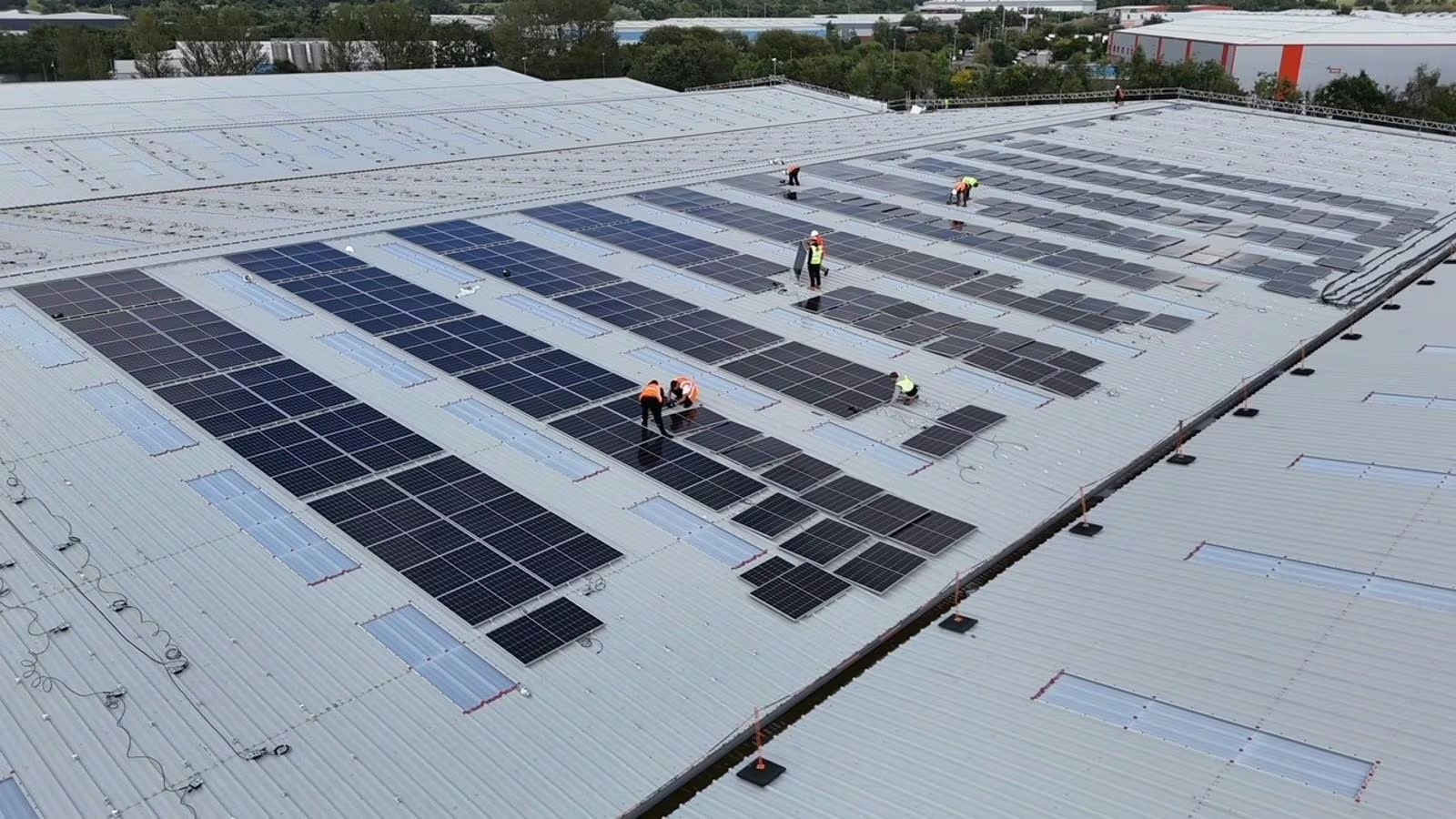
TL;DR: The right solar panel for factory roofs in Malaysia today is a 580–650 W N-type TOPCon module, clamped to metal deck or framed low on concrete, feeding string inverters with string-level monitoring. Keep it clear of rooftop plant, tilt it enough to self-clean, and size it to your maximum demand under Solar ATAP. EDCA Energy delivers all of this through its industrial solar panel installation service.
Most guides to factory solar stop at roof area and payback; our factory solar installation guide covers those. This article is the next step: the hardware and roof questions a plant engineer must answer before signing off a quotation for a solar panel for factory use.
We cover module type and wattage, metal deck versus concrete mounting, roof loading, inverters and monitoring, tilt and shading, and how Solar ATAP, which replaced NEM from 1 January 2026, treats a solar panel for factory export.
First, a short look at how a factory metal roof is actually fitted out, from clamps to cabling.
Watch: how a rooftop solar plant goes onto a factory metal roof
A short site walkthrough of a factory metal-roof solar install: clamp mounting, module laying and cabling.
Source: How to install a rooftop solar plant on a factory metal roof (YouTube)
1. Which solar panel suits a factory roof in Malaysia?
Quick Answer: For a factory roof, choose a 72-cell or 78-cell N-type TOPCon module rated 580–650 W. It gives more kWp per square metre than older PERC panels, loses less output in Malaysian heat, and is now the mainstream industrial format. Bifacial glass-glass versions only pay off on bright concrete roofs. See our industrial solar page for the modules we fit.
Three module technologies are on offer for a solar panel for factory roofs in 2026, compared below on top commercial efficiency and bifaciality.
| Technology | Top commercial efficiency | Typical 72/78-cell wattage | Best factory-roof fit |
|---|---|---|---|
| Mono PERC (P-type) | 21.7% (ceiling since 2022) | 540–560 W | Being phased out |
| TOPCon (N-type) | 24.1% | 580–650 W | Default for all roofs |
| HJT (N-type) | 23.8% | 700–740 W | Large flat roofs; higher cost |
| Bifacial TOPCon (glass-glass) | Same cell; up to ~85% bifaciality | 590–650 W front | Elevated frames on light concrete |
Compiled by EDCA Energy from TaiyangNews TOP Modules, September 2026 and the JinkoSolar Tiger Neo page; wattage bands are typical ranges.
Why TOPCon wins:
- More power per module. PERC cannot pass 21.7% module efficiency, while commercial TOPCon has reached 23.7–24.1%: 8–10% more kWp from the same clamps.
- Better in heat. N-type cells have a lower temperature coefficient, which matters on a metal deck at 60–70°C by noon.
- One standard size. A 72-cell module such as the Jinko 590–615 W Tiger Neo is 2,335 × 1,134 mm and 28.5 kg.
On bifacial: the rear side only pays where light bounces up. ECN field testing found bifacial gain rising from 5% to 20% as albedo increases. A dark metal deck gives almost none, so we specify bifacial only on elevated frames over pale concrete.
Key takeaway: Specify N-type TOPCon at 580–650 W as the baseline solar panel for factory roofs. Treat HJT and bifacial as options for specific roofs, not a default upgrade.
2. Metal deck vs concrete roof: how the mounting changes
Quick Answer: On metal deck, a solar panel for factory use is fixed with clamps that grip the rib or seam, so the array follows the roof pitch with no ballast. On flat concrete, modules sit on tilt frames anchored into the slab or ballasted. Roof type decides the clamp system, waterproofing and structural check, which is why our industrial solar team surveys the roof before quoting.
Most Malaysian factories have a metal deck roof — trapezoidal, standing seam or clip-lock sheet on steel purlins. Older plants often have concrete flat roofs. Each needs a different way of fixing a solar panel for factory roof use.
Metal deck (trapezoidal, standing seam, clip-lock)
- Clamp, do not drill where possible. Standing seam and clip-lock profiles take non-penetrating seam clamps; trapezoidal sheet needs mini-rails screwed through the rib crest into the purlin, with EPDM seals.
- Follow the purlin, not the sheet. Fixings that only bite thin sheet loosen under wind uplift.
- Check sheet condition first. Rusted sheet older than 15–20 years means re-roof before solar.
Concrete flat roof
- Ballasted frames avoid drilling the waterproofing but add concrete blocks to the roof load.
- Anchored frames use sealed chemical anchors into the slab and weigh less.
- Elevated east-west frames improve airflow and allow bifacial gain from a light membrane.
Either way, follow Malaysian code of practice MS 2440, with sign-off from a professional engineer.
Key takeaway: Metal deck means clamps and purlin fixings; concrete means anchored or ballasted tilt frames. Ask every bidder which clamp system fits your sheet profile.
Not sure what your roof sheet can take? Send us a photo of the roof profile and your building drawings and we will advise the mounting method. Book a free factory roof survey →
3. How much weight does a solar array add to a factory roof?
Quick Answer: A clamp-mounted solar panel for factory metal deck adds roughly 12–16 kg per square metre, mostly the modules. Anchored frames on concrete add 15–20 kg/m²; ballasted frames 25–60 kg/m². All are usually within a factory roof’s design margin, but a structural check is still mandatory. Our industrial solar projects in Kuala Lumpur all start with this calculation.
The figures below are illustrative, modelled from a 28.5 kg, 2.65 m² TOPCon module (about 10.8 kg/m² alone) plus typical racking weights.
| Roof × mounting | Modules | Racking / ballast | Total added load | Roof penetrations |
|---|---|---|---|---|
| Metal deck × rail-less seam clamp | ~11 kg/m² | ~1–2 kg/m² | ~12–13 kg/m² | None |
| Metal deck × mini-rail on trapezoidal | ~11 kg/m² | ~3–5 kg/m² | ~14–16 kg/m² | Sealed purlin screws |
| Concrete flat × anchored tilt frame | ~11 kg/m² | ~4–9 kg/m² | ~15–20 kg/m² | Sealed anchors |
| Concrete flat × ballasted frame | ~11 kg/m² | ~14–49 kg/m² | ~25–60 kg/m² | None |
Illustrative modelling by EDCA Energy using module mass from the Jinko Tiger Neo 72HL4R datasheet; racking and ballast ranges are typical, not a quote.
Two things the table cannot show: wind uplift on an exposed estate often governs the fixing design, and ballast blocks and frame feet put point loads on the slab that the engineer checks separately.
Key takeaway: Clamp-mounted modules on metal deck add about the weight of a second roof sheet. Ballast on concrete is where load climbs fast, so get the structural check done before the frame type is chosen.
4. String or central inverters, and what to monitor
Quick Answer: For factory roofs up to about 1 MWp, three-phase string inverters of 50–150 kW each are the better choice. They track each roof section separately, keep a fault to one block of panels, and fit on a wall. Central inverters suit ground-mount farms. Monitoring should report at string level, as on every industrial solar project in Johor we deliver.
A factory roof is rarely one clean rectangle. String inverters cope because each has several maximum power point trackers (MPPTs), so a shaded string does not drag down the rest. RatedPower notes this can give 4–8% higher production than a central inverter, with about a third less DC cabling.
What to specify for a solar panel for factory inverter package:
- Inverter sizing. A DC-to-AC ratio of about 1.1–1.25, in a shaded, ventilated spot.
- Export control. The inverter must be able to limit export if TNB requires it under Solar ATAP.
- Monitoring. A data logger reading every inverter and string, plus a roof irradiance sensor, so the system reports a performance ratio and alarms on a dead string.
Our solar panel maintenance cost guide covers what a factory should expect to pay.
Key takeaway: Three-phase string inverters, string-level monitoring and a roof irradiance sensor find a bad string in days instead of months.
5. Tilt, orientation and shading on a Malaysian factory roof
Quick Answer: Malaysia sits 1–7° north of the equator, so orientation barely matters and the ideal tilt is close to flat. We lay panels on the existing metal deck pitch (usually 5–10°) in any direction, enough to self-clean. Shading from rooftop plant is the bigger risk, which is why a commercial solar design starts with a shade survey.
Independent yield modelling for Klang gives an optimum fixed tilt of only 3° facing south, with daily output around 5.3–5.4 kWh per kW. The practical rules for a solar panel for factory roofs follow from that:
- Use the roof pitch you have. An east-west metal deck loses only a few percent against south-facing; tilt frames add cost, wind load and shadows for no real gain.
- Never go below about 5°. Flat modules hold water and dust at the lower edge, which becomes hard soiling.
- Map every rooftop obstacle. Chillers, exhaust stacks, ducting, tanks, parapets and the neighbouring wall all cast moving shadows; hot extract fans also heat modules and deposit oily dust.
Because modules are wired in series, one shadow can pull down a whole string. The fix is layout: run strings along the shadow line and give shaded areas their own MPPT.
Key takeaway: Near the equator, tilt and direction are minor; shading and soiling are not. Spend the design effort on the shade survey.
Want to know how much your roof can really generate? Try the quick estimate, then ask us for a shade-mapped design. Use the EDCA solar savings calculator →
6. Where does a factory solar system lose yield?
Quick Answer: On a Malaysian factory roof the largest losses are module temperature, shading from rooftop plant and soiling, in that order. Tilt, cabling and inverter clipping are small by comparison. Good design and a cleaning schedule, as in our solar panel maintenance service, recover most of what is controllable.
The ranking below is directional and illustrative, from EDCA project experience rather than a measured study.
| Loss factor | Relative size | Annual loss | Main control |
|---|---|---|---|
| Module temperature | 6–10% | N-type modules | |
| Shading from rooftop plant | 2–8% | Shade survey | |
| Soiling and dust | 2–5% | Cleaning schedule | |
| Cabling and mismatch | 2–3% | Short DC runs | |
| Inverter clipping | 1–3% | DC:AC ratio | |
| East-west tilt vs optimum | 1–3% | Accept |
Illustrative, directional ranges from EDCA Energy project experience; not a measured dataset.
Temperature tops the list because it is unavoidable in Malaysia, which is why the module choice in Section 1 matters. Shading and soiling are the two losses a good solar panel for factory installer can design and maintain away.
Key takeaway: Heat, shade and dirt decide real-world yield. Buy modules that handle heat, design around shade, and budget for cleaning.
7. How Solar ATAP applies to a factory
Quick Answer: Solar ATAP replaced NEM for new applications from 1 January 2026. A factory can install up to 100% of its maximum demand, capped at 1 MW, and exports are credited at the monthly average System Marginal Price for ten years, with no roll-over. Applications go through SEDA using a registered installer such as EDCA Energy.
Solar ATAP is run by SEDA Malaysia, with the Energy Commission as regulator, under guideline GP/ST/No. 60/2025. The points below come from the SEDA Solar ATAP page and the published guidelines.
- Capacity cap. Non-domestic systems up to 100% of maximum demand or 1,000 kWac, whichever is lower, for any TNB consumer in Peninsular Malaysia not already on NEM or SelCo.
- Export credit. Non-domestic consumers are credited at the Average SMP: the monthly average of the half-hourly System Marginal Price between 07:00 and 19:00 in the preceding month, published by the Single Buyer.
- Export ceiling. Credits apply only up to the Maximum Allowable Quantity: installed kWac × 5 sun hours × days in the billing period. Export above the MAQ, above what you imported, or unused that month is forfeited.
- Tenure. Ten years, then self-consumption only.
- Licensing. Systems above 72 kW three-phase sit outside the Section 54 exemption, so a factory-scale system needs an Energy Commission licence.
- Installer. Applications go through a SEDA Registered PV Service Provider; TNB fits a bi-directional meter.
Export is credited at wholesale SMP, not your retail tariff, and capped by the MAQ, so a factory earns most by consuming its own output. If you need more clean energy than the 1 MW cap allows, a renewable energy certificate can cover the balance.
Key takeaway: Solar ATAP rewards self-consumption and pays only wholesale SMP for export, with a monthly ceiling and no roll-over. Size the solar panel for factory load first.
8. How does solar output match a factory’s hourly load under Solar ATAP?
Quick Answer: On a working day a single-shift factory usually consumes every kWh its roof produces, so Solar ATAP export credits hardly come into play. On weekends and shutdown days the same roof exports most of its output at SMP, which decides how much export credit you actually use. To shift that surplus, solar battery storage is the next step.
This is a modelled 500 kWp Klang Valley system generating roughly 2,250 kWh on a clear day, with single-shift weekday load and base-services weekend load.
| kWh per 2-hour block | 07–09 | 09–11 | 11–13 | 13–15 | 15–17 | 17–19 |
|---|---|---|---|---|---|---|
| Solar generation | 180 | 520 | 680 | 560 | 260 | 50 |
| Weekday factory load (export 0) | 900 | 1,300 | 1,200 | 1,300 | 1,100 | 500 |
| Weekend base load | 150 | 200 | 200 | 200 | 150 | 100 |
| Weekend export (at SMP) | 30 | 320 | 480 | 360 | 110 | 0 |
Illustrative modelling by EDCA Energy at about 4.5 kWh/kWp on a clear day, consistent with published Klang yield estimates; not a measured site.
On the weekday every kWh offsets TNB energy at the full non-domestic tariff. On the weekend about 1,300 kWh is exported at Average SMP, up to the MAQ: the second-order benefit of a solar panel for factory use. Evening shifts may instead justify a battery to move that surplus into the TNB weekday peak period of 2 pm to 10 pm.
Key takeaway: Model the weekend day before fixing system size. It shows how much output is exported at SMP and whether a battery or a smaller array gives the better return.
9. Conclusion
Choosing a solar panel for factory use in Malaysia comes down to a few engineering calls. Pick N-type TOPCon at 580–650 W. Clamp it to metal deck or frame it low on concrete, with an engineer’s load check. Use string inverters with string-level monitoring, keep the array clear of rooftop plant, and size it to your maximum demand under Solar ATAP.
Get those right and the hardware performs for 25 years. EDCA Energy’s industrial solar panel installation team can survey the roof, model the load and handle the SEDA application. See completed roofs in our project portfolio, or compare installers with our guide to choosing an industrial solar panel company.
Ready to specify solar for your factory roof?
Get a free roof survey, a shade-mapped design and a Solar ATAP sizing check from EDCA Energy’s industrial team. We handle the engineering, SEDA application and installation.
10. Frequently asked questions
What wattage solar panel is best for a factory roof?
A 72-cell or 78-cell N-type TOPCon module rated 580–650 W is the current standard solar panel for factory roofs in Malaysia. It packs more kWp into limited roof area than older 540–560 W PERC panels and holds output better in heat. Larger 700 W-plus HJT modules cost more and need bigger frames.
Can solar panels be installed on a metal deck factory roof without drilling?
Yes, on standing seam and clip-lock profiles. Seam clamps grip the rib without penetrating the sheet, preserving the roof warranty and watertightness. Trapezoidal sheet needs screw fixings into the purlins with EPDM seals, which stay watertight when done properly.
How much weight do solar panels add to a factory roof?
A clamp-mounted array on metal deck adds roughly 12–16 kg per square metre, mostly the modules at around 28–31 kg each. Ballasted frames on concrete can add 25–60 kg per square metre. A professional engineer should confirm the roof can carry the load and wind uplift.
How does Solar ATAP work for a factory?
From 1 January 2026, a factory can install solar up to 100% of its maximum demand, capped at 1 MW. On-site use offsets grid purchases at full tariff; exports are credited at the monthly Average System Marginal Price, up to a Maximum Allowable Quantity, for ten years, with no roll-over.
Do I need a battery with a factory solar system?
Usually not for a single-shift plant, which consumes almost all of its solar during working hours. A battery makes sense for evening shifts into TNB’s 2 pm to 10 pm peak, shifting weekend surplus, or backup for critical lines.
See your solar savings in under a minute
Estimate your ideal system size, payback period and monthly bill offset with the EDCA calculator.