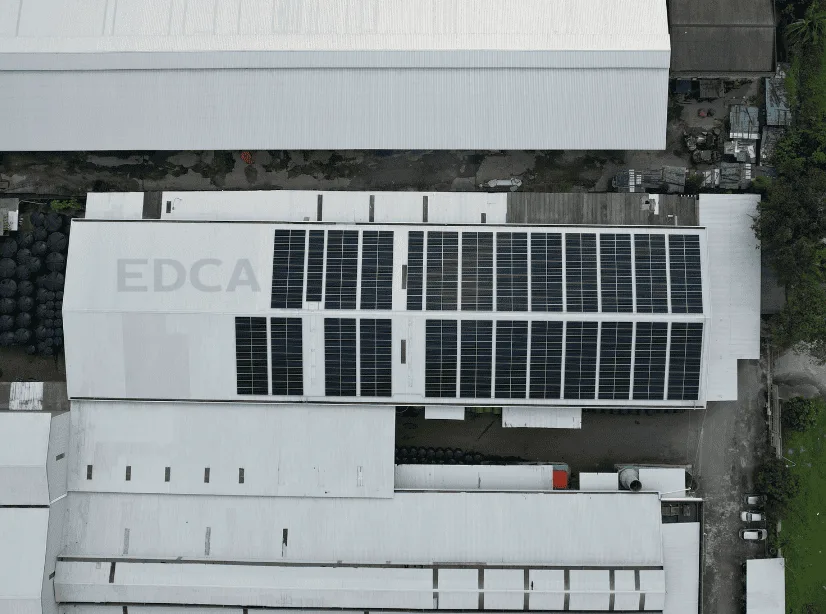
TL;DR: A solar rooftop on a factory in Malaysia mainly cuts the energy (kWh) part of the TNB bill, plus the monthly fuel adjustment that rides on it. Under the RP4 tariff those two lines are a little over half of a typical medium-voltage factory bill. In an illustrative model, a 500 kWp system saves around RM180,000 a year at today’s rates, and a 1 MWp system roughly double. Your shift pattern decides how close you get. EDCA Energy models this as part of its industrial solar installation service.
Every owner weighing a solar rooftop for a factory in Malaysia has the same first question: how much will it actually take off the bill? Most answers online give a percentage range and stop there, which is not much use when your finance team wants to see the working.
This guide does the working. It starts with how a Malaysian factory’s TNB bill is built under the RP4 tariff that took effect in July 2025, shows which lines a solar rooftop can touch, then models savings by shift pattern and system size, lists the levers that move the number, and runs the 25-year outlook. The figures are illustrative and labelled as such, but they are built on the published tariff rates.
If you want the installation process itself, our guide to factory solar installation in Malaysia covers roof sizing and the EPCC steps. This article stays on the money. First, a look at a factory rooftop system already running in Malaysia.
Watch: how a 1.47 MW factory rooftop solar system pays back
A short look at a 1.47 MW rooftop solar system on a confectionery factory and the share of its power bill it now covers.
1. How is a Malaysian factory’s TNB bill built under RP4?
Quick Answer: Since 1 July 2025, a factory’s TNB bill has five lines: an energy charge per kWh, a monthly fuel adjustment (AFA) per kWh, capacity and network charges per kW of maximum demand, and a fixed retail charge. A solar rooftop for a factory in Malaysia works on the first two directly, which is why an industrial solar system is sized to your kWh profile first.
The Energy Commission’s restructured tariff runs from 1 July 2025 to 31 December 2027 (Regulatory Period 4). It replaced the old commercial and industrial labels with voltage bands: low, medium or high. The base average tariff is 45.40 sen/kWh, as reported in The Star’s coverage of the new schedule. A medium-voltage factory bill has five lines:
- Energy charge (sen/kWh). The electricity itself, billed on every unit consumed.
- Automatic Fuel Adjustment, or AFA (sen/kWh). A monthly surcharge or rebate tracking fuel and exchange rates. It replaced the six-monthly ICPT on 1 July 2025; TNB says it returned RM3.1 billion in rebates before turning into a surcharge in 2026.
- Capacity charge (RM/kW). Billed on your highest half-hour demand in the month, for generation held ready for you.
- Network charge (RM/kW). Also billed on maximum demand, for the transmission and distribution network.
- Retail charge (RM/month). A fixed fee for metering and billing.
Two more items matter. The 1.6% KWTBB renewable-energy levy applies to the usage charges, excluding AFA and retail. And on the Time-of-Use option, TNB defines peak hours as 2pm to 10pm on weekdays, with weekends fully off-peak.
Key takeaway: Your bill has kWh lines and kW lines. Solar is a kWh machine first, so the energy charge and AFA are where most savings come from; the kW lines need a separate plan.
2. What does a medium-voltage factory bill look like, line by line?
Quick Answer: For an illustrative factory on the Medium Voltage General tariff using 180,000 kWh a month with a 500 kW maximum demand, the bill is roughly RM106,600 at the October 2026 AFA rate. About 56% of that is energy plus AFA, the part a solar rooftop for a factory in Malaysia attacks directly. Try your own numbers in the EDCA solar savings calculator.
The table applies the Medium Voltage General rates in the Energy Commission’s tariff schedule for Peninsular Malaysia: 29.83 sen/kWh energy, RM29.43/kW capacity, RM59.84/kW network and RM200 retail. AFA is the October 2026 rate of 3.61 sen/kWh published by the Single Buyer.
| Bill line | How it is billed | Monthly amount | Can solar cut it? |
|---|---|---|---|
| Energy charge | 180,000 kWh × 29.83 sen | RM53,694 | Yes |
| AFA (Oct 2026) | 180,000 kWh × 3.61 sen | RM6,498 | Yes |
| Capacity charge | 500 kW × RM29.43 | RM14,715 | Partly (daylight peaks only) |
| Network charge | 500 kW × RM59.84 | RM29,920 | Partly |
| Retail charge | Fixed | RM200 | No |
| KWTBB levy | 1.6% of usage charges | RM1,573 | Yes |
| Total | ~RM106,600 | Energy + AFA = ~56% |
Illustrative bill modelled by EDCA Energy on the Energy Commission’s RP4 rates and the October 2026 AFA; excludes ToU, power-factor surcharges and service tax. Not a quote.
The last column is the point. A solar rooftop on a factory in Malaysia removes kWh from the grid one unit at a time, so the energy, AFA and levy lines fall with it. The kW lines only fall if solar is producing at the exact half-hour your demand peaks.
Key takeaway: On a typical MV factory bill, roughly 56 sen of every ringgit is open to solar savings. The rest is capacity, network and fixed charges that need demand management, not just panels.
Want this table built from your own TNB bill? Send us three recent bills and we will map every line to what a rooftop system can and cannot save. Request a free bill analysis →
3. How much of the bill can solar offset by shift pattern?
Quick Answer: In an illustrative model, a single-shift factory with a system sized at 75% of maximum demand self-consumes about 85% of its solar and trims around a quarter of its annual bill. A 24-hour plant self-consumes almost everything but offsets a smaller share, because its night-time kWh stay on the grid. Sizing rules are in our factory solar installation guide.
Two things set the offset from a solar rooftop on a factory in Malaysia: how much solar you use on site (self-consumption) and how big the system is against your load. The grid shows both across four operating patterns and three system sizes, expressed as a share of maximum demand (MD). Each cell reads self-used share, then approximate share of annual bill offset.
| Operating pattern | System at 50% of MD | System at 75% of MD | System at 100% of MD |
|---|---|---|---|
| Single day shift (8am–5pm) | 95% · 18% | 85% · 25% | 70% · 28% |
| Two shifts (7am–11pm) | 98% · 15% | 92% · 21% | 85% · 25% |
| 24-hour continuous | 99% · 11% | 97% · 16% | 93% · 20% |
| Warehouse / low daytime load | 80% · 20% | 60% · 23% | 50% · 26% |
Illustrative modelling by EDCA Energy on typical Malaysian factory load shapes and RP4 rates; export credits excluded.
Across any row, bill offset rises with size but self-consumption falls. Down the 100% column, the 24-hour plant offsets the least even though it wastes the least. That is the trade-off every industrial solar panel company should walk you through before quoting a solar rooftop for a factory in Malaysia.
Key takeaway: A single- or two-shift factory gets the best of both: high self-consumption and a meaningful bill cut. A 24-hour plant should size for its daytime floor, not total consumption.
4. How much can a factory save by system size?
Quick Answer: At an avoided cost of about 34 sen per self-consumed kWh, an illustrative 300 kWp solar rooftop for a factory in Malaysia saves roughly RM108,000 a year, a 500 kWp system about RM180,000, and a 1 MWp system about RM339,000. Site-specific results in Johor or the Klang Valley move with roof orientation and load.
The model uses a yield of 1,250 kWh per kWp a year, in line with large Malaysian rooftops: Honda’s 5.6 MWp Melaka plant is expected to generate about 7,042 MWh a year, roughly 1,260 kWh per kWp. The 34 sen avoided cost combines the MV General energy charge, the October 2026 AFA and the KWTBB levy; export credits are left out, so the figures are conservative.
| System size | Year-1 savings | Annual output | Self-consumed |
|---|---|---|---|
| 150 kWp | ~RM57,000 | 187,500 kWh | 90% |
| 300 kWp | ~RM108,000 | 375,000 kWh | 85% |
| 500 kWp | ~RM180,000 | 625,000 kWh | 85% |
| 1,000 kWp (1 MWp) | ~RM339,000 | 1,250,000 kWh | 80% |
Illustrative model by EDCA Energy: 1,250 kWh/kWp yield, ~34 sen/kWh avoided cost, export credits and MD savings excluded. Not a quote or guaranteed return.
Two things sit outside this table. Surplus from a factory solar rooftop in Malaysia exported under SEDA’s Solar ATAP programme, which replaced NEM from 1 January 2026, is credited as an energy offset, so the unused 10–20% is not wasted. And the Green Investment Tax Allowance lets 60% of qualifying capital expenditure be set against 70% of statutory income for systems installed by 31 December 2026, shortening payback further.
Key takeaway: Savings scale almost linearly with size until self-consumption slips. Each self-consumed kWh is worth about 34 sen today, and that rises every time the AFA or base tariff goes up.
5. Does rooftop solar reduce the maximum demand charge?
Quick Answer: Sometimes, but never reliably on its own. Capacity and network charges are billed on your single highest half-hour of the month. Solar lowers that peak only if it occurs in strong sunlight, and one cloudy afternoon resets it. For a guaranteed cut in the kW lines, pair the rooftop with solar battery storage for peak shaving.
On the illustrative bill in section 2, capacity and network together cost RM89.27 per kW of maximum demand, so a 100 kW drop in the monthly peak saves close to RM8,900 that month. The honest position:
- Solar helps when peaks are midday. A plant whose compressors and chillers peak between 11am and 3pm sees its metered demand fall on most days.
- Solar does not help with evening peaks. On the ToU tariff the peak window runs 2pm to 10pm; panels cover its first few hours and nothing after dusk.
- One cloudy half-hour sets the month. The charge uses the highest reading, so one overcast start-up can wipe out the reduction.
- Batteries make it dependable. A battery discharges on demand, whatever the weather, so it holds the peak down on purpose rather than by chance.
For most plants we model kW savings separately and treat them as upside, not part of the headline figure for a factory solar rooftop in Malaysia.
Key takeaway: Count maximum-demand savings as a bonus from solar alone. If the kW lines are a big share of your bill, ask for a solar-plus-storage model rather than a bigger array.
Are capacity and network charges eating your bill? We model solar alone against solar plus storage so you see the kW savings side by side. Ask for a peak-demand review →
6. Which levers move factory solar savings the most?
Quick Answer: Four levers decide whether a solar rooftop on a Malaysian factory hits its modelled savings: self-consumption, panel degradation, soiling and cleaning, and monitoring. Self-consumption is the biggest by far; the other three are small each year but compound over 25. A planned solar panel maintenance schedule keeps them in check.
- Self-consumption. Every kWh used on site is worth the full avoided cost; every exported kWh is worth a scheme credit. Moving a compressor run or chiller set-point into daylight hours lifts self-consumption at no capital cost.
- Degradation. Major manufacturers warrant their panels at around 0.5% output loss a year, and some premium modules track closer to 0.2%. Over 25 years that is roughly 11% less output.
- Soiling and cleaning. Dust and haze sit on the glass. A US study measured output down by as much as 15% in heavy pollen season, with 5–11% recovered after wet-brush cleaning. Industrial estates are dusty, so a cleaning plan pays for itself; costs are in our guide to solar panel maintenance cost in Malaysia.
- Monitoring. A tripped string or faulty inverter can quietly cut output for weeks. Portal alerts turn a month of lost generation into a day.
Tariff movement is the lever you do not control, and it works in your favour: each AFA surcharge, such as the +3.67 sen/kWh set for September 2026, raises the value of every kWh a factory solar rooftop in Malaysia supplies.
Key takeaway: Fix self-consumption at design time, then protect it with cleaning and monitoring. How a solar rooftop on a Malaysian factory is run matters more than the panel brand.
7. What do factory solar savings look like over 25 years?
Quick Answer: In an illustrative 25-year model, a 500 kWp solar rooftop for a factory in Malaysia saves about RM4.2 million at today’s rates, or around RM5.4 million if tariffs rise 2% a year, after 0.5% annual degradation. It pays for itself well inside that period, which is why we treat it as a plant asset, as our guide to solar for business in Malaysia explains.
The table tracks the 500 kWp scenario from section 4 on two tariff paths: flat at today’s rates, and rising 2% a year. Output falls 0.5% a year. Both paths exclude export credits, maintenance and tax allowances.
| Year | Output vs year 1 | Annual saving (flat tariff) | Annual saving (+2%/yr tariff)* | Cumulative (flat / rising) |
|---|---|---|---|---|
| 1 | 100% | RM180,000 | RM180,000 | RM0.18m / RM0.18m |
| 5 | 98.0% | RM177,000 | RM191,000 | RM0.89m / RM0.93m |
| 10 | 95.6% | RM172,000 | RM206,000 | RM1.76m / RM1.93m |
| 15 | 93.2% | RM168,000 | RM222,000 | RM2.61m / RM3.00m |
| 20 | 90.9% | RM164,000 | RM239,000 | RM3.44m / RM4.16m |
| 25 | 88.7% | RM160,000 | RM257,000 | RM4.24m / RM5.41m |
* Projection assuming a 2% annual rise in the combined energy and AFA rate. Illustrative model by EDCA Energy on RP4 rates, 0.5%/yr degradation, 85% self-consumption; not a quote.
The gap between the two cumulative figures is the tariff risk you are hedging. Since the 2025 restructuring, fuel-price swings reach the bill within a month, so a factory with its own generation is less exposed. Many manufacturers also add a renewable energy certificate to evidence green supply to customers.
Key takeaway: Degradation takes about 11% off output by year 25, but even modest tariff growth more than makes up for it. Judge the system on its full life, not its first bill.
8. Conclusion
How much a solar rooftop saves a factory in Malaysia is arithmetic you can check. Roughly 56% of a medium-voltage bill is energy and AFA, and those lines fall with every self-consumed kWh. A single- or two-shift plant keeps 85–95% of its solar on site, so an illustrative 500 kWp system saves around RM180,000 in year one and RM4–5 million over 25 years. The kW lines need storage or demand management to move.
Those numbers are protected by decisions made before installation: size to the daytime load, confirm the tariff category, and plan cleaning and monitoring from day one. EDCA Energy runs that modelling as the first step of every industrial solar installation; see completed factory projects in our portfolio.
Ready to see your factory’s real savings number?
Send EDCA Energy your recent TNB bills and roof details. We will model your shift pattern, tariff and roof and give you a savings estimate you can take to your finance team, with no obligation.
9. Frequently asked questions
What percentage of a factory’s electricity bill can solar save in Malaysia?
For most single- or two-shift plants, a well-sized solar rooftop for a factory in Malaysia offsets roughly 20–30% of the annual bill, because it cuts the energy and AFA lines but leaves most of the capacity, network and retail charges. A 24-hour plant usually lands lower. The share depends on tariff, shift pattern and system size.
Does solar reduce the AFA charge on a TNB bill?
Yes. The Automatic Fuel Adjustment is billed per kWh drawn from the grid, so every kWh your rooftop supplies on site avoids both the energy charge and that month’s AFA. When the AFA is a surcharge, as it has been through much of 2026, solar savings rise with it.
Which TNB tariff is a factory on after July 2025?
Most factories supplied at 11 kV or 33 kV are on the Non-Domestic Medium Voltage General tariff, or the Medium Voltage Time-of-Use tariff if they opted in. Smaller workshops on 415 V are on Low Voltage General. The old E1, E2 and C1 labels were retired under RP4.
Is it still worth exporting surplus solar from a factory?
Self-consumption is always worth more, because exported energy is credited under Solar ATAP as an energy offset rather than at your full tariff. A system sized to your daytime load keeps export small, so the credit is a bonus rather than the basis of the business case.
How long does a solar rooftop for a factory in Malaysia take to pay back?
Payback is quote-specific, but factories with high daytime load typically recover the investment well inside the first half of the system’s 25-year life, faster again with the Green Investment Tax Allowance claimed before the end of 2026. After payback, the remaining years are close to pure saving apart from light maintenance.
See your solar savings in under a minute
Estimate your ideal system size, payback period and monthly bill offset with the EDCA calculator.